
Enter cubic meters to find the matching volume in liters, including whole numbers or decimals.
Advanced options
Table of contents
How to use our Cubic Meters to Liters Converter
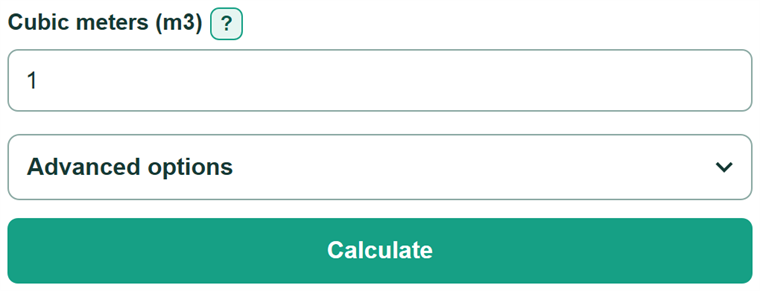
- Copy the volume into the Cubic meters (m3) field. You can enter a number alone or add the m3 or m^3 suffix.
- Open Advanced options if you need more or fewer digits after the decimal point in the liters result.
- Click Calculate to see the volume in liters.
- Check the answer by multiplying the cubic-meter value by 1,000. For example, 2.5 m3 should equal 2,500 L.
Definitions
Cubic meter (m3 or m^3): A metric unit of volume equal to the space in a cube 1 meter long, 1 meter wide, and 1 meter high.
Liter (L): A metric unit of volume. One liter is one cubic decimeter, so one cubic meter equals 1,000 liters.
Decimal places: The number of digits shown after the decimal point. This setting changes display rounding only.
Signed volume: A value with a plus or minus sign. A negative value can record a decrease in volume.
Common mistakes and quick fixes
Mistake: Entering meters (m) instead of cubic meters (m3).
Fix: Enter a volume in m3. Meters measure length, so they cannot convert directly to liters.
Mistake: Entering square meters (m2).
Fix: Use a cubic-meter value. Square meters measure area, not volume.
Mistake: Typing a decimal comma, such as 1,25.
Fix: Use a decimal point, such as 1.25.
Mistake: Reading the result as US gallons.
Fix: The answer is in liters (L). Convert liters to gallons separately if gallons are needed.
Mistake: Assuming a displayed 0 means the exact converted value is zero.
Fix: Increase Result decimal places when converting a very small nonzero volume.
Limitations & Key Assumptions / Boundary Conditions
- This converter works only for volume. A length in meters or an area in square meters needs additional measurements before it can be expressed in liters.
- The conversion of 1 m3 to 1,000 L is exact, but the selected decimal-place setting can round the displayed answer.
- A negative result can describe a recorded decrease in volume. It does not mean a container physically holds a negative amount.
- The answer is in liters, not US gallons, imperial gallons, or cubic feet.
Methodology
Conversion rule
One cubic meter equals 1,000 liters. A liter is one cubic decimeter, so this metric conversion is exact.
liters = cubic meters x 1,000
Worked example
For 1.2345 m3, multiply 1.2345 by 1,000 to get 1,234.5 L. With the display set to one decimal place, the result stays 1,234.5 L. For 0.001 m3, the result is exactly 1 L.
Calculation details
The calculator accepts one decimal number with an optional m3 or m^3 suffix. Zero is valid. A negative sign is preserved for a signed volume change. Result decimal places changes only the displayed rounding; it does not change the conversion. Inputs in meters or square meters are rejected because they are not volume units.