
Enter a volume in liters to find the same volume in cubic meters and check that the decimal moves three places left.
Advanced options
Table of contents
How to use our Liters to Cubic Meters Converter
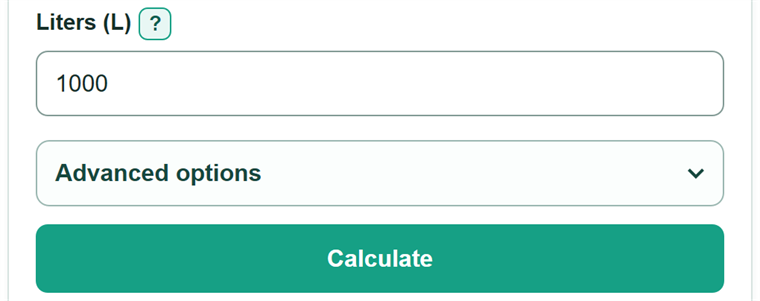
- Enter one nonnegative volume in the Liters (L) field, such as 250, 250 L, or 1,000.
- Click Calculate to see the equivalent volume in cubic meters (m3).
- Open Advanced options if a worksheet, report, or form requires a fixed number of decimal places.
- Sanity-check the answer: for a positive input, the m3 number should be 1,000 times smaller than the liters number. For example, 250 L should become 0.25 m3.
Definitions
Liter (L): A metric unit of volume. One liter equals exactly 0.001 m3. [1]
Cubic meter (m3): A metric unit of volume equal to 1,000 liters. [1]
Volume: The amount of three-dimensional space an object or substance takes up. Volume is different from mass.
Decimal places: Digits shown to the right of the decimal point. This setting changes only the displayed result.
Common mistakes and quick fixes
Mistake: Multiplying liters by 1,000 instead of dividing.
Fix: For liters to cubic meters, divide by 1,000. For example, 500 L is 0.5 m3.
Mistake: Moving the decimal one or two places instead of three.
Fix: Move the decimal three places left. For example, 2.5 L becomes 0.0025 m3.
Mistake: Entering gallons, milliliters, or another unit.
Fix: Convert the amount to liters first, then enter the liters value. This converter accepts liters only.
Mistake: Typing a range or calculation, such as 1 to 2 or 2+3.
Fix: Enter one finished volume value only.
Mistake: Using a comma incorrectly, such as 1,00.
Fix: Use commas only for thousands, such as 1,000. Use a decimal point for decimals, such as 1.5.
Mistake: Treating cubic meters as mass or length.
Fix: Liters and cubic meters both measure volume. Converting to a mass such as kilograms needs density.
Limitations & Key Assumptions / Boundary Conditions
- This is a volume-to-volume conversion only. It cannot convert liters to kilograms, pounds, or metric tons because those calculations need density.
- The conversion factor is exact, but the reported value cannot be more accurate than the original liters measurement.
- Enter one finite value that is 0 or greater. Negative values, ranges, formulas, malformed commas, and unsupported units are not accepted.
- A fixed decimal setting can round a very small nonzero value to 0. The calculator shows a higher-precision value beside that display when needed.
Methodology
Conversion method
One cubic meter contains exactly 1,000 liters. [1] Divide the entered liters by 1,000 to convert the volume to m3.
cubic meters (m3) = liters (L) / 1,000
Worked example
For 2.5 L, divide 2.5 by 1,000. The converted volume is 0.0025 m3.
2.5 / 1,000 = 0.0025 m3
Zero is a valid input and converts to exactly 0 m3. Automatic formatting keeps useful digits for small nonzero values, while a fixed decimal setting rounds only what is shown.