
Convert cubic yards to liters or liters to cubic yards, then use optional check units to catch common volume mistakes.
Table of contents
How to use our Cubic Yards to Liters Converter
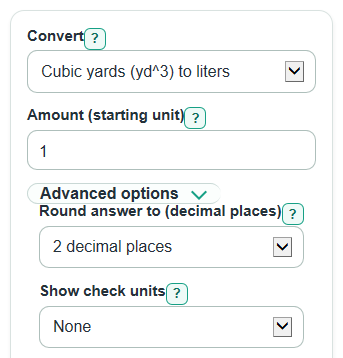
- Choose the starting direction in Convert: cubic yards to liters, or liters to cubic yards.
- Type the volume in Amount. Commas and spaces are okay, so 1,250 works the same as 1250.
- Open Advanced options if you want to change Round answer to or turn on Show check units.
- Select Calculate, then read Converted volume first. Use Math used if you need to show your work.
- Sanity-check the answer: 1 yd^3 is about 765 L, so a few cubic yards should be thousands of liters, not just a few liters.
Definitions
Cubic yard (yd^3): A unit for volume. It is the space inside a cube that is 1 yard long, 1 yard wide, and 1 yard high.
Liter (L): A metric unit for volume. It is often used for liquids, but it can describe any space or capacity.
Cubic meter (m^3): A metric volume unit equal to 1,000 liters.
US gallon (gal): A US liquid-volume unit. This converter uses US gallons, not imperial gallons.
Round answer to: The number of digits shown after the decimal point. Rounding changes the display, not the internal conversion math.
Check units: Extra equivalent volumes shown only to help you spot unit mistakes.
Common mistakes and quick fixes
Mistake: Leaving Amount blank.
Fix: Enter a number, such as 1, 2.5, or 1,250.
Mistake: Choosing the wrong Convert direction.
Fix: Pick Cubic yards to liters when your starting number is in yd^3, and Liters to cubic yards when your starting number is in L.
Mistake: Reading Converted volume without checking its unit.
Fix: If Convert is cubic yards to liters, the answer is in L; if it is liters to cubic yards, the answer is in yd^3.
Mistake: Using a negative Amount for a pile, tank, or container volume.
Fix: Enter 0 or a positive number because ordinary volume cannot be negative.
Mistake: Setting Round answer to too low for homework or records.
Fix: Use more decimal places or Show full useful answer when small differences matter.
Mistake: Turning off Show check units when the result seems surprising.
Fix: Show Same volume in cubic meters or Same volume in US gallons to compare the answer with a unit you recognize.
Limitations & Key Assumptions / Boundary Conditions
- The converter treats volumes as exact unit conversions. It does not estimate how much soil, concrete, gravel, or liquid you need for a project.
- The factor used is 1 yd^3 = 764.554857984 L. Real package labels may round this number, so their printed values can differ slightly.
- Same volume in US gallons uses US liquid gallons only. It is not the same as an imperial gallon.
- Round answer to affects the displayed answer. Calculations for check units are based on the unrounded internal liter value.
- Very large numbers are formatted for reading, but extremely large inputs may be limited by normal browser number precision.
- Negative volumes are blocked because this converter is meant for ordinary physical volumes.
Methodology
How the conversion is calculated
The converter first removes commas and spaces from Amount, then reads it as the starting unit chosen in Convert. It keeps the internal math unrounded until the final display step.
liters = cubic_yards * 764.554857984
cubic_yards = liters / 764.554857984
If Show check units is turned on, the converter uses the liter value as the common middle step.
cubic_meters = liters / 1000
us_gallons = liters / 3.785411784
Worked example
For 2.5 cubic yards, the main conversion is:
liters = 2.5 * 764.554857984 = 1911.38714496 L
With Round answer to set to 2 decimal places, Converted volume displays 1,911.39 L. If cubic meters are shown, the check value is 1.91138714496 m^3, which displays as 1.91 m^3 with the same 2-decimal setting.
Rounding method
When a fixed decimal setting is selected, the visible answer is rounded to that many digits after the decimal point. When Show full useful answer is selected, the converter shows a practical long decimal without scientific notation when possible.