
Convert fluid ounces to cubic feet, or back the other way, using US or Imperial fluid ounce sizes.
Advanced options
Table of contents
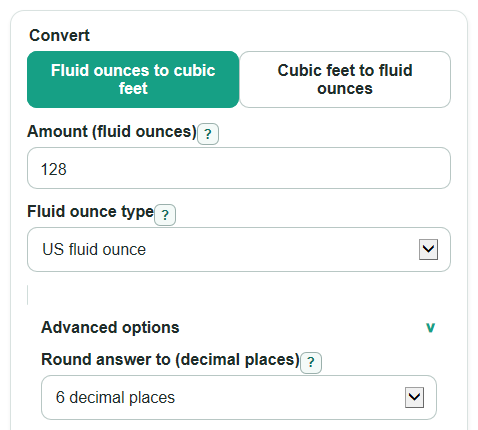
How to use our Fluid Ounces to Cubic Feet Converter
- Choose Convert to set the direction: Fluid ounces to cubic feet or Cubic feet to fluid ounces.
- Enter the Amount in the starting unit named by your Convert choice, using a number like 128 or 0.75.
- Choose Fluid ounce type: US fluid ounce for most US labels and recipes, or Imperial fluid ounce for UK-style volume.
- Use Round answer to only to change the displayed number of decimals; the calculation still uses the full factor.
- Read Converted volume first, then use Quick check, Factor used, and Same volume in cubic inches to catch unit mix-ups.
Definitions
Fluid ounce: A unit of liquid volume, not a unit of weight. A fluid ounce tells how much space a liquid takes up.
US fluid ounce: The fluid ounce used on most US bottles, food labels, and recipes. This is the default choice.
Imperial fluid ounce: A different fluid ounce size used in the Imperial system. It is not the same as a US fluid ounce.
Cubic foot (ft^3): A volume equal to a cube that is 1 foot long, 1 foot wide, and 1 foot tall.
Cubic inch (in^3): A smaller volume equal to a cube that is 1 inch on each side. There are 1,728 cubic inches in 1 cubic foot.
Factor used: The exact multiplier used for the selected direction and fluid ounce type before the displayed answer is rounded.
Common mistakes and quick fixes
Mistake: Entering weight ounces in Amount and expecting a volume answer.
Fix: Use Amount only for fluid ounces or cubic feet; weight ounces need the liquid density before this converter can help.
Mistake: Leaving Fluid ounce type on US fluid ounce when your source uses Imperial fluid ounces.
Fix: Change Fluid ounce type to Imperial fluid ounce before reading Converted volume or Factor used.
Mistake: Choosing the wrong Convert direction and putting cubic feet where fluid ounces are expected.
Fix: Set Convert first, then enter Amount in the starting unit shown by that direction.
Mistake: Treating Round answer to as a change in accuracy or unit size.
Fix: Use Round answer to only for display; check Rounding note if a small difference matters.
Mistake: Comparing Same volume in cubic inches to Converted volume as if they use the same unit.
Fix: Use Same volume in cubic inches only as a support value for container or box math.
Limitations & Key Assumptions / Boundary Conditions
- This converter handles volume only. It does not convert weight ounces to cubic feet because that needs the material's density.
- US and Imperial fluid ounces are different. Picking the wrong Fluid ounce type changes the answer by about 4 percent.
- The Amount must be a finite number and cannot be negative. Zero is allowed and returns zero for the volume results.
- Round answer to changes only the displayed decimals. The internal calculation uses the full conversion factor.
- Very large values are formatted for reading, but the browser still has normal floating-point limits for extreme numbers.
- The cubic-inch support value is based on 1 cubic foot = 1,728 cubic inches.
Methodology
How the conversion is done
The calculator first reads Convert to decide the direction. It then chooses the US or Imperial factor from Fluid ounce type and multiplies the Amount by that factor.
US: cubic_feet = fluid_ounces * 231 / (128 * 1728)
US: fluid_ounces = cubic_feet * (128 * 1728) / 231
Imperial: cubic_feet = fluid_ounces * 0.0284130625 / 28.316846592
Imperial: fluid_ounces = cubic_feet * 28.316846592 / 0.0284130625
The US formula uses 231 cubic inches per US gallon, 128 US fluid ounces per US gallon, and 1,728 cubic inches per cubic foot. The Imperial formula uses 4.54609 liters per Imperial gallon and 160 Imperial fluid ounces per Imperial gallon, so 1 Imperial fluid ounce is 0.0284130625 liters [1].
Support value
Same volume in cubic inches is found after the cubic-foot volume is known.
cubic_inches = cubic_feet * 1728
Worked example
For 500 US fluid ounces to cubic feet, the calculator uses 500 * 231 / (128 * 1728). The unrounded result is 0.5221896701388888 ft^3, and the same volume is 0.5221896701388888 * 1728 = 902.34375 in^3.
Rounding
Round answer to controls only the visible decimals. For example, rounding 0.5221896701388888 to 6 decimal places shows 0.522190, but the Factor used and support calculation are based on the full value before display rounding.