
Convert cups and cubic feet using the cup standard that matches your recipe, label, or worksheet.
Advanced options
Table of contents
How to use our Cups to Cubic Feet Converter
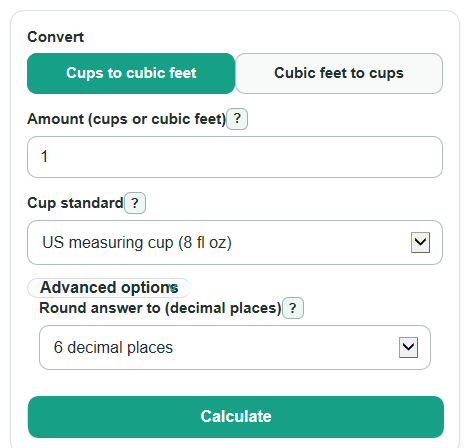
- Choose Convert: Cups to cubic feet or Cubic feet to cups.
- Enter Amount (cups or cubic feet) as a number, such as 1, 1.5, or 12.
- Pick Cup standard: US measuring cup, US nutrition label cup, or Metric cup.
- Open Advanced options only if you want to change Round answer to from the default 6 decimal places.
- Sanity-check Same volume in liters and Conversion factor used. If the answer seems too large or too small, recheck Convert and Cup standard.
Definitions
Cup: A volume amount. In this converter, a cup can mean a US measuring cup, a US nutrition label cup, or a metric cup.
Cubic foot: A cube-shaped volume that is 1 foot long, 1 foot wide, and 1 foot tall. One cubic foot is 28.316846592 liters.
Cup standard: The exact cup size used in the math. Changing it changes the answer.
US measuring cup: The common US kitchen cup, equal to 8 US fluid ounces, or about 0.2365882365 liters.
US nutrition label cup: A 240 mL cup used for some US food label serving sizes [3].
Metric cup: A 250 mL cup used in some metric recipes and measuring tools.
Conversion factor used: The number multiplied by the entered amount to get the converted result.
Common mistakes and quick fixes
Mistake: Using Amount (cups or cubic feet) as cups while Convert is set to Cubic feet to cups.
Fix: Set Convert to Cups to cubic feet when the Amount (cups or cubic feet) is a cup count.
Mistake: Leaving Cup standard on US measuring cup when the problem says 240 mL cups or a nutrition label serving.
Fix: Change Cup standard to US nutrition label cup before reading Converted volume.
Mistake: Choosing Metric cup for an ordinary US recipe that only says cups.
Fix: Use Cup standard: US measuring cup unless the recipe says metric cup or 250 mL cup.
Mistake: Reading Same volume in liters as the main answer.
Fix: Use Converted volume as the main result, and use Same volume in liters only as a size check.
Mistake: Setting Round answer to 0 decimal places for a small cup-to-cubic-foot amount and seeing 0.
Fix: Increase Round answer to 6 or 8 decimal places, then compare Conversion factor used.
Limitations & Key Assumptions / Boundary Conditions
- The calculator treats volume as exact math. It does not adjust for packing, settling, foam, temperature, or how a dry ingredient is scooped.
- Recipes, labels, and school problems may mean different cup standards. The Cup standard choice must match the source you are using.
- Rounding changes only the displayed answer. The internal calculation uses the full cup standard and cubic-foot conversion values.
- Very tiny positive volumes can round to 0 if Round answer to is set too low. Use more decimal places to see small cubic-foot results.
- The converter handles volume only. It does not convert cups of an ingredient into weight such as ounces, pounds, or grams.
Methodology
How the conversion is done
The converter first chooses the liters per cup from Cup standard. It uses 0.2365882365 L for a US measuring cup, 0.24 L for a US nutrition label cup, and 0.25 L for a metric cup. It uses 28.316846592 L for 1 cubic foot, a standard volume conversion factor [1].
cubic feet = cups * cup_liters / 28.316846592
cups = cubic_feet * 28.316846592 / cup_liters
liters = cups * cup_liters
liters = cubic_feet * 28.316846592
US measuring cup cross-check
For the US measuring cup, the exact cubic-foot factor can also be found from US liquid measure and cubic inch relationships.
US cup in ft^3 = (231 / 16) / 1728 = 0.008355034722222222
That means 1 US measuring cup is about 0.008355 ft^3, and 1 ft^3 is about 119.688312 US measuring cups.
Mini example
If Convert is Cups to cubic feet, Amount (cups or cubic feet) is 16, and Cup standard is US measuring cup, the calculator uses 16 * 0.2365882365 / 28.316846592. The result is 0.13368055555555555 ft^3, shown as 0.133681 ft^3 when Round answer to is 6 decimal places. The Same volume in liters is 3.785411784 L.
Validation and rounding
Commas and spaces are removed before parsing the amount, so 1,000 is read as 1000. Blank text, words, negative volumes, unsupported cup standards, and non-finite numbers are blocked with an error. The selected Round answer to value changes only the displayed digits, not the conversion factor or the hidden full-precision math.
Sources
- NIST Guide to the SI, Appendix B.9: Factors for units listed by kind of quantity or field of science - NIST
- USBR (U.S. Bureau of Reclamation) - Conversions (volume incl. cubic feet) PDF - USBR
- CFR (9 CFR 381.409): for nutrition labeling purposes, "a cup means 240 mL" (US nutrition label cup) - Cornell