
Convert cubic feet to cups or cups to cubic feet while choosing the exact cup size used for the math.
Table of contents
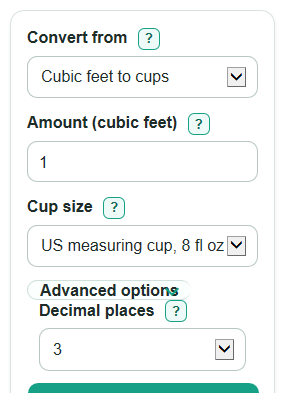
How to use our Cubic Feet to Cups Converter
- Choose Convert from to set the direction: cubic feet to cups or cups to cubic feet.
- Enter Amount in the starting unit. Commas and decimals are fine.
- Pick Cup size to match your recipe, food label, or school problem.
- Choose Decimal places based on how rounded you want the answer to look.
- Press Calculate, then sanity-check Converted amount by comparing Cup size used and Same volume in US liquid gallons with what you expected.
Definitions
Cubic foot: A volume equal to a box 1 foot long, 1 foot wide, and 1 foot tall.
Cup size: The measured volume of one cup. This converter uses 236.5882365 mL for a US measuring cup, 240 mL for an FDA label cup, or 250 mL for a metric recipe cup.
Converted amount: The main answer after changing the starting volume into the result unit.
Cup size used: The exact mL per cup value used in the calculation.
Same volume in US liquid gallons: The same cubic-foot volume shown in US liquid gallons, not dry gallons or imperial gallons.
Rate used: The multiply rate for the selected direction, such as cups per ft^3 or ft^3 per cup.
Common mistakes and quick fixes
Mistake: Leaving Cup size on US measuring cup when the recipe says metric cup.
Fix: Set Cup size to Metric recipe cup, 250 mL before using Converted amount.
Mistake: Choosing Cups to cubic feet in Convert from, then typing a cubic-foot value in Amount.
Fix: Set Convert from to Cubic feet to cups when Amount is in cubic feet.
Mistake: Treating Cup size used as a note that does not affect the answer.
Fix: Check Cup size used because changing it changes Converted amount.
Mistake: Using 0 Decimal places for homework or technical work.
Fix: Change Decimal places to 3 or 6 so Rate used and Converted amount keep enough detail.
Mistake: Comparing Same volume in US liquid gallons with imperial gallons or dry gallons.
Fix: Use Same volume in US liquid gallons only as a US liquid gallon check.
Limitations & Key Assumptions / Boundary Conditions
- The selected Cup size controls every cup conversion. The calculator does not guess cup type from the recipe or the Amount.
- Same volume in US liquid gallons uses US liquid gallons only. It does not use dry gallons or imperial gallons.
- A negative Amount is allowed for a change in volume, such as a decrease. It does not describe the size of a real container.
- Decimal places only round what you see. The internal calculation uses the full constants listed in the methodology.
- This is a volume converter, not a weight converter. Flour, sugar, water, and packed ingredients can have very different weights per cup.
- Physical measuring cups, scoops, and containers can be marked or filled unevenly, so real kitchen measurements may not match the math exactly.
Methodology
Unit path
The converter uses milliliters as the bridge between cubic feet and cups. One cubic foot equals 28316.846592 mL, based on the exact international foot of 0.3048 m and cubing the length conversion. Standard US liquid volume relationships are used for the gallon check [1]. The FDA label cup option follows FDA serving-size labeling practice [2].
milliliters = cubic_feet * 28316.846592
cups = cubic_feet * 28316.846592 / cup_mL
cubic_feet = cups * cup_mL / 28316.846592
us_liquid_gallons = cubic_feet * 1728 / 231
Cup choices
The Cup size menu sets cup_mL. The US measuring cup uses 236.5882365 mL, the FDA label cup uses 240 mL, and the metric recipe cup uses 250 mL. This matters because 1 ft^3 is 119.6883116883 US measuring cups, but only 113.267386368 metric recipe cups.
Worked example
For Amount = 1, Convert from = Cubic feet to cups, and Cup size = US measuring cup, 8 fl oz, the calculation is 28316.846592 / 236.5882365 = 119.6883116883 cups. The gallon check is 1 * 1728 / 231 = 7.480519 US liquid gallons.
Rounding and display
Decimal places controls the displayed rounding for Converted amount, Same volume in US liquid gallons, and Rate used. The Math used line shows the entered amount, the selected cup size, and the main operation so students can check the direction of the conversion.