
Convert a fraction or mixed number to a percent fast, and see the decimal form, simplified fraction, and clear worked steps.
How to use our Fraction to Percent Calculator
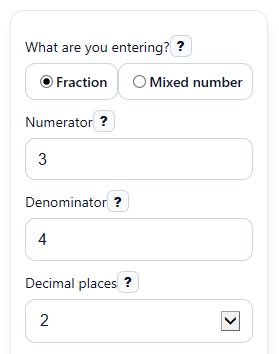
- Choose "Fraction" for a basic fraction or "Mixed number" if you have a whole number plus a fraction.
- Enter the values in "Whole number," "Numerator," and "Denominator," then pick "Decimal places" for how much rounding you want to see.
- Click "Calculate" to see the "Percent" first, then check "Decimal form" and "Simplified fraction" to make sure the answer matches what you expected.
- Use "How it was worked out" to follow the steps from fraction to decimal to percent, especially if you want to check homework or learn the method.
Definitions
Numerator: The top number in a fraction.
Denominator: The bottom number in a fraction. It cannot be 0.
Mixed number: A whole number and a fraction together, such as 1 3/4.
Improper fraction: A fraction with a numerator greater than or equal to the denominator, such as 7/4.
Simplified fraction: The fraction reduced to lowest terms, like 6/8 becoming 3/4.
Decimal form: The same value written as a decimal, like 3/4 = 0.75.
Percent: A value out of 100. For example, 75% means 75 out of 100 [1].
Common mistakes and quick fixes
Mistake: Entering 0 in "Denominator."
Fix: Change "Denominator" to any nonzero integer before you click Calculate.
Mistake: Using "Mixed number" but leaving "Whole number" blank when your value is something like 1 3/4.
Fix: Enter the whole part in "Whole number," then put the fraction part in "Numerator" and "Denominator."
Mistake: Typing a minus sign in both "Whole number" and "Numerator" for a negative mixed number.
Fix: Put the minus sign on "Whole number" only, such as -1 with 3 over 4.
Mistake: Thinking "Decimal form" and "Percent" should look the same.
Fix: Remember that "Percent" is the decimal value multiplied by 100, so 0.75 becomes 75%.
Mistake: Forgetting that "Decimal places" changes only how the result is shown.
Fix: If "Percent" looks rounded, try a larger "Decimal places" setting to see more digits.
Mistake: Being confused when "Improper fraction" appears for a mixed number or for a fraction like 7/4.
Fix: Read "Improper fraction" as the single fraction version of the value before it is turned into "Decimal form" and "Percent."
Limitations & Key Assumptions / Boundary Conditions
- This calculator expects whole-number entries for "Whole number," "Numerator," and "Denominator." It is not designed for decimal fractions typed into those boxes.
- "Denominator" cannot be 0. If it is 0, the calculator shows an error instead of a result.
- For negative mixed numbers, the sign rule is kept consistent by placing the minus sign on "Whole number" only. Entering extra negative signs in the fractional part can change the meaning.
- "Decimal form" and "Percent" may be rounded based on "Decimal places," so repeating decimals are shown approximately even though internal math should use the full value.
- If you enter a mixed number with a fractional part greater than or equal to 1, such as 1 5/4, the calculator still works, but the value is better understood by checking the "Improper fraction" result.
- A negative "Denominator" is normalized in the displayed outputs so the denominator is shown as positive and the sign is carried by the numerator or overall value.
Methodology
How the calculator converts a fraction to a percent
It first turns the entry into one fraction value. For a basic fraction, it uses the numerator and denominator as entered. For a mixed number, it changes the mixed number into an improper fraction first [1].
percent = (numerator / denominator) * 100
improper_numerator = sign(whole number) * (abs(whole number) * denominator + numerator)
simplified_numerator = numerator / gcd(numerator, denominator)
simplified_denominator = denominator / gcd(numerator, denominator)
What each step means
First, divide the numerator by the denominator to get the decimal form. Then multiply that decimal by 100 because percent means "per hundred" [1]. The simplified fraction is found separately by dividing both parts of the fraction by their greatest common divisor.
Mini example
Example: convert 1 3/4 to a percent.
improper fraction = (1 * 4 + 3) / 4 = 7/4
decimal form = 7 / 4 = 1.75
percent = 1.75 * 100 = 175%
So the main answer is 175%, and the same value in decimal form is 1.75.
Sign handling and simplification
If the fraction is negative, the result stays negative. The calculator also normalizes a negative denominator so the denominator shown in outputs is positive. For mixed numbers, the sign is applied to the whole mixed number, such as -1 3/4 becoming -7/4.
Assumptions used
The calculator assumes integer inputs, a nonzero denominator, and standard fraction-to-percent conversion. Displayed decimals and percents may be rounded to the selected number of decimal places, so long repeating decimals can look shortened even though the exact fraction has not changed.