
Convert conductivity, TDS, ppm, and mg/L fast, then see how your chosen meter factor changes the estimated TDS result.
How to use our TDS Calculator
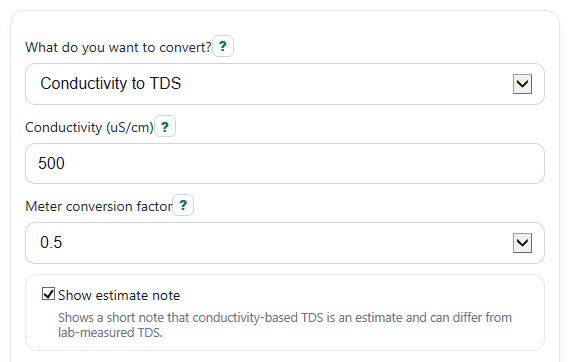
- Choose What do you want to convert? based on the reading you already have.
- Enter either Conductivity (uS/cm) or TDS (ppm or mg/L), and if you are using a conductivity-based estimate, pick the Meter conversion factor your meter uses.
- Leave Show estimate note checked if you want a quick reminder that conductivity-based TDS is only an estimate.
- Click Calculate, then read Converted value first and use Matching equivalent and Drinking-water context to interpret it.
- Sanity-check the answer by trying another Meter conversion factor if your meter manual is unclear, because a different factor can noticeably change estimated TDS.
Definitions
TDS: Total dissolved solids. This means the dissolved material in water, usually shown as mg/L or ppm.
Conductivity (uS/cm): A measure of how well water carries electricity. More dissolved ions usually means higher conductivity.
Meter conversion factor: The number used to estimate TDS from conductivity. Common handheld meters may use values such as 0.5, 0.55, 0.64, 0.65, or 0.7.
ppm: Parts per million. For dilute water, it is commonly treated as about the same numeric value as mg/L.
mg/L: Milligrams per liter. This is a concentration unit often used for water testing.
Drinking-water context: A plain-language comparison of the TDS result with the EPA secondary guidance level of 500 mg/L for drinking water aesthetics [2].
Common mistakes and quick fixes
Mistake: Entering a TDS number while What do you want to convert? is set to Conductivity to TDS.
Fix: In Conductivity to TDS mode, fill in Conductivity (uS/cm) and leave TDS (ppm or mg/L) for the modes that start with a TDS reading.
Mistake: Using the wrong Meter conversion factor because the meter's default was assumed.
Fix: Check your meter manual and match the Meter conversion factor before trusting Converted value.
Mistake: Treating ppm and mg/L as exactly identical in every liquid.
Fix: Use ppm and mg/L as a practical match here only for dilute water, and read Matching equivalent as an approximate equivalent when the result is TDS.
Mistake: Reading Drinking-water context as a universal safe-or-unsafe decision.
Fix: Use Drinking-water context as a simple comparison to 500 mg/L for taste and scaling context, not as a one-rule answer for every use.
Mistake: Entering a negative value in Conductivity (uS/cm) or TDS (ppm or mg/L).
Fix: Enter a non-negative number only, because Converted value cannot be calculated from a negative conductivity or TDS reading.
Mistake: Assuming lab TDS and meter-estimated TDS must match exactly.
Fix: If Important note appears, use it as a reminder that conductivity-based TDS is an estimate and can differ from a lab-style TDS measurement.
Limitations & Key Assumptions / Boundary Conditions
- Conductivity to TDS and TDS to conductivity are estimates because the result depends on the chosen Meter conversion factor and the water's chemistry.
- The ppm and mg/L conversion here assumes dilute water, so the same numeric value is used as a practical approximation.
- Drinking-water context compares TDS with 500 mg/L for EPA secondary guidance, which is mainly about taste, scaling, and other aesthetic concerns rather than a universal health cutoff for every situation [2].
- This calculator does not adjust for temperature, pressure, or detailed ion makeup, even though those can affect conductivity readings and estimated TDS.
- Results are neutral for non-drinking uses because acceptable TDS can differ for aquariums, irrigation, industrial systems, and other applications.
- Hidden inputs are ignored in each mode, so only the visible reading and any needed factor affect the calculation.
Methodology
How the calculator works
The calculator uses one of four simple conversions based on the mode you choose. When you start from conductivity, it estimates TDS by multiplying conductivity by the selected meter factor. When you start from TDS, it estimates conductivity by dividing by that same factor. For dilute water, ppm and mg/L are treated as approximately the same numeric value.
TDS_est_mgL = EC_uScm x k
EC_uScm = TDS_est_mgL / k
mg/L ~= ppm
ppm ~= mg/L
What the factor means
The meter conversion factor, shown here as k, is the setting many handheld meters use to turn conductivity into an estimated TDS number. A higher factor gives a higher estimated TDS from the same conductivity reading. That is why this page lets you choose the factor instead of hiding it.
Worked mini-example
If What do you want to convert? is set to Conductivity to TDS, Conductivity (uS/cm) is 500, and Meter conversion factor is 0.5, the estimate is 250 mg/L. For dilute water, the calculator also shows about 250 ppm as the matching equivalent. If you keep the same 500 uS/cm reading but change the factor to 0.7, the estimate becomes 350 mg/L, which shows how much the factor can change the answer.
How drinking-water context is assigned
When the result is TDS, the calculator compares that TDS value with 500 mg/L, the EPA secondary guidance level for total dissolved solids in drinking water [2]. It labels the result as below 500 mg/L, at 500 mg/L, near 500 mg/L, or above 500 mg/L in plain language. This is meant to help with quick interpretation, not to create a universal pass-fail rule.
Assumptions used
The ppm to mg/L and mg/L to ppm modes use a dilute-water approximation. The conductivity-based modes assume the selected factor is appropriate for the water and meter you are using. Real water samples can differ because dissolved substances do not all conduct electricity the same way, so lab-measured TDS and conductivity-estimated TDS may not match exactly [3].
Sources
- Secondary Drinking Water Standards: Guidance for Nuisance Chemicals | US EPA - EPA
- Drinking Water Regulations and Contaminants | US EPA - EPA
- Chloride, Salinity, and Dissolved Solids | U.S. Geological Survey - USGS
- Salinity and total dissolved solid determinations using PHREEQCI | U.S. Geological Survey - USGS