
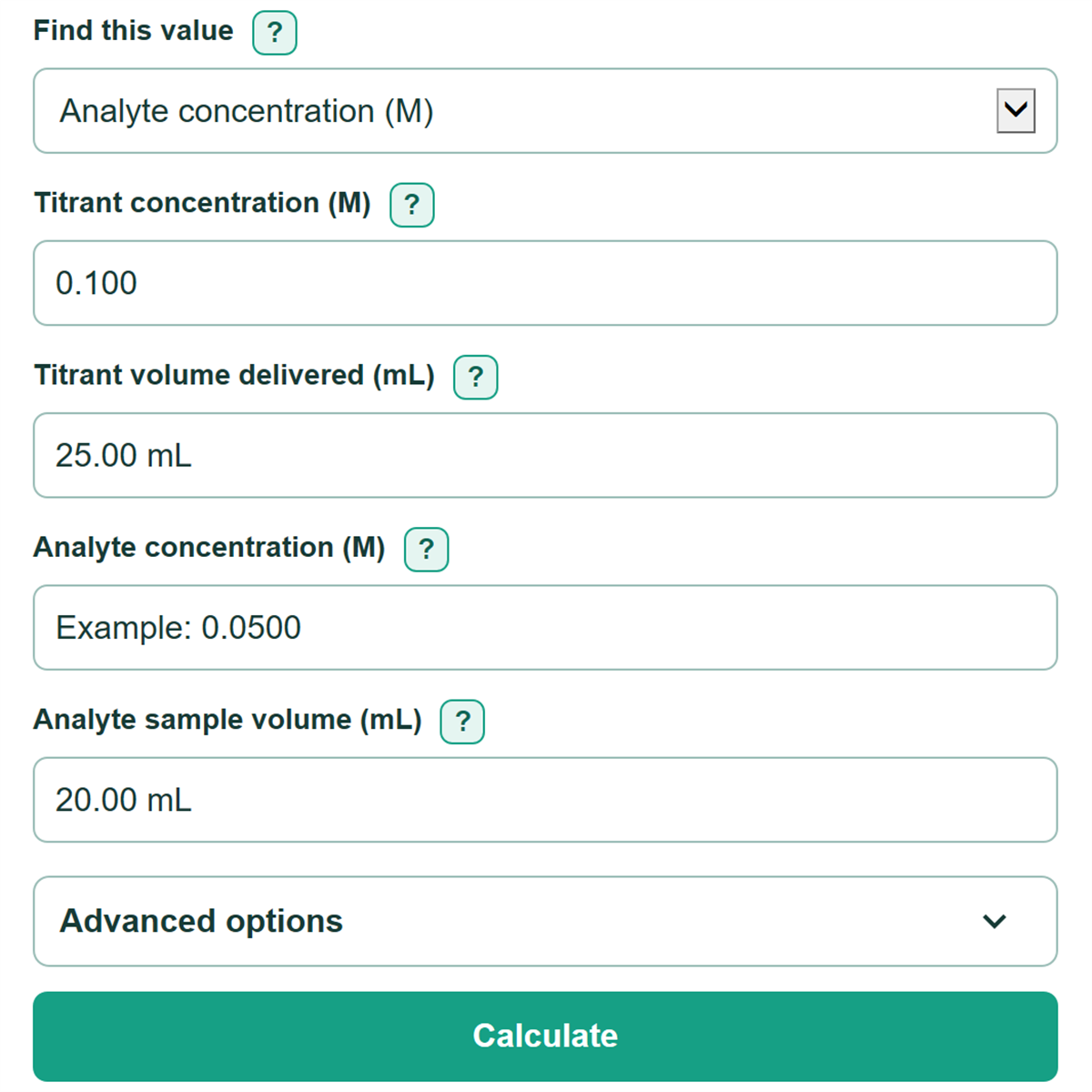
Choose the unknown and enter your known titration values to find the concentration or volume at the equivalence point.
Advanced options
Balanced reaction parts
This is the requested value at the ideal equivalence point using the entered balanced-reaction parts.
This amount follows the balanced-reaction parts, so it does not always equal the titrant amount.
M multiplied by mL equals mmol.
A 1:1 relationship is used only when both parts are 1.
Table of contents
How to use our Titration Calculator
- Choose the value your worksheet or lab asks you to find.
- Enter the three known values shown. Use M for concentration and mL for volume.
- Open Advanced options and enter the analyte and titrant reaction parts from the balanced equation if the reaction is not 1:1.
- Click Calculate to see the requested value and the analyte and titrant amounts at equivalence.
- Check that the answer unit matches the selected unknown: concentration is in M and volume is in mL. For unequal reaction parts, the two millimole amounts should follow that same ratio.
Definitions
Analyte: The substance being measured, usually in the flask.
Titrant: A solution of known concentration added to react with the analyte.
Molarity (M): Concentration measured in moles of solute per liter of solution.
Equivalence point: The ideal point where analyte and titrant react in the exact mole relationship set by the balanced equation.
Endpoint: The observed signal, often an indicator color change, used to estimate the equivalence point.
Aliquot: The measured portion of analyte solution used for one titration.
Millimole (mmol): One thousandth of a mole. Multiplying M by mL gives mmol.
Reaction parts: The whole-number coefficients in a balanced chemical equation. They set the mole relationship between analyte and titrant. [1]
Common mistakes and quick fixes
Mistake: Using a 1:1 relationship when the balanced equation has unequal reaction parts.
Fix: Enter the analyte and titrant coefficients from the balanced equation in Advanced options.
Mistake: Entering a final burette reading as the titrant volume delivered.
Fix: Enter final reading minus initial reading, unless the initial reading was 0.00 mL.
Mistake: Typing liters into a field labeled mL.
Fix: Convert to mL before entry. For example, 0.025 L is 25 mL.
Mistake: Mixing up analyte and titrant reaction parts.
Fix: Match each coefficient to the substance's role in the balanced equation, not its position on the page.
Mistake: Treating the observed endpoint as the exact equivalence point.
Fix: Use the measured endpoint volume for the calculation and report measurement uncertainty or indicator error when your lab requires it.
Limitations & Key Assumptions / Boundary Conditions
- The calculation applies to ideal equivalence-point stoichiometry, not pH before or after equivalence.
- You need a balanced reaction and positive whole-number reaction parts.
- Enter volumes in mL and concentrations in M; the calculator does not convert liters entered in an mL field.
- A measured endpoint can differ from the true equivalence point because of indicator choice, burette reading precision, technique, or incomplete reaction.
- This calculator does not calculate pH, buffer behavior, weak-acid or weak-base equilibrium, or uncertainty propagation.
Methodology
Calculation method
The calculator finds the titrant amount from its concentration and delivered volume. Using M and mL gives mmol directly, so no separate liter conversion is needed.
titrant amount (mmol) = titrant concentration (M) x titrant volume (mL)
It then uses the whole-number parts from the balanced reaction. For example, if 1 analyte part reacts with 2 titrant parts, the analyte amount is half the titrant amount.
analyte amount (mmol) = titrant amount x analyte parts / titrant parts
The calculator rearranges this relationship to solve for the selected concentration or volume. The balanced-reaction parts determine the required mole relationship. [1]
analyte concentration (M) = titrant concentration x titrant volume x analyte parts / (titrant parts x analyte volume)
titrant volume (mL) = analyte concentration x analyte volume x titrant parts / (titrant concentration x analyte parts)
analyte volume (mL) = titrant concentration x titrant volume x analyte parts / (titrant parts x analyte concentration)
titrant concentration (M) = analyte concentration x analyte volume x titrant parts / (analyte parts x titrant volume)
Worked example
Suppose 25.00 mL of 0.100 M titrant reacts with 20.00 mL of analyte. The balanced reaction has 1 analyte part and 2 titrant parts. The titrant amount is 0.100 x 25.00 = 2.50 mmol. The analyte amount is 2.50 x 1 / 2 = 1.25 mmol. The analyte concentration is 1.25 / 20.00 = 0.0625 M.
Calculation details
Known concentrations and volumes must be greater than zero. Each reaction part must be a whole number of 1 or more. The decimal-place setting changes only the displayed rounding; calculations use the unrounded value.