
Use this Raoult's law calculator to find vapor pressures, vapor fractions, mole fractions, or vapor-pressure lowering for common ideal-solution problems.
Advanced options
Entry and units
Moles (only if you choose "Enter moles")
Optional consistency check
How to use our Raoult's Law Calculator
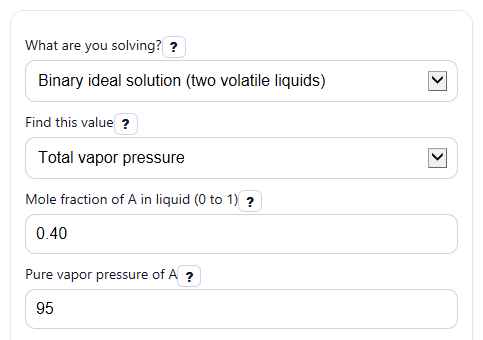
- Choose What are you solving? first, then pick the exact target in Find this value.
- Enter the needed composition as Mole fraction of A in liquid (0 to 1) or Mole fraction of solvent (0 to 1); if your problem gives amounts instead, open Advanced options and switch How will you enter composition? to moles.
- Enter the matching pure-component pressure values in Pure vapor pressure of A, Pure vapor pressure of B, or Pure vapor pressure of solvent, keeping all pressures in the same Pressure unit.
- Click Calculate, then check that Liquid composition used matches your chemistry setup and that vapor fractions are between 0 and 1.
- Use Main result as your answer, and read Use conditions note to see whether the ideal-solution assumption may make the result only approximate.
Definitions
Mole fraction in liquid, x: The part of the liquid mixture made of one component. In a binary liquid, x_A + x_B = 1.
Pure vapor pressure, P*: The vapor pressure of a pure substance at the same temperature as the solution.
Partial pressure: The pressure contribution from one vapor component above the liquid.
Total vapor pressure: The sum of all partial pressures above the solution.
Vapor fraction, y: The part of the vapor made of one component. For two volatile components, y_A + y_B = 1.
Nonvolatile solute: A dissolved substance that is assumed to contribute essentially no vapor pressure in this model.
Vapor-pressure lowering: The drop between the pure-solvent vapor pressure and the solution vapor pressure.
Ideal solution: A solution that follows Raoult's law closely, so each component's partial pressure is proportional to its liquid mole fraction.
Common mistakes and quick fixes
Mistake: Entering vapor composition into Mole fraction of A in liquid (0 to 1) instead of the liquid composition.
Fix: Put the liquid-phase x-value in Mole fraction of A in liquid (0 to 1) ; the calculator finds Vapor fraction of A separately.
Mistake: Mixing units, such as typing one pressure in kPa and another in mmHg while Pressure unit shows only one unit.
Fix: Convert all entered pressures first, then make sure Pure vapor pressure of A , Pure vapor pressure of B , and Pure vapor pressure of solvent all use the same Pressure unit .
Mistake: Using moles from the problem but leaving How will you enter composition? on direct mole fraction entry.
Fix: Switch How will you enter composition? to moles and fill in Moles of A and Moles of B , or Moles of solvent and Moles of solute .
Mistake: Typing values outside 0 to 1 in Mole fraction of solvent (0 to 1) or Mole fraction of A in liquid (0 to 1) .
Fix: Enter a true mole fraction only. If you have percentages, divide by 100 first.
Mistake: Entering both Mole fraction of A in liquid (0 to 1) and Optional check: mole fraction of B in liquid (0 to 1) even though they do not add to 1.
Fix: Correct one of the values so the two liquid mole fractions add to 1 for a binary mixture.
Mistake: Trying to find Vapor fraction of A or Vapor fraction of B when the total vapor pressure comes out zero.
Fix: Check the entered mole fraction and pure vapor pressure values. At least one partial pressure must be positive before a vapor fraction can be computed.
Limitations & Key Assumptions / Boundary Conditions
- This calculator uses Raoult's law for ideal solutions, so real mixtures that strongly attract or repel each other can differ from the result.
- All pure-component vapor pressures must be for the same temperature as the mixture or solution.
- The binary volatile case assumes exactly two volatile liquid components.
- The nonvolatile-solute case assumes the solute adds essentially no vapor pressure of its own.
- Vapor-fraction outputs need a positive total vapor pressure; if total pressure is zero, y-values are not defined.
- Mole fractions must stay between 0 and 1, and mole-entry modes need total moles greater than 0.
- If entered values make solution vapor pressure higher than pure-solvent vapor pressure, the calculator keeps the signed difference and flags that the setup may be physically inconsistent for this model.
Methodology
Core equations
The calculator follows the selected chemistry case and uses only the inputs needed for that case.
P_i = x_i * P_i*
For a volatile component i, the partial pressure equals its liquid mole fraction times its pure vapor pressure.
P_total = P_A + P_B = x_A * P_A* + x_B * P_B*
For a binary ideal solution with two volatile liquids, total vapor pressure is the sum of the two partial pressures.
y_i = P_i / P_total
Vapor composition uses Dalton's law form. This step is done only when total pressure is positive.
P_solution = x_solvent * P_solvent*
For a solvent with a nonvolatile solute, only the solvent contributes vapor pressure.
DeltaP = P_solvent* - P_solution
Vapor-pressure lowering is the pure-solvent pressure minus the solution pressure.
x_A = n_A / (n_A + n_B)
x_solvent = n_solvent / (n_solvent + n_solute)
If you enter moles instead of mole fraction, the calculator converts moles to the needed x-value first.
Worked mini-example
Suppose a binary liquid has x_A = 0.40, P_A* = 95 mmHg, and P_B* = 28 mmHg. Then x_B = 1 - 0.40 = 0.60.
P_A = 0.40 * 95 = 38.0 mmHg
P_B = 0.60 * 28 = 16.8 mmHg
P_total = 38.0 + 16.8 = 54.8 mmHg
y_A = 38.0 / 54.8 = 0.6934
So the vapor is richer in A than the liquid, because y_A is greater than x_A.
How solve-for mode works
If you ask for a pressure, the calculator applies the matching equation directly. If you ask for a mole fraction or pure vapor pressure, it rearranges the same equation algebraically, as long as the needed denominator is not zero. If you ask for a vapor fraction, it first finds partial pressures and total pressure, then computes y.
Pressure units
The calculator keeps all pressure outputs in the same unit you select for input. Common conversions include 1 atm = 101.325 kPa and 1 atm = 760 mmHg [1].
Assumptions behind the result
The math assumes an ideal solution and matching temperature data for the pure-component vapor pressures. That is why results are best for classroom ideal-solution problems and may differ from measured values for non-ideal mixtures or for solutions where the solute is not truly nonvolatile [2].