
Calculate pH from hydrogen ion concentration, convert pH to hydrogen ion concentration, or solve strong and weak acid or base chemistry problems.
Table of contents
How to use our pH Calculator
- Choose the calculation path that matches what your worksheet, lab result, or problem gives you.
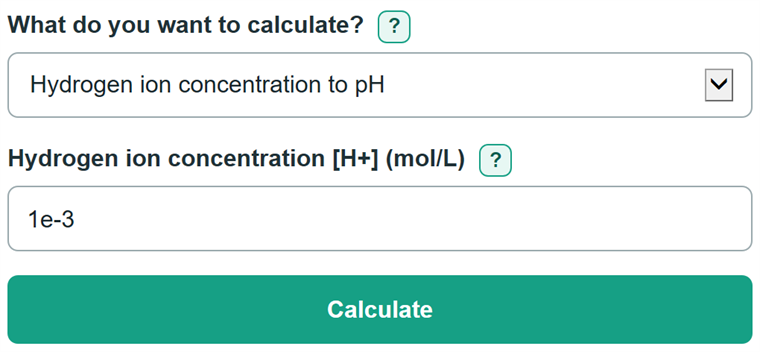
- For a direct conversion, enter either the final hydrogen ion concentration [H+] in mol/L or the known pH. You can type concentrations as decimals or scientific notation, such as 0.001 or 1e-3.
- For a strong acid or base, enter the initial concentration and the number of H+ or OH- ions released per formula unit.
- For a weak acid or base, enter the initial concentration, choose K or pK, and enter the Ka, Kb, pKa, or pKb value from the problem.
- Click Calculate, then check that the calculation method matches the chemical type in the question. For the 25 C results, calculated pH plus pOH should equal 14.
Definitions
pH: In this calculator, pH is the negative base-10 logarithm of hydrogen ion concentration. At 25 C, values below 7 are acidic, 7 is neutral, and values above 7 are basic. [1]
Hydrogen ion concentration [H+]: The amount of hydrogen ions in a liter of solution, entered in mol/L.
Hydroxide ion concentration [OH-]: The amount of hydroxide ions in a liter of solution, expressed in mol/L.
pOH: A logarithmic measure based on hydroxide ion concentration. In the calculator's 25 C water model, pH plus pOH equals 14.
Initial concentration: The concentration of an acid or base before it dissociates. For a weak acid or base, it is not the same as the final ion concentration.
Ka and Kb: Equilibrium constants for a weak acid and weak base. A larger K means more dissociation under the same conditions.
pKa and pKb: The negative base-10 logarithms of Ka and Kb, respectively.
Percent dissociation: The percent of the starting weak acid or weak base that has formed ions at equilibrium.
Common mistakes and quick fixes
Mistake: Entering a weak acid's initial concentration as hydrogen ion concentration [H+].
Fix: Choose Weak acid and enter the initial concentration plus its Ka or pKa value.
Mistake: Entering a base concentration in the hydrogen ion concentration [H+] field.
Fix: Choose Strong base or Weak base, then enter the base information the problem gives you.
Mistake: Typing incomplete scientific notation, such as 1e or 1e--3.
Fix: Enter one complete number, such as 0.001 or 1e-3.
Mistake: Entering pKa or pKb while "K value" is selected.
Fix: Select "pK value" before entering pKa or pKb.
Mistake: Assuming every strong acid or base releases one ion per formula unit.
Fix: Check the dissociation equation and enter the correct number of released H+ or OH- ions.
Mistake: Using the pOH result as though it applies at any temperature.
Fix: Use pOH and OH- results only under this calculator's 25 C aqueous-water assumption.
Limitations & Key Assumptions / Boundary Conditions
- The calculator uses concentration as a pH model and does not apply activity coefficients, so it is not a high-precision activity-based pH measurement.
- pOH, hydroxide ion concentration, and the acidic-neutral-basic label use a water ion product of 1e-14 at 25 C. Temperature changes this relationship.
- Strong acid and strong base paths assume complete dissociation according to the ion factor you enter.
- Weak acid and weak base paths model one monoprotic weak acid or one monobasic weak base with one equilibrium constant.
- The weak-species paths do not model buffers, mixtures, added salts, dilution, multiple dissociation steps, or reactions between several acids and bases.
- At very low concentrations, water autoionization can matter and is outside these equations.
Methodology
Direct conversion
When you know the final hydrogen ion concentration, the calculator finds pH directly. When you know pH, it reverses the same relationship to find [H+].
pH = -log10([H+])
[H+] = 10^(-pH)
Strong acids and bases
For a strong acid, initial concentration is multiplied by the number of H+ ions released per formula unit. For a strong base, that step gives [OH-], which is converted to [H+] before pH is calculated.
[H+] or [OH-] = initial concentration * ions released per formula unit
[H+] = 1e-14 / [OH-]
Weak acids and bases
For a weak acid or base, the calculator uses Ka or Kb directly, or converts pKa or pKb to K. It solves the positive root of the equilibrium equation instead of using a small-change approximation.
K = 10^(-pK)
x = (-K + sqrt(K^2 + 4*K*C)) / 2
C is the initial concentration. For a weak acid, x is the final [H+]. For a weak base, x is the final [OH-]. Percent dissociation is x divided by C, multiplied by 100.
percent dissociation = 100 * x / C
Related 25 C values
The calculator derives pOH and the opposite ion concentration from the 25 C water relationship. [2]
pOH = 14 - pH
[OH-] = 1e-14 / [H+]
Worked example
For a 0.10 mol/L weak acid with Ka = 1e-5, the equation gives [H+] = 0.0009950125 mol/L. The calculated pH is about 3.0022, and percent dissociation is about 0.9950%.