
Estimate a cat's cephalexin dose by weight, prescription rate, schedule, and medicine strength, then see liquid or tablet amounts per dose.
Advanced options
How to use our Cephalexin For Cats Dosage Calculator
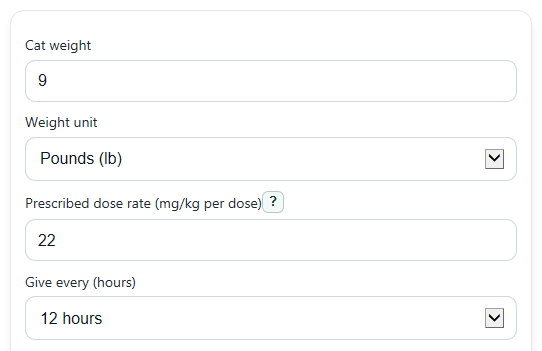
- Enter Cat weight, choose the matching Weight unit, and type the Prescribed dose rate (mg/kg per dose) exactly as written by the veterinarian.
- Choose Give every and Medicine form, then enter Strength as mg per mL for liquid or mg per tablet for tablets.
- If you want a practical estimate for measuring, open Advanced options and set Treatment length (days), Round measured amount to, and for tablets Smallest tablet fraction allowed.
- Click Calculate and read Cephalexin needed each dose, Amount to give each dose, and Closest measurable amount first, then check Actual dose after rounding and Reference range note.
- Sanity-check the result before using it: if Actual dose after rounding is noticeably different from the prescribed mg/kg, or Practical measuring warning says the dose is hard to measure, ask your veterinarian or pharmacist to confirm the form, strength, or rounding.
Definitions
Prescribed dose rate (mg/kg per dose): The amount of cephalexin ordered for each kilogram of body weight each time you give a dose.
Strength: How concentrated the medicine is. For liquid, it means mg per mL. For tablets or capsules, it means mg per tablet.
Amount to give each dose: The exact measured amount that matches the calculated mg dose before rounding.
Closest measurable amount: The nearest practical mL mark or tablet fraction based on your selected rounding step.
Actual dose after rounding (mg/kg per dose): The real body-weight dose the cat would receive after using the rounded amount instead of the exact amount.
Doses per day: How many times the medicine is given in 24 hours based on the selected interval.
Reference range note: A safety context note that compares the entered prescription rate with a common feline oral range; it does not replace the veterinarian's instructions.
Smallest tablet fraction allowed: The smallest part of one tablet you believe can be split and given accurately, such as 1/2 or 1/4.
Common mistakes and quick fixes
Mistake: Entering the bottle strength into Prescribed dose rate (mg/kg per dose) .
Fix: Put the vet's body-weight dose in Prescribed dose rate (mg/kg per dose) and put the bottle or tablet strength in Strength .
Mistake: Typing a weight in pounds but leaving Weight unit set to kilograms.
Fix: Make sure Cat weight and Weight unit match before you calculate.
Mistake: Entering Strength as total mg in the bottle instead of mg per mL for liquid or mg per tablet for tablets.
Fix: For liquid, enter only mg per mL in Strength . For tablets, enter mg per tablet in Strength .
Mistake: Choosing a coarse Round measured amount to value and not checking how much the dose changes.
Fix: Compare Closest measurable amount with Actual dose after rounding to see whether the rounded dose still matches the prescription closely.
Mistake: Using tablets when the needed amount is smaller than the allowed split in Smallest tablet fraction allowed .
Fix: Read Practical measuring warning . If splitting is too fine, ask about a different tablet strength or a liquid form.
Mistake: Forgetting that Amount needed for full treatment depends on the rounded amount actually given.
Fix: Set Treatment length (days) and review Amount needed for full treatment so you know whether the supply is enough.
Limitations & Key Assumptions / Boundary Conditions
- This calculator estimates oral cephalexin amounts only from the entered body weight, mg/kg plan, interval, and product strength.
- The veterinarian's prescription controls even if the Reference range note says the entered dose is below or above a common context range.
- The common feline oral context range used here is 15 to 35 mg/kg per dose every 6 to 12 hours, so a 24-hour schedule may fall outside that comparison note.
- Total cephalexin per day is based on the exact calculated mg dose, while Amount needed for full treatment uses the rounded amount because that is what would actually be measured.
- Rounding can change the delivered mg/kg meaningfully for very small cats, very strong liquids, or large tablet strengths.
- Tablet splitting accuracy varies by tablet size, score lines, and handling, so Closest measurable amount is a practicality estimate, not a guarantee.
- If Round measured amount to is too coarse for a tiny liquid dose, rounding can produce 0 mL; in that case the exact amount still matters and the product may be impractical for that cat.
- This page does not adjust for kidney disease, compounded products, missed doses, route changes, or condition-specific directions that can change real-world dosing.
Methodology
How the calculator works
The calculator first converts body weight to kilograms, then multiplies that weight by the entered prescription rate to get the exact mg of cephalexin needed per dose. Next, it divides by the entered Strength to show the exact liquid volume or tablet count, applies the selected rounding step, and then recalculates the true mg/kg delivered after rounding.
Formulas used
weight_kg = weight_value if Weight unit is kg, otherwise weight_value / 2.2046226218
dose_mg = weight_kg x Prescribed dose rate (mg/kg per dose)
doses_per_day = 24 / interval_hours
amount_each_dose = dose_mg / Strength
rounded_amount = round(amount_each_dose / step) x step
actual_mg_per_kg = (rounded_amount x Strength) / weight_kg
daily_total_mg = dose_mg x doses_per_day
course_total_amount = rounded_amount x doses_per_day x Treatment length (days)
Worked example
Suppose a cat weighs 9 lb, the prescription is 22 mg/kg per dose, the schedule is every 12 hours, and the liquid strength is 50 mg per mL. First convert 9 lb to about 4.082 kg. Then multiply 4.082 x 22 to get about 89.81 mg per dose. Divide 89.81 by 50 to get about 1.796 mL per dose. If you round to 0.1 mL, the practical amount becomes 1.8 mL. That rounded amount delivers about 22.05 mg/kg per dose, which is very close to the prescribed rate.
Reference note logic
The calculator compares the entered Prescribed dose rate (mg/kg per dose) with a common feline oral context range of 15 to 35 mg/kg per dose every 6 to 12 hours. If the entered rate is below that range, it shows a below-range note. If it is above that range, it shows an above-range note. This note is only a safety context check, and prescriptions can differ by case.[2]
Practical measuring warning logic
For liquids, a warning appears when the chosen rounding step makes the rounded amount 0 even though the exact dose is greater than 0, because that means the selected measurement step is too coarse. For tablets, a warning appears when the rounded tablet amount is smaller than the selected Smallest tablet fraction allowed, because that dose may be too hard to split accurately.
Assumptions used
The math assumes the entered Strength is correct for the selected form, the chosen interval divides 24 exactly, and each rounded dose is given consistently for the full treatment length. Real prescriptions may also depend on diagnosis, formulation, kidney function, and veterinary judgment.[1]