
Use this HHHHHMM calculator to score your cat's daily comfort, spot weak areas, and compare today with a past check.
Advanced options
Tracking
How to use our Cat Quality of Life Calculator
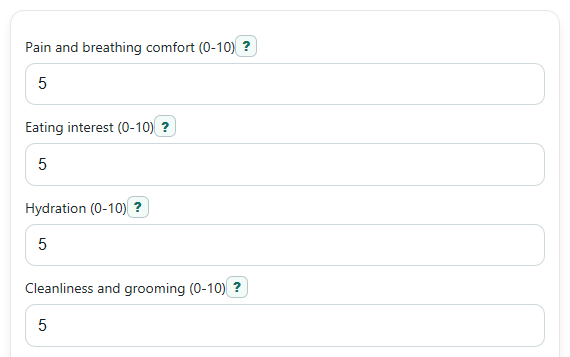
- Score each area from 0 to 10 using whole numbers, where higher numbers mean your cat seems more comfortable, interested, clean, mobile, and able to enjoy the day.
- If you have an earlier result, open Advanced options and enter Previous total score (0-70); you can also keep a record with Check date.
- Click Calculate to see the Total quality-of-life score, What this range suggests, and the Lowest-scoring area to review first.
- Sanity-check the result before acting on it: if one very low category seems off compared with the rest, think about your cat's last 24 hours and rescore that area as honestly as you can.
- Use the result to guide a vet conversation, especially if the total is low, the Change from last score is negative, or the urgent note appears.
Definitions
HHHHHMM scale: A seven-part quality-of-life checklist for pets. Each area gets a score, then the scores are added for one total [2][3].
Pain and breathing comfort: How well pain seems controlled and how comfortable breathing looks.
Eating interest: How willing and able your cat is to eat enough food.
Hydration: Whether your cat seems to be getting enough fluids, by drinking or with treatment help.
Cleanliness and grooming: How clean, dry, and well-groomed your cat stays, with help if needed.
Enjoyment and social comfort: Interest in people, favorite spots, touch, routines, or other normal pleasures.
Getting around: Ability to stand, walk, reach food and water, and use the litter box without major distress.
More good days than bad: Whether comfortable days still outnumber hard days overall.
Total quality-of-life score: The sum of all seven category scores. On this calculator, totals run from 0 to 70.
Change from last score: The current total minus Previous total score (0-70). A negative number means the total dropped.
Common mistakes and quick fixes
Mistake: Treating Pain and breathing comfort (0-10) as pain only and forgetting hard breathing or visible distress.
Fix: Score Pain and breathing comfort (0-10) based on both pain control and how easy breathing looks right now.
Mistake: Entering decimals or values outside the scale in Eating interest (0-10) or Hydration (0-10).
Fix: Use whole numbers only, and keep every required score from 0 through 10.
Mistake: Scoring Cleanliness and grooming (0-10) high even when your cat is often soiled, matted, or needs a lot more cleanup than before.
Fix: Base Cleanliness and grooming (0-10) on how clean and dry your cat stays, even if you are helping.
Mistake: Guessing Previous total score (0-70) from memory and then overreading Change from last score.
Fix: Enter Previous total score (0-70) only if you know the earlier total, or leave it blank so trend results stay hidden.
Mistake: Focusing only on Total quality-of-life score and ignoring the Lowest-scoring area to review first.
Fix: Read both cards together so you can see the overall picture and the biggest problem area at the same time.
Mistake: Waiting on a low score while your cat has severe breathing trouble, collapse, uncontrolled pain, or cannot urinate.
Fix: Treat the When to call your vet now card as a safety prompt and contact a veterinarian right away for those urgent signs regardless of score.
Limitations & Key Assumptions / Boundary Conditions
- This tool is a guide for discussion and tracking, not a diagnosis or a stand-alone treatment decision.
- Scores depend on caregiver observation, so two people may rate the same cat differently.
- The calculator uses whole-number category scores from 0 to 10 and a simple total out of 70, which keeps scoring easy but less detailed.
- A total above 35 is commonly treated as a more acceptable range on this scale, but the same total can still hide one severe problem that needs fast attention.
- Trend results only compare today's total with Previous total score (0-70); they do not show what changed inside each category unless you review the breakdown yourself.
- Sudden distress, severe breathing trouble, collapse, uncontrolled pain, seizures, or inability to urinate are urgent even if the total score is not very low.
- Quality of life can change quickly, so one score should be read in context with your cat's recent pattern and your veterinarian's advice.
Methodology
How the score is calculated
This calculator follows the HHHHHMM approach, which uses seven categories scored individually and then added into one total [2][3].
total_score = hurt + hunger + hydration + hygiene + happiness + mobility + more_good_days
Each category uses a whole-number score from 0 to 10. Because there are seven categories, the total ranges from 0 to 70.
minimum total = 7 x 0 = 0
maximum total = 7 x 10 = 70
How the range is interpreted
The main result shows the Total quality-of-life score first. This calculator then gives a plain-language range note. A score above 35 is commonly used as a sign of more acceptable quality of life on the HHHHHMM scale, while lower scores call for closer review with a veterinarian.
The calculator also finds the lowest category score and names that area first, because one weak area can matter even when the total looks moderate.
How trend is calculated
If you enter Previous total score (0-70), the calculator shows the signed change from the last check.
trend_change = total_score - previous_total
A positive result means today's total is higher. A negative result means the total fell since the previous check. If Previous total score (0-70) is blank, no trend cards are shown.
Worked mini-example
Suppose you enter 8 for Pain and breathing comfort (0-10), 6 for Eating interest (0-10), 7 for Hydration (0-10), 6 for Cleanliness and grooming (0-10), 7 for Enjoyment and social comfort (0-10), 5 for Getting around (0-10), and 6 for More good days than bad (0-10).
total_score = 8 + 6 + 7 + 6 + 7 + 5 + 6 = 45
If Previous total score (0-70) was 49, then:
trend_change = 45 - 49 = -4
That means the total dropped by 4 points since the last check, and Getting around (0-10) would be the first low area to review here.
Urgent note logic
The urgent note appears when the total is very low or when any single category is extremely low, because a major problem in one area can need fast veterinary attention even before the overall picture is fully clear.
Assumptions used here
This calculator assumes each category should count equally in the total, uses whole-number inputs only, and treats the score as a practical tracking tool rather than a final medical judgment. Real-life decisions may differ because of diagnosis, treatment options, sudden crises, and your cat's day-to-day pattern.