
Estimate your cat's chocolate poisoning risk from weight, chocolate type, and amount eaten, then see the most urgent next step first.
Advanced options
How to use our Cat Chocolate Toxicity Calculator
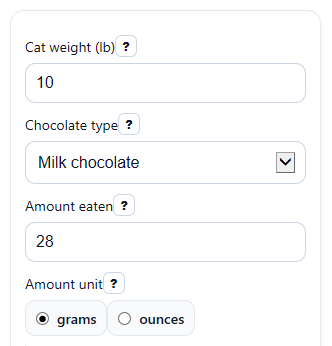
- Enter your cat's weight, then choose the Chocolate type and the Amount eaten with the matching Amount unit.
- Open Advanced options if you want to add Time since eaten (hours) or switch Weight unit to kilograms.
- Click Calculate to see What to do now first, followed by the estimated dose in mg/kg and the total estimated methylxanthines.
- Sanity-check the result by confirming the Chocolate amount used in calculation matches what you meant to enter and that you picked the correct chocolate type.
- If your cat is already showing symptoms, or if the chocolate type or amount is uncertain, follow the more urgent advice in Important notes even if the estimated risk looks lower.
Definitions
Chocolate type: The kind of chocolate eaten. Different types contain different amounts of theobromine, a stimulant in chocolate, and caffeine, so the same amount can create very different risk.[2]
Methylxanthines: The stimulant chemicals in chocolate, mainly theobromine and caffeine. This calculator combines them into one estimate.
Estimated methylxanthine dose (mg/kg): The estimated stimulant dose compared with your cat's body weight. Higher mg/kg means higher poisoning risk.
Estimated total methylxanthines eaten (mg): The estimated total amount of theobromine plus caffeine eaten before adjusting for body weight.
Chocolate amount used in calculation (g): Your entered amount converted to grams so all chocolate types are compared the same way.
Estimated risk level: A screening band based on the estimated mg/kg dose. It helps sort the situation into lower, moderate, serious, or emergency concern.
Common mistakes and quick fixes
Mistake: Entering the whole brownie, cookie, or cake weight as Amount eaten when only part of it was chocolate.
Fix: Use the estimated chocolate portion only for Amount eaten , not the full dessert weight unless the whole item was mostly chocolate.
Mistake: Picking the wrong Amount unit after typing a number from a package label.
Fix: Match the number to the same unit shown on the label, then check Chocolate amount used in calculation to confirm the grams used.
Mistake: Leaving the default Cat weight (lb) even though your cat is much smaller or larger.
Fix: Update Cat weight (lb) or switch Weight unit and enter Cat weight (kg) , because lower body weight raises the Estimated methylxanthine dose (mg/kg) .
Mistake: Choosing Milk chocolate when the product was actually dark, semisweet, baking chocolate, cocoa powder, or unknown.
Fix: Recheck the package and choose the closest match in Chocolate type . If you are unsure, use Unknown or mixed chocolate and follow the more cautious result.
Mistake: Treating a lower Estimated risk level as proof everything is fine.
Fix: Read What to do now and Important notes carefully. Symptoms, a very recent exposure, or missing details can make the real situation more urgent.
Mistake: Skipping Time since eaten (hours) when the chocolate was eaten very recently.
Fix: Add Time since eaten (hours) if you know it, because very recent exposure can still need urgent vet or poison-line guidance before symptoms start.
Limitations & Key Assumptions / Boundary Conditions
- This calculator is a screening tool based on estimated methylxanthine content, not a diagnosis.
- Chocolate recipes vary, so the real theobromine and caffeine content may be lower or higher than the estimate.
- If Chocolate type is unknown or mixed, the calculator uses a cautious assumption to avoid false reassurance.
- The dose estimate depends heavily on accurate Cat weight (lb) or Cat weight (kg) and accurate Amount eaten.
- Time since eaten (hours) changes urgency wording only. It does not change the mg/kg math.
- Symptoms override the number result. A cat with vomiting, restlessness, tremors, seizures, collapse, or a fast heartbeat needs urgent veterinary advice even if the estimate looks lower.
- White chocolate is usually very low in methylxanthines, but stomach upset can still happen from fat and sugar.
- This tool does not account for every health factor, such as other illnesses, other stimulants, or individual sensitivity.
Methodology
How the calculator works
The calculator estimates how many chocolate stimulants were eaten, converts that to a dose based on body weight, and then maps that dose to a screening risk band. The main chemicals counted are theobromine and caffeine, often grouped here as methylxanthines.
Step 1: Convert the chocolate amount to grams
amount_g = amount_value x 28.349523125 if amount_unit = oz, else amount_value
This lets the calculation use one consistent unit even when you enter ounces.
Step 2: Convert body weight to kilograms
weight_kg_calc = weight_lb x 0.45359237 if body_weight_unit = lb, else weight_kg
Dose comparisons are made in mg per kg, so the cat's weight must be in kilograms.
Step 3: Estimate total methylxanthines eaten
total_mg = amount_g x conc_mg_per_g
The concentration value depends on Chocolate type. Darker chocolate usually contains more theobromine and caffeine than milk chocolate, and cocoa powder or baking chocolate can be much more concentrated.[2]
The calculator uses these fixed estimates in mg per gram: milk 2.0, dark 8.0, semisweet 5.5, baking 14.5, dry cocoa powder 26.0, white 0.1, and unknown or mixed 8.0.
Step 4: Estimate the dose per kilogram
dose_mg_per_kg = total_mg / weight_kg_calc
This is the key comparison number. A higher dose per kilogram means a higher expected poisoning risk.
Step 5: Map the dose to a screening band
less than 20 mg/kg = low
20 to less than 40 mg/kg = mild-to-moderate concern
40 to less than 60 mg/kg = serious concern
60 mg/kg or more = emergency
The action message is then adjusted upward when the chocolate type is unknown, when the product is cocoa powder, baking chocolate, or very dark chocolate, or when the exposure was very recent.
Mini example
If a 10 lb cat ate 28 g of milk chocolate, the estimate uses 2.0 mg/g for milk chocolate.
amount_g = 28
weight_kg_calc = 10 x 0.45359237 = 4.5359237
total_mg = 28 x 2.0 = 56
dose_mg_per_kg = 56 / 4.5359237 = 12.3459
That falls below 20 mg/kg, so the screening band is lower estimated risk, but symptoms or uncertainty would still push the advice toward urgent veterinary guidance.
Assumptions used for urgency wording
If Time since eaten (hours) is very short, the calculator gives stronger action wording because early veterinary guidance may matter before symptoms start. If your cat already has symptoms, the symptom situation is treated as more important than the number result.