
Estimate your cat's daily calories, food amount, treat calories, and weight-loss target in one simple feeding calculator.
Advanced options
How to use our Cat Calorie Calculator
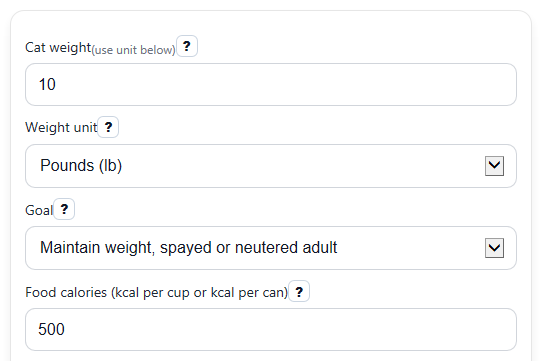
- Enter Cat weight, choose the matching Weight unit, then pick the best Goal for your cat right now.
- Enter Food calories (kcal per cup or kcal per can) from the food label, then choose Food amount type so the daily food amount is shown in cups or cans.
- If you want a better estimate, open Advanced options and add Body condition score (1-9), Treat share (% of daily calories), and Kitten age range when needed.
- Click Calculate to see Daily calories, Calories left for main food, Daily food amount, and the factor used to build the estimate.
- Sanity-check the result: make sure the Daily food amount seems reasonable for your food label and that the selected cup or can setting matches the calorie number you entered.
Definitions
Cat weight: Your cat's current body weight entered in pounds or kilograms.
Body condition score (1-9): A simple body fat check. A score of 5 is ideal, higher numbers usually mean extra body fat, and lower numbers usually mean a thinner cat.
Resting calories: The estimated calories a cat needs at rest before any goal or life-stage factor is applied.
Daily need factor used: The multiplier applied to resting calories for the selected goal, such as maintenance, weight loss, or kitten growth.
Daily calories: The full calorie target for the day before splitting calories into meals and treats.
Treat share (% of daily calories): The percent of the daily calorie target saved for treats instead of the main food.
Calories left for main food: The calories still available for complete food after treat calories are set aside.
Daily food amount: The estimated amount of the chosen food to feed per day, shown in cups or cans based on your selected food unit.
Estimated ideal weight: A rough target weight used mainly for weight-loss planning when body condition score is above ideal.
Common mistakes and quick fixes
Mistake: Entering Cat weight in pounds while Weight unit is set to kilograms, or the other way around.
Fix: Match the number and the unit before you calculate.
Mistake: Using the wrong label value for Food calories (kcal per cup or kcal per can) .
Fix: Copy the calorie density exactly from the package and make sure it is per cup or per can, not per bag or per case.
Mistake: Choosing Food amount type as Cup when your calorie number is really per can.
Fix: Set Food amount type to the same unit used by the food label so Daily food amount is not off.
Mistake: Entering an unrealistic Body condition score (1-9) for a cat that looks close to ideal.
Fix: Use 5 for an ideal cat, and use values above 5 only when the cat clearly has extra body fat.
Mistake: Setting Treat share (% of daily calories) too high and then wondering why Calories left for main food looks low.
Fix: Lower the treat share if you want more calories available for complete meals.
Mistake: Using Goal = Needs weight loss even though Body condition score (1-9) is 5 or lower.
Fix: Recheck body condition first. If your cat is not carrying extra fat, a weight-loss target may not be appropriate.
Limitations & Key Assumptions / Boundary Conditions
- This calculator gives a starting estimate, not a diagnosis or a full feeding plan.
- Results depend on the accuracy of Cat weight, Food calories (kcal per cup or kcal per can), and the chosen Goal.
- The weight-loss method uses an estimated ideal weight when Body condition score (1-9) is above 5, so the target can differ from a veterinarian's exam.
- For kittens, the tool uses a simplified age-stage factor and does not cover every growth pattern.
- Indoor activity, medical problems, medications, pregnancy, nursing, and unusual metabolism can change real calorie needs a lot.
- If the food amount looks extremely small or large, recheck whether your calorie number was per cup or per can before using the result.
- Treats are reserved as a percent of total calories, but real treat labels and table foods can vary widely in calorie content.
Methodology
How the calculator works
The tool first converts body weight to kilograms when needed, then estimates resting calories, applies a goal factor, subtracts treat calories, and converts the remaining calories into cups or cans of food.
RER = 70 x BWkg^0.75
Daily calories = RER x factor
Ideal weight = Current weight / (1 + 0.1 x (BCS - 5))
Weight-loss calories = RER at ideal weight x 0.8
Food calories after treats = Daily calories x (1 - Treat share/100)
Daily food amount = Food calories after treats / Food calories
Goal factors used
For a spayed or neutered adult, the factor is 1.2. For an intact adult, the factor is 1.4. For a cat prone to weight gain, the factor is 1.0. For weight loss, the factor is 0.8 and is applied to resting calories at estimated ideal weight when body condition score is above 5. For kittens, the factor is 2.5 under 4 months and 2.0 from 4 to 10 months.
Worked mini-example
Suppose your cat weighs 10 lb, is a neutered adult, eats a food with 500 kcal per cup, and gets 10% of daily calories as treats. First convert 10 lb to 4.54 kg. Then resting calories are about 70 x 4.54^0.75 = 217.8 kcal/day. Next daily calories are 217.8 x 1.2 = 261.3 kcal/day. Treat calories are 261.3 x 0.10 = 26.1 kcal/day, so calories left for main food are about 235.2 kcal/day. Finally, 235.2 / 500 = 0.47 cups/day.
How to read the results
A higher Daily calories result usually means a larger cat or a higher-need life stage. A lower Calories left for main food result often means more calories were set aside for treats. If Estimated ideal weight is lower than current weight, the calculator is signaling that body condition may be above ideal.
Assumptions used
This method assumes the food label calorie value is correct and that your cat broadly fits the selected goal. It also assumes body condition score is entered reasonably when used for weight loss. Real feeding needs can differ based on health status, activity, age, and veterinary treatment, so use the result as a starting point and adjust with your veterinarian if your cat's body condition or weight trend moves the wrong way [2].