
Check a cold window for interior condensation risk and find the indoor humidity level that keeps its surface above dew point.
Stay below this threshold to leave some safety margin. This limit applies to the entered room and window temperatures.
Dew point is the temperature where moisture in the room air begins turning into liquid water.
Table of contents
How to use our Window Condensation Risk Calculator
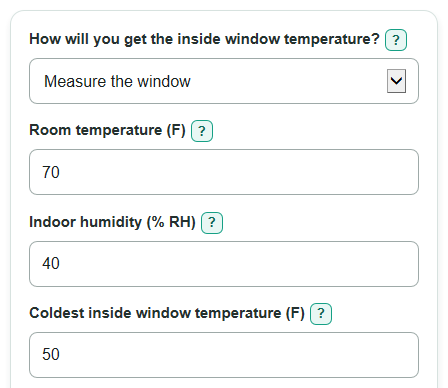
- Choose how you will get the window temperature: measure the coldest room-facing spot, or estimate it from outdoor temperature and Window U-factor.
- Enter Room temperature and Indoor humidity from the affected room, preferably near the window and away from a vent.
- Enter the temperature required by your chosen method, then select Calculate.
- Read the Interior window condensation assessment and Window temperature above dew point. A positive margin means the entered spot is warmer than dew point; a negative margin means condensation is likely.
- Compare Indoor humidity with Highest indoor humidity before condensation begins. Keep humidity below that number and recheck the coldest glass edge or frame spot.
Definitions
Relative humidity (% RH): How full the air is with water vapor compared with the most it can hold at its current temperature.
Dew point: The temperature where the room air begins to form liquid water on a surface.
Window temperature above dew point: Inside window temperature minus indoor dew point. A positive number means the entered window spot is warmer than dew point.
U-factor: A window heat-flow rating in Btu/h-ft2-F. Lower U-factors mean less heat passes through the window.
Inside window temperature: The room-facing surface temperature used for the check, either measured directly or estimated from room temperature, outdoor temperature, and U-factor.
Common mistakes and quick fixes
Mistake: Using Indoor humidity from another floor, a bathroom, or a thermostat in a different zone.
Fix: Use a humidity reading from the affected room near the window.
Mistake: Measuring only the warm center of the glass for Coldest inside window temperature.
Fix: Check the coldest room-facing glass edge, frame area, or spot behind a covering.
Mistake: Entering an R-value in Window U-factor.
Fix: Enter the U-factor from the NFRC label, window quote, or manufacturer sheet. U-factor and R-value are different ratings.
Mistake: Using the current Outdoor temperature when the window was wet during a colder time.
Fix: Enter the outdoor temperature at the time the condensation appears.
Mistake: Treating a positive Window temperature above dew point as proof that every part of the window is dry.
Fix: Recheck colder edges, frames, air-leak areas, and covered sections because they can be colder than the entered spot.
Limitations & Key Assumptions / Boundary Conditions
- This checks possible condensation on the room-facing window surface only. It does not assess outdoor dew or moisture between sealed panes.
- The measured path is only as good as the temperature reading. Glass edges, frames, air leaks, and areas behind closed blinds or curtains can be colder than the point measured.
- The estimate path uses a fixed indoor surface resistance of 0.68 h-ft2-F/Btu and steady conditions. It does not model wind, sun, changing airflow, frame geometry, edge effects, or coverings.
- Highest indoor humidity before condensation begins is the threshold for the entered surface temperature. Stay below it for a practical margin because room readings and surface temperatures can change.
- Indoor humidity must be greater than 0% and no more than 100%. Window U-factor must be greater than zero.
Methodology
Calculation method
The calculator converts temperatures from F to C, then uses the Magnus dew-point approximation with constants a = 17.625 and b = 243.04 C. It compares indoor dew point with the selected room-facing window temperature.
temperature_c = (temperature_f - 32) * 5 / 9
gamma = ln(indoor_humidity / 100) + a * room_temperature_c / (b + room_temperature_c)
dew_point_f = (b * gamma / (a - gamma)) * 9 / 5 + 32
For the measured method, the entered Coldest inside window temperature is used directly. For the estimate method, the calculator uses a simplified steady-state surface-temperature equation with an indoor surface resistance of 0.68 h-ft2-F/Btu. Interior surface heat transfer changes with airflow and other conditions. [1]
window_surface_f = room_temperature_f - window_u_factor * 0.68 * (room_temperature_f - outdoor_temperature_f)
window_dew_point_margin = window_surface_f - dew_point_f
A margin of 0 F or less is assessed as likely condensation. The humidity threshold is found by setting dew point equal to the window surface temperature, then limiting the result to the physical 0% to 100% RH range.
maximum_safe_indoor_humidity = min(100, max(0, 100 * exp(surface_saturation_term - room_vapor_term)))
Worked example
With Room temperature of 70 F, Indoor humidity of 40% RH, and a measured Coldest inside window temperature of 50 F, the dew point is about 44.57 F. The margin is about +5.43 F, so condensation is unlikely at that entered spot. The humidity threshold is about 49.06% RH.
Input conditions
The 40% RH starting value is a planning reference within EPA guidance to keep indoor humidity ideally between 30% and 50% and below 60%; it is not a window-specific target. [2]