
Compare metal and asphalt roof ownership costs using your quotes, replacement timing, maintenance, and a low-to-high electricity savings estimate.
Advanced options
Roof and cost planning
Energy effect
Table of contents
How to use our Metal Roof vs Asphalt Shingle Lifetime Energy Cost Calculator
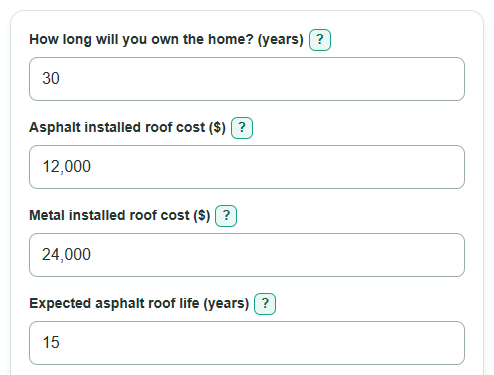
- Enter how many years you expect to own the home, then enter comparable installed quotes for asphalt and metal roofing.
- Enter each roof's expected service life in years. Use an installer or product estimate for real-world service life, not only a warranty length.
- Open Advanced options to add maintenance, replacement cost growth, and an electricity usage rate from your utility bill.
- Enter low, best, and high annual electricity savings for metal in kWh per year. Positive values mean metal may use less electricity; negative values mean it may use more.
- Check the best-estimate cost advantage first, then compare the low and high cases and review replacement years before making a decision.
Definitions
Ownership period: The number of years you expect to own the home. It sets how long maintenance and energy effects are counted.
Installed roof cost: The all-in starting price for one roof option, based on the work included in its contractor quote.
Expected roof life: The planned number of years before a roof needs replacement. This can differ from its warranty length.
Replacement cost growth: The yearly percentage used to increase the cost of each future replacement from today's entered quote.
Electricity usage rate: The charge for each kWh of electricity used, in cents per kWh. It excludes a fixed monthly customer charge. The default 17.30 cents per kWh is a replaceable 2025 U.S. residential average. [1]
Electricity saved with metal: The estimated yearly change in electricity use for metal compared with asphalt. A positive number means metal uses fewer kWh; a negative number means it uses more.
Lasting break-even year: The first whole year when metal is no more expensive than asphalt and stays no more expensive through the end of the ownership period.
Common mistakes and quick fixes
Mistake: Using home floor area instead of roof surface area.
Fix: For Roof surface area, use the roof measurement from a bid or roof report, not the square footage inside the home.
Mistake: Comparing quotes with different work included.
Fix: Make sure Asphalt installed roof cost and Metal installed roof cost both include comparable labor, tear-off, underlayment, flashing, permits, and disposal.
Mistake: Entering a warranty term as Expected asphalt roof life or Expected metal roof life.
Fix: Ask the installer for an expected service life for the specific roof system and local conditions.
Mistake: Adding the fixed monthly utility charge to Electricity usage rate.
Fix: Enter only the usage rate in cents per kWh because a fixed customer charge normally does not change with roof choice.
Mistake: Treating a positive Best estimate: electricity saved with metal as guaranteed.
Fix: Enter a cautious low estimate, a best estimate, and a supportable high estimate, then see whether the roof choice changes across the range.
Mistake: Ignoring a negative Best-estimate lifetime cost advantage of metal.
Fix: Keep the sign: a positive amount means metal costs less, while a negative amount means asphalt costs less for the selected ownership period.
Limitations & Key Assumptions / Boundary Conditions
- The calculation uses your quotes, service-life estimates, maintenance allowances, and ownership plan. A different scope of work can change the comparison.
- Future replacement costs grow by one shared yearly rate when entered. The model does not forecast separate labor, material, or local price changes.
- The annual electricity effect and electricity usage rate stay constant for every year of ownership. Actual bills and utility rates can change.
- Roof-related energy use depends on roof finish, climate, insulation, ventilation, shade, and heating and cooling equipment. Metal roofing alone does not establish an energy saving.
- Fixed utility customer charges are excluded because they normally do not change with electricity use.
- Insurance discounts, financing, taxes, rebates, storm damage, resale value, and major one-time repairs are excluded.
- A replacement scheduled exactly at the end of the ownership period is excluded because the comparison ends then.
Methodology
Cost calculation
The calculator starts each roof with its installed quote. It adds annual maintenance for every ownership year and adds each replacement that occurs before the ownership period ends.
replacement_years = [life, 2 * life, 3 * life,...] where replacement_year < ownership_years
replacement_cost_t = installed_cost * (1 + replacement_cost_growth / 100) ^ t
nonenergy_cost = installed_cost + annual_maintenance * ownership_years + total replacement costs
Energy adjustment
The entered annual kWh difference is converted using the electricity usage rate. The result is applied only to metal because the kWh entry already states metal's difference from asphalt. The default rate is 17.30 cents per kWh, a replaceable 2025 U.S. residential average. [1]
annual_energy_savings = energy_saved_kwh * electricity_rate_cents / 100
lifetime_energy_savings = annual_energy_savings * ownership_years
metal_adjusted_cost = metal_nonenergy_cost - lifetime_energy_savings
metal_lifetime_advantage = asphalt_nonenergy_cost - metal_adjusted_cost
A positive cost advantage means metal costs less. A negative cost advantage means asphalt costs less.
Mini-example
For 30 years, assume a 15-year asphalt life, a 40-year metal life, $12,000 asphalt installation, $24,000 metal installation, $200 yearly asphalt maintenance, $100 yearly metal maintenance, and no replacement cost growth. Asphalt is replaced once in year 15, so its non-energy cost is $30,000. Metal's non-energy cost is $27,000. If metal saves 1,000 kWh per year at 17.30 cents per kWh, its lifetime energy savings are $5,190, making its adjusted cost $21,810 and its advantage $8,190.
Break-even method
For each whole year, the calculator compares cumulative asphalt cost with cumulative metal cost after the best energy estimate. It returns the first year when metal is no more expensive and remains that way through the selected endpoint. If a later replacement reverses the advantage, that earlier year does not count.
cost_per_sqft = lifetime_cost / roof_area
Calculation choices
Roof area is optional and only creates cost-per-square-foot results. Positive kWh savings lower metal's adjusted cost; negative kWh savings raise it. Fixed utility charges, financing, insurance, taxes, resale value, and unverified rebates are not included.