
Check each radiator at planned heat-pump water temperatures, find room shortfalls, and estimate a local replacement budget.
Table of contents
How to use our Heat Pump Radiator Size and Upgrade Cost Calculator
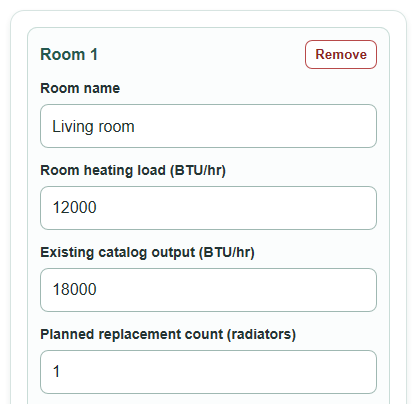
- Replace the example under Rooms and radiators with each room name, its room heating load, existing catalog output, and planned replacement count.
- Enter the Planned supply water temperature, Planned return water temperature, and Indoor design temperature from the system design or heat-loss report.
- Enter the Catalog temperature difference and Radiator output exponent from the radiator manufacturer documentation.
- Open Advanced options to set a Replacement output margin and enter local cost allowances if you want an upgrade budget.
- Click Calculate. Check every room in the Low-temperature radiator check by room table because a home total with extra output can still hide a short room.
Definitions
Room heating load: The heat a room needs at the design outdoor condition, measured in BTU/hr.
Catalog output: A radiator's listed heat output in BTU/hr at a stated catalog temperature difference.
Mean water temperature: The average of the planned supply and return water temperatures.
Catalog temperature difference: Catalog mean water temperature minus catalog room temperature. It is not the supply-to-return temperature drop.
Radiator output exponent: A manufacturer-provided number that describes how radiator output changes as the water-to-room temperature difference changes.
Output gap: Room heating load minus estimated radiator output. A positive gap is a shortfall; a negative gap is estimated extra capacity.
Replacement output margin: An optional percentage added to a short room's heating load when setting its replacement catalog-output target.
Common mistakes and quick fixes
Mistake: Entering an old boiler setting in Planned supply water temperature.
Fix: Use the planned heat-pump design temperature from the installer or system design.
Mistake: Treating Catalog temperature difference as the difference between Planned supply water temperature and Planned return water temperature.
Fix: Enter the catalog mean-water-to-room difference listed for the radiator rating.
Mistake: Using a whole-home estimate as a room heating load in Rooms and radiators.
Fix: Enter a separate room load in BTU/hr for each room from a room-by-room heat-loss report.
Mistake: Assuming a negative Home radiator output gap means every room passes.
Fix: Read the Low-temperature radiator check by room table; one room can have a shortfall while another has extra output.
Mistake: Entering only Radiator material low estimate and expecting an Estimated radiator upgrade budget low end.
Fix: Complete every low and high cost field, including valves, labor, and one-time project estimates.
Mistake: Entering a high estimate below its matching low estimate.
Fix: Check Rooms and radiators and then recalculate. Make each high cost at least as large as the matching low cost before calculating the budget.
Limitations & Key Assumptions / Boundary Conditions
- Use a room-by-room heat-loss report where possible. Room area rules of thumb can produce a wrong radiator target.
- The output adjustment is a simplified estimate using the entered catalog output, Catalog temperature difference, and Radiator output exponent. Use manufacturer data for the specific radiator model.
- All entered radiators are assumed to use the same catalog rating condition and exponent. Separate radiator families may need separate calculations.
- The calculation does not model pipe losses, flow balance, thermostatic valve settings, heat-pump controls, radiator location, furniture blockage, or warm-up time.
- A passing radiator result estimates capacity at the entered design temperatures; it does not confirm comfort in every operating condition.
- The budget uses your local allowances. It is not a contractor quote and excludes ongoing electricity costs unless they are quoted separately.
- One-time project costs are added only if at least one room has a calculated shortfall and planned replacement radiator count.
Methodology
Calculation method
The calculator first finds planned mean water temperature from the separate supply and return temperatures. It then subtracts Indoor design temperature to get the planned water-to-room temperature difference.
mean water temperature = (planned supply water temperature + planned return water temperature) / 2
planned temperature difference = mean water temperature - indoor design temperature
For each room, existing catalog output is adjusted using the entered radiator output exponent. Because both values are Fahrenheit temperature differences, their ratio can be used directly. This correction-factor form follows manufacturer technical guidance [1].
estimated existing output = catalog output * (planned temperature difference / catalog temperature difference) ^ radiator output exponent
The room output gap stays signed so extra capacity is visible rather than changed to zero.
room output gap = room heating load - estimated existing output
A positive room output gap marks that room as short. Only short rooms receive a suggested replacement catalog-output target, using the optional Replacement output margin.
replacement catalog target = room heating load * (1 + replacement output margin / 100) * (catalog temperature difference / planned temperature difference) ^ radiator output exponent
For example, with 120 F supply water, 100 F return water, and a 70 F room, mean water temperature is 110 F and planned temperature difference is 40 F. A 10,000 BTU/hr radiator rated at a catalog temperature difference of 80 F with an exponent of 1 estimates to 5,000 BTU/hr. In an 8,000 BTU/hr room, the output gap is +3,000 BTU/hr. With a 10% Replacement output margin, the suggested replacement catalog target is 17,600 BTU/hr.
Budget calculation
Planned replacement radiator count adds the planned count only for rooms with a positive output gap. The calculator multiplies that count by each per-radiator allowance, adds one-time project costs once, then applies Budget contingency.
low budget = (upgrade count * (material low + valves and trim low + labor low) + one-time project low) * (1 + contingency / 100)
high budget = (upgrade count * (material high + valves and trim high + labor high) + one-time project high) * (1 + contingency / 100)