
Enter air temperature and relative humidity to find the dew point, then compare an optional surface temperature for condensation potential.
Table of contents
How to use our Dew Point Calculator
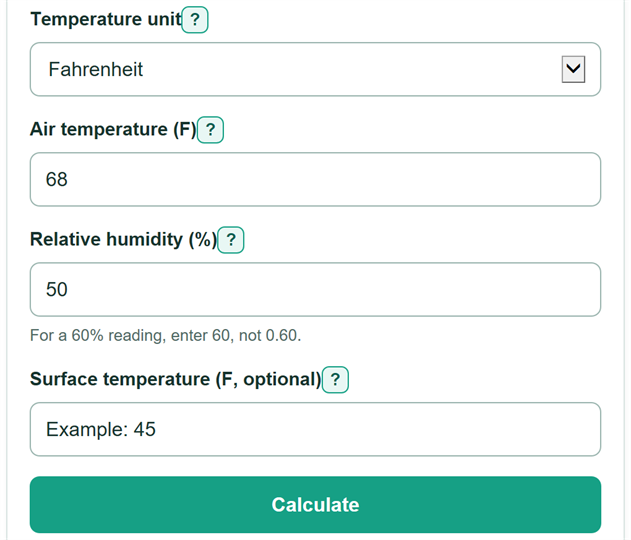
- Choose the temperature unit used by your weather app, thermostat, hygrometer, or sensor.
- Enter the current air temperature and relative humidity. For a reading of 60%, enter 60.
- If you are checking a window, pipe, wall, or other object, enter its measured surface temperature; otherwise leave it blank.
- Select Calculate to see the dew point first, followed by the air-to-dew-point spread and any surface comparison.
- Sanity-check the answer: at 100% relative humidity, dew point should equal air temperature and the air-to-dew-point spread should be zero.
Definitions
Dew point: The temperature at which air reaches saturation. Condensation is possible when a surface is at or below that temperature. [2]
Relative humidity: How close the air is to saturation, stated as a percent. Enter 50 for 50%, not 0.50. [1]
Magnus approximation: A mathematical method that estimates dew point from air temperature and relative humidity.
Air temperature above dew point: Air temperature minus dew point. A smaller positive spread means the air is closer to saturation.
Surface temperature above or below dew point: Measured surface temperature minus calculated dew point. Zero or a negative value means the surface is at or below the dew point.
Common mistakes and quick fixes
Mistake: Entering 0.60 when the humidity reading is 60%.
Fix: Check Temperature unit and then recalculate. Enter 60. This field uses a percent, not a decimal fraction.
Mistake: Switching the temperature unit and assuming the same number now means the new unit.
Fix: Check Temperature unit and then recalculate. The calculator converts entered temperatures when the unit changes. Check that the converted value still matches your source.
Mistake: Entering 0% or more than 100% relative humidity.
Fix: Check Temperature unit and then recalculate. Enter a value greater than 0 and no more than 100. The formula has no finite result at 0%.
Mistake: Treating a negative surface margin as an error.
Fix: Check Temperature unit and then recalculate. A negative margin means the measured surface is below the dew point, so condensation is possible on that surface.
Mistake: Treating a sub-freezing dew point as proof that frost will form.
Fix: Check Temperature unit and then recalculate. Frost also depends on the actual surface temperature, ice formation, airflow, and other local conditions.
Limitations & Key Assumptions / Boundary Conditions
- The result is an estimate from a Magnus approximation, not a calibrated instrument reading.
- Relative humidity must be greater than 0% and no more than 100%. Supersaturated air is outside this calculation.
- The formula models saturation over liquid water. A sub-freezing dew point alone does not determine frost or ice formation.
- The surface check compares one measured surface temperature with the calculated dew point. Surface material, sensor error, airflow, pressure, and local temperature differences can change real conditions.
- Use readings taken at about the same time and place. Outdoor weather data may not describe indoor air or a particular window, pipe, or wall.
Methodology
Calculation method
The calculator converts Fahrenheit input to Celsius for the calculation, then converts the dew point back to the selected unit. Relative humidity is changed from a percent to a fraction by dividing by 100.
TC = (TF - 32) / 1.8
In this formula, TC is temperature in Celsius and TF is temperature in Fahrenheit. The Magnus helper value γ uses ln, the natural logarithm. The calculation uses constants 17.625 and 243.04 degrees C.
γ = ln(RH) + 17.625 * TC / (243.04 + TC)
Dew point in C = 243.04 * γ / (17.625 - γ)
For Fahrenheit output, the calculator uses the reverse temperature conversion.
Dew point in F = dew point in C * 1.8 + 32
Surface comparison
When a surface temperature is entered, the calculator subtracts dew point from that temperature. A positive margin means the surface is warmer than the dew point. A margin of zero or less means condensation is possible.
Surface margin = surface temperature - dew point
Worked example
At 68 F and 50% relative humidity, the calculated dew point is about 48.7 F. The air is about 19.3 F above its dew point. If a measured surface is 45 F, its margin is about -3.7 F, so the surface is at or below the calculated dew point.