
Compare vinyl, fiberglass, and wood window quotes over your planned ownership years, including replacements and optional wood refinishing.
Advanced options
Separate whole-project charges
Replacement timing
Wood repainting or refinishing
The example window-life values are active planning assumptions. Future projects use your entered prices in today's dollars.
Table of contents
How to use our Vinyl vs Fiberglass vs Wood Window Lifetime Cost Calculator
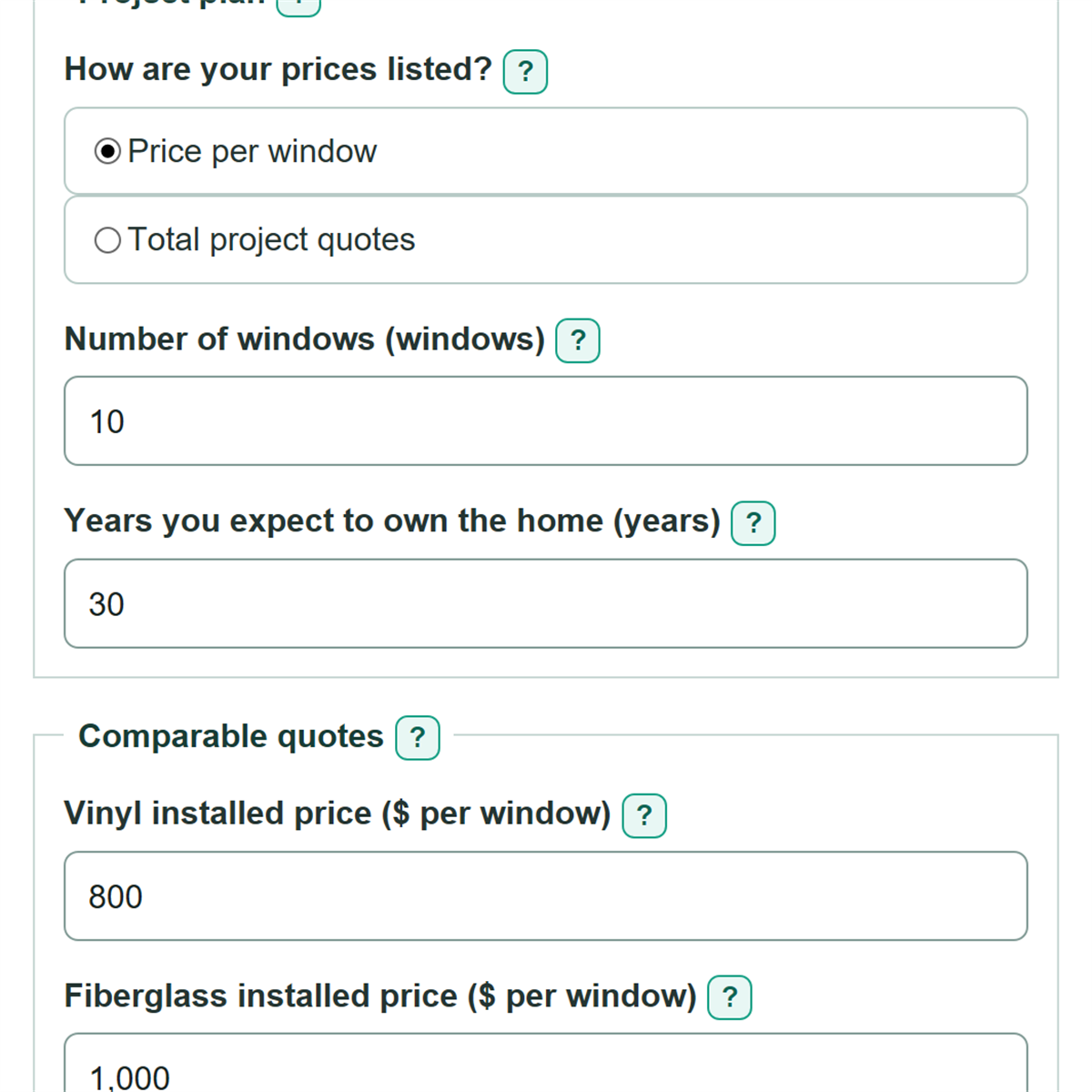
- Choose How are your prices listed? based on your proposals: use Price per window for an installed amount per opening, or Total project quotes for a complete job price.
- Enter the same Number of windows covered by each quote and your Years you expect to own the home.
- Copy each comparable installed amount into Vinyl installed price, Fiberglass installed price, and Wood installed price.
- Open Advanced options to adjust expected window life, add a fixed project charge in per-window mode, or enter a Wood repaint or refinish price and Time between wood maintenance (years).
- Click Calculate, then check that each Initial project cost matches the proposal and that planned replacement projects fit your ownership period.
Definitions
Initial project cost: The cost of the first installation project. In Price per window mode, it is the window price times the Number of windows plus any fixed project charge.
Expected window life: A planning number of years before a replacement project is scheduled. It is not a warranty promise.
Replacement project: A repeat installation counted when a window generation reaches its expected life before the ownership period ends.
Fixed project charge: A charge added once per installation project, such as a permit, mobilization, or repair charge. It is used only with Price per window.
Wood maintenance cycle: One planned repainting or refinishing visit. Its price can be entered per window or for the whole project.
Lifetime cost: The modeled initial installation, scheduled replacement projects, and, for wood, planned maintenance during the Years you expect to own the home.
Common mistakes and quick fixes
Mistake: Entering a whole-job proposal while Price per window is selected under How are your prices listed?.
Fix: Choose Total project quotes, so the amount is not multiplied by Number of windows.
Mistake: Using a Vinyl installed price, Fiberglass installed price, or Wood installed price that covers a different set of windows.
Fix: Compare quotes covering the same openings, or revise the quote amounts and Number of windows so they match.
Mistake: Adding permits or mobilization into a per-window price and again in Vinyl fixed project charge ($), Fiberglass fixed project charge ($), or Wood fixed project charge ($).
Fix: Count each cost once. Use a fixed project charge only for an amount charged once per installation project.
Mistake: Treating Expected wood window life (years) as a guaranteed date for replacement.
Fix: Use it as a planning assumption and replace it with guidance for the quoted product, installation, and exterior exposure.
Mistake: Entering a positive Wood repaint or refinish price without a Time between wood maintenance (years).
Fix: Enter the planned number of years between maintenance visits, or use zero or blank when no recurring work is planned.
Mistake: Writing a price such as 1,01 in Vinyl installed price.
Fix: Use commas only for thousands, such as 1,000, and use a decimal point for cents, such as 1000.50.
Limitations & Key Assumptions / Boundary Conditions
- Results use the prices you enter in today's dollars. Future replacement prices are assumed to be the same as the entered initial price.
- The calculation does not include inflation, financing, energy bills, resale value, taxes, tax credits, repair costs outside entered fixed charges, or disposal costs unless they are already in your quotes.
- Expected vinyl window life (years), Expected fiberglass window life (years), and Expected wood window life (years) are editable planning assumptions. Actual life can differ with product quality, installation, weather exposure, and care.
- Wood maintenance is counted only when Wood repaint or refinish price is greater than zero. Wood-clad and exposed wood products may need different maintenance plans.
- A replacement or maintenance event exactly at the end of the Years you expect to own the home is not counted.
- All three quotes should cover comparable window sizes, styles, glass packages, installation scope, and openings. A lower result does not prove the products have equal performance or features.
Methodology
Project cost
In Price per window mode, each material's initial project cost multiplies its installed price by the Number of windows and adds its own fixed project charge. In Total project quotes mode, the entered price is already the complete initial project cost, so fixed charges are ignored.
initial project cost = (number of windows x installed price) + fixed project charge
For example, 10 windows at $800 each plus a $500 vinyl fixed charge gives an initial vinyl project cost of $8,500.
Replacement timing
The calculator counts a replacement only when the expected life ends before the ownership period ends. A replacement exactly at the endpoint is excluded.
replacement projects = max(0, ceil(ownership years / expected window life) - 1)
For a 30-year ownership period and a 20-year vinyl life, the calculator counts one replacement project. With the $8,500 initial project cost in the example, vinyl installation cost is $17,000 before any other costs.
Wood maintenance
If Wood repaint or refinish price is above zero, the calculator counts maintenance cycles before each wood replacement and in the final years of ownership. The schedule restarts after a replacement. A per-window maintenance price is multiplied by the Number of windows; a whole-project price is used once per cycle.
wood maintenance total = maintenance cycles x maintenance price per cycle
wood lifetime cost = wood installation cost + wood maintenance total
Comparing the quotes
Each lifetime cost includes its initial project and repeat replacement projects. Wood also includes its planned maintenance total. The lowest value is the smallest of the three calculated lifetime costs, and each amount above the lowest is that material's lifetime cost minus the lowest value.
cost above lowest = material lifetime cost - lowest lifetime cost
Calculation assumptions
The model uses undiscounted dollars and repeats each entered installation price for future replacements. It does not model energy savings, because frame material alone is not enough to estimate a home's heating or cooling costs. Enter comparable all-in quotes and adjust service-life and maintenance assumptions to test your own plan.