
Compare spray foam and fiberglass quotes to see the savings needed for spray foam to pay back during your years in the home.
Table of contents
How to use our Spray Foam vs Fiberglass Insulation Lifetime Cost Calculator
- Enter the full quote for Spray foam installed price and Fiberglass installed price, including required preparation, labor, permits, and taxes.
- Enter Estimated spray foam energy savings as the first year's heating and cooling savings compared with fiberglass; exclude fixed utility customer charges.
- Enter Years you expect to own the home, then choose Advanced options only if you want to add area, R-value, yearly savings changes, or a discount rate.
- Click Calculate and compare Spray foam lifetime net advantage with First-year savings needed for spray foam to break even. A positive net advantage means spray foam costs less over your selected period.
- Sanity-check that both quotes cover comparable surfaces and have similar proposal R-values. If the Proposal comparison note appears, confirm the different scope is intentional before choosing.
Definitions
Installed price: The complete one-time project quote, including required labor, materials, preparation, and fees.
R-value: A measure of resistance to heat flow. A higher R-value means more resistance, but recommended levels vary by climate and where insulation is installed. [1]
Upfront price premium: Spray foam installed price minus fiberglass installed price. A negative premium means spray foam starts cheaper.
Energy savings in today's dollars: Future estimated savings converted to a present-dollar value using the yearly change in energy savings and Discount rate.
Discount rate: A percentage used to value future dollars less than dollars available today. A rate of 0% uses a simple dollar comparison.
Break-even: The first full year when accumulated savings in today's dollars equal or exceed spray foam's upfront price premium.
Common mistakes and quick fixes
Mistake: Entering only the material portion of Spray foam installed price or Fiberglass installed price.
Fix: Use each full installed quote, including required labor, removal, access work, barriers, permits, taxes, and minimum charges.
Mistake: Using a whole utility bill as Estimated spray foam energy savings.
Fix: Enter only the estimated difference in heating and cooling usage costs. Leave out fixed utility customer charges and unrelated appliance use.
Mistake: Treating Years you expect to own the home as the insulation's physical life.
Fix: Enter the years you expect to receive the savings, even if that period is shorter than the insulation may last.
Mistake: Comparing Spray foam installed price per sq ft and Fiberglass installed price per sq ft when only one coverage area was entered.
Fix: Enter both Spray foam coverage area and Fiberglass coverage area, using the areas stated in the two proposals.
Mistake: Assuming matching prices mean matching insulation performance.
Fix: Enter both Spray foam proposal R-value and Fiberglass proposal R-value and review the Proposal comparison note if they differ.
Limitations & Key Assumptions / Boundary Conditions
- This is an incremental comparison, not a forecast of the home's complete utility bills. It uses only the Estimated spray foam energy savings entered by the user.
- Actual savings can differ because of weather, energy prices, thermostat settings, HVAC equipment, air leaks, moisture control, installation quality, and how the home is used.
- Compare proposals with care when Spray foam coverage area and Fiberglass coverage area cover different surfaces, such as a roof deck versus an attic floor.
- Different Spray foam proposal R-value and Fiberglass proposal R-value can mean the options do not provide the same resistance to heat flow or solve the same building need.
- Installed prices should include one-time charges. Fixed utility customer charges should not be included in annual energy savings because insulation usually does not change them.
- The calculator treats the entered savings estimate as the difference caused by spray foam relative to fiberglass. It does not estimate resale value, financing payments, repairs, or replacement costs.
Methodology
Calculation method
The calculator starts with the two full installed quotes. It applies the entered first-year energy savings for each ownership year, changes that savings by the Yearly change in energy savings, and discounts each future year's savings when a Discount rate is entered.
premium = spray foam installed price - fiberglass installed price
factor = sum from t = 1 to N of ((1 + g)^(t - 1) / (1 + d)^t)
energy savings in today's dollars = estimated spray foam energy savings * factor
spray foam lifetime net advantage = energy savings in today's dollars - premium
In the factor, N is Years you expect to own the home, g is the yearly savings-change rate as a decimal, d is the discount rate as a decimal, and t is the year number. A positive Spray foam lifetime net advantage means spray foam is lower-cost over the selected ownership period.
first-year savings needed = max(0, premium / factor)
The $0 floor is intentional: when spray foam has the same or lower installed price, no positive energy savings are needed to break even. Break-even is year 0 in that case. Otherwise, the calculator finds the first full year in which accumulated savings in today's dollars reach the premium; it reports that break-even is outside the selected ownership period if it never reaches it.
Worked example
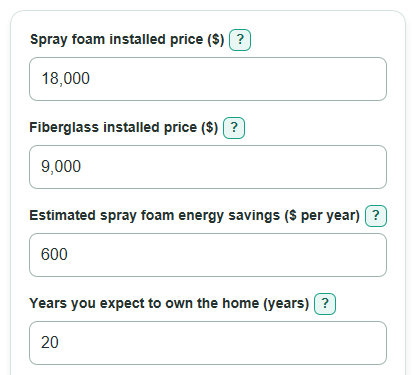
With a spray foam quote of $18,000, a fiberglass quote of $9,000, estimated savings of $600 per year, and 20 ownership years, the premium is $9,000. With both rates at 0%, savings in today's dollars are $12,000, so the lifetime net advantage is $3,000 and break-even occurs in year 15.
$12,000 - $9,000 = $3,000
Spray foam lifetime comparison cost equals its installed price minus the savings in today's dollars. Fiberglass lifetime comparison cost equals its installed price because shared future energy costs are outside this incremental comparison.