
Compare your crawl-space project cost range with estimated yearly savings, recurring moisture-control costs, and simple payback.
Advanced options
Table of contents
How to use our Crawl Space Encapsulation Cost Payback Calculator
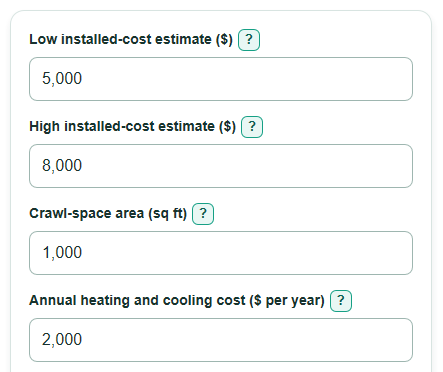
- Enter the low and high complete-project estimates under "Low installed-cost estimate" and "High installed-cost estimate." Make sure both prices cover the same work.
- Enter the crawlable footprint under "Crawl-space area," excluding garages, slab areas, and other spaces that are not above the crawl space.
- Use bills or an energy audit to enter "Annual heating and cooling cost," then adjust "Expected heating and cooling savings" if you have a project-specific estimate.
- Open Advanced options if a dehumidifier or recurring upkeep is planned, and enter its yearly electricity use, electricity price, and maintenance cost.
- Check that "Estimated annual net savings" is positive before using the simple payback figures. Compare the low and high payback values to see how much your quote range changes the estimate.
Definitions
Installed-cost range: Your low-to-high estimate for all one-time project work included in the same scope.
Typical installed cost: The midpoint of your entered low and high installed-cost estimates. It is a comparison point, not a contractor quote.
Gross heating and cooling savings: Estimated yearly heating and air-conditioning savings before subtracting dehumidifier electricity and maintenance.
Recurring moisture-control cost: Yearly dehumidifier electricity plus yearly maintenance entered in the calculator.
Net savings: Gross heating and cooling savings minus recurring moisture-control cost. A negative amount means recurring costs are larger than estimated energy savings.
Simple payback: The installed cost divided by positive yearly net savings. It estimates years to recover the cost without financing, price changes, or other financial effects.
kWh: Kilowatt-hour, a unit of electrical energy used on electric bills and appliance labels.
Common mistakes and quick fixes
Mistake: Using the full house size for "Crawl-space area" even though part of the home is over a garage or slab.
Fix: Enter only the crawlable floor footprint in sq ft.
Mistake: Comparing a basic liner quote in "Low installed-cost estimate" with a quote that includes drainage or repairs in "High installed-cost estimate."
Fix: Make both estimates cover the same project scope before calculating.
Mistake: Entering the whole electric bill as "Annual heating and cooling cost."
Fix: Use only the yearly cost tied to heating and air conditioning, not lights, appliances, or fixed account charges.
Mistake: Treating "Expected heating and cooling savings" as a guaranteed encapsulation result.
Fix: Replace the planning percentage with an energy audit or contractor estimate when one is available.
Mistake: Leaving "Dehumidifier electricity use" at zero when the completed crawl space will use a dehumidifier.
Fix: Enter annual kWh from the unit label or product information, then check the effect on "Estimated annual net savings."
Mistake: Adding a one-time dehumidifier purchase to "Annual moisture-control maintenance."
Fix: Include one-time equipment and installation in the installed-cost estimates; enter only recurring yearly costs in maintenance.
Limitations & Key Assumptions / Boundary Conditions
- This is a planning estimate based on your cost range and savings assumption. It is not a site inspection, moisture diagnosis, engineering assessment, or contractor bid.
- The 15% default is a whole-home air-sealing and insulation planning scenario, not a guaranteed savings rate for crawl-space encapsulation alone. Local climate, fuel type, duct location, insulation, air leaks, and how the home is used can change savings.
- Simple payback assumes yearly net savings stay constant. It excludes financing, taxes, rebates, future utility-price changes, home-value changes, and equipment replacement.
- Enter drainage, mold cleanup, structural repair, sump work, permits, and one-time dehumidifier installation in the installed-cost range only if they are part of the project being compared.
- Dehumidifier and maintenance costs may change with humidity, equipment settings, runtime, and local electricity rates. Sump-pump electricity is not included unless you add it to annual maintenance.
- Cost per sq ft is useful only for projects with similar scope and site conditions. Crawl height, access, standing water, repairs, and liner or insulation choices can make similar-sized projects cost very differently.
Methodology
Calculation method
The calculator takes the middle of your low and high one-time project estimates as the typical installed cost.
typical cost = (low installed cost + high installed cost) / 2
It estimates gross yearly heating and cooling savings from your annual heating and cooling cost and expected savings percentage. The 15% starter percentage is based on ENERGY STAR whole-home air-sealing and insulation guidance, so it should be treated as a replaceable planning input rather than an encapsulation-only promise [1].
gross savings = annual heating and cooling cost x expected savings percentage / 100
Dehumidifier electricity is calculated from yearly kWh and the electricity price. Dividing cents by 100 changes the price to dollars per kWh. The 17.30 cents per kWh starter price is a 2025 U.S. residential average and may differ from your bill [2].
dehumidifier electricity cost = yearly kWh x electricity price in cents per kWh / 100
Yearly maintenance is added to dehumidifier electricity, then subtracted from gross savings. The calculator keeps a negative net result because it means recurring moisture-control costs exceed estimated heating and cooling savings.
net savings = gross savings - (dehumidifier electricity cost + annual maintenance)
Simple payback is calculated only when net savings are above $0. The calculator divides each installed-cost value by net savings, giving a low, typical, and high payback range.
payback years = installed cost / positive annual net savings
Worked example
With a $5,000 to $8,000 cost range, the typical cost is $6,500. If annual heating and cooling cost is $2,000 and expected savings are 15%, gross savings are $300 per year. With no recurring moisture-control cost, typical simple payback is $6,500 divided by $300, or about 21.7 years. If recurring costs are $223 per year, net savings fall to $77 per year and typical simple payback rises to about 84.4 years.
The typical cost per sq ft divides typical installed cost by crawl-space area. This comparison is only meaningful when the project scope and site conditions are similar.
typical cost per sq ft = typical cost / crawl-space area