
Compare inside and outside solid-wall insulation quotes using separate restoration costs, incentives, annual bill savings, and lifetime cost assumptions.
Calculation details
Table of contents
How to use our Interior vs Exterior Wall Insulation Cost Calculator
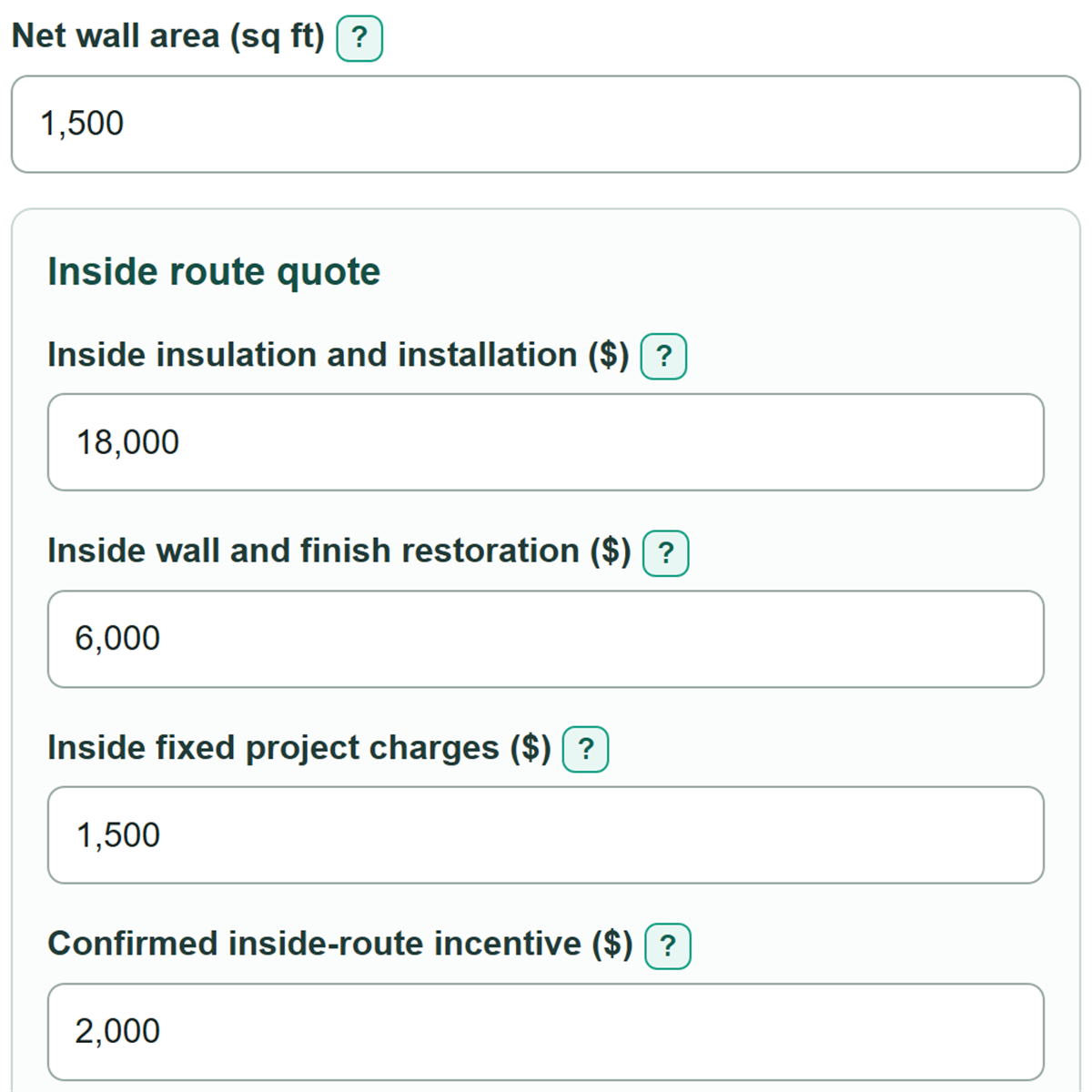
- Enter Net wall area from the quote or measured exterior wall surface, excluding windows and doors.
- Copy each quote into its matching inside or outside cost fields, keeping insulation, restoration, fixed charges, and incentives separate.
- Enter a route-specific estimate in each first-year bill savings field; use a negative value only if that route is expected to raise annual bills.
- Open Advanced options to change Years to compare, the discount rate, or the yearly energy-price increase, then select Calculate.
- Check that the lower-cost route still makes sense after comparing quote scope, especially finish restoration, siding or cladding work, permits, and access costs.
Definitions
Net wall area: Exterior wall surface to be insulated after subtracting windows and doors, measured in square feet.
Restoration: Work needed after insulation access, such as drywall, plaster, paint, siding, cladding, trim, or flashing.
Fixed project charges: Route-specific costs that do not directly scale with wall area, such as permits, mobilization, site protection, or scaffolding setup.
Confirmed incentive: A rebate, grant, or credit expected for that specific route. It reduces the modeled upfront cost and is not annual bill savings.
Discounted lifetime net cost: Net upfront cost minus the present value of estimated future bill savings over the chosen years. A negative value means discounted savings exceed upfront cost.
Simple payback: Net upfront cost divided by first-year bill savings. It does not account for the time value of money or future energy-price changes.
Common mistakes and quick fixes
Mistake: Entering house floor area as Net wall area.
Fix: Use exterior wall surface area minus windows and doors for Net wall area.
Mistake: Putting drywall, paint, or trim work into Inside insulation and installation.
Fix: Put those quote lines in Inside wall and finish restoration so the inside scope stays visible.
Mistake: Putting scaffolding or permit charges into Outside insulation and installation.
Fix: Put charges that do not change with wall area in Outside fixed project charges.
Mistake: Entering a possible rebate as Confirmed outside-route incentive.
Fix: Enter only the amount you expect this route to receive, and keep it no higher than the route's gross project cost.
Mistake: Using the same guess for Inside-route first-year bill savings and Outside-route first-year bill savings.
Fix: Use separate estimates from an assessment, utility program, contractor model, or your stated planning scenario.
Mistake: Treating simple payback as the discounted lifetime answer.
Fix: Use Discounted lifetime cost gap for the main comparison; simple payback ignores later energy-price changes and discounting.
Limitations & Key Assumptions / Boundary Conditions
- This is a quote comparison, not a construction estimate or a building-energy model. It does not calculate savings from R-value, wall layers, climate, air leakage, HVAC equipment, or weather.
- Both routes use the same Years to compare, discount rate, and yearly energy-price increase. Changing these assumptions can change the lower-cost route.
- Annual bill savings are user-entered planning estimates. Actual bills can differ because of occupancy, thermostat settings, fuel prices, weather, installation quality, and other home upgrades.
- The calculation treats a confirmed incentive as an upfront reduction. A credit received later, an incentive with eligibility rules, or financing costs may need separate planning outside this tool.
- A lower financial cost does not mean the routes are equal for moisture control, appearance, disruption, wall performance, permits, or historic-building requirements.
- Simple payback is shown only when net upfront cost is positive and first-year bill savings are positive. It is a rough timing measure, not a full investment return.
Methodology
Cost calculation
For each route, the calculator adds the insulation-and-installation quote, restoration quote, and fixed project charges. It then subtracts the confirmed route-specific incentive. Incentives cannot exceed that route's gross project cost.
net upfront cost = insulation and installation + restoration + fixed project charges - confirmed incentive
It divides each net upfront cost by Net wall area to show a comparable upfront cost per square foot.
net upfront cost per sq ft = net upfront cost / net wall area
Lifetime savings and present value
The entered first-year bill savings grows each later year by the yearly energy-price increase. Each future year's savings is then discounted using the yearly discount rate. The calculator subtracts the resulting savings value from net upfront cost.
growth ratio = (1 + energy-price increase / 100) / (1 + discount rate / 100)
discounted savings factor = years / (1 + discount rate / 100), when the two rates are equal
discounted savings factor = (1 - growth ratio ^ years) / ((discount rate - energy-price increase) / 100), otherwise
discounted lifetime net cost = net upfront cost - first-year bill savings x discounted savings factor
The discounted lifetime cost gap is outside-route discounted lifetime net cost minus inside-route discounted lifetime net cost. A positive gap means the inside route costs less; a negative gap means the outside route costs less.
discounted lifetime cost gap = outside discounted lifetime net cost - inside discounted lifetime net cost
For the undiscounted result, savings still grow by the yearly energy-price increase but are not reduced for the timing of future dollars.
undiscounted savings factor = years, when energy-price increase is 0
undiscounted savings factor = ((1 + energy-price increase / 100) ^ years - 1) / (energy-price increase / 100), otherwise
Worked example
Suppose the inside route has a $23,500 net upfront cost and $1,200 first-year bill savings. Its simple payback is 23,500 divided by 1,200, or about 19.6 years. With a 20-year horizon, a 3% discount rate, and a 2% yearly energy-price increase, the calculator uses discounted savings rather than simply multiplying $1,200 by 20.
simple payback years = net upfront cost / first-year bill savings
Planning assumptions
The editable 20-year default is a planning horizon supported by DOE weatherization evidence on the weighted average life of installed measures. [1] Blank discount and energy-price increase fields are treated as 0%. If first-year savings are zero or negative while upfront cost is positive, the calculator shows no simple payback. Negative lifetime net costs remain negative because they mean modeled savings exceed the route's upfront cost over the selected period.