
Estimate annual savings and simple payback for high heat retention storage heaters using your heating use, electricity rates, costs, and rebates.
Project costs
Advanced options
Table of contents
How to use our High Heat Retention Storage Heater Upgrade Payback Calculator
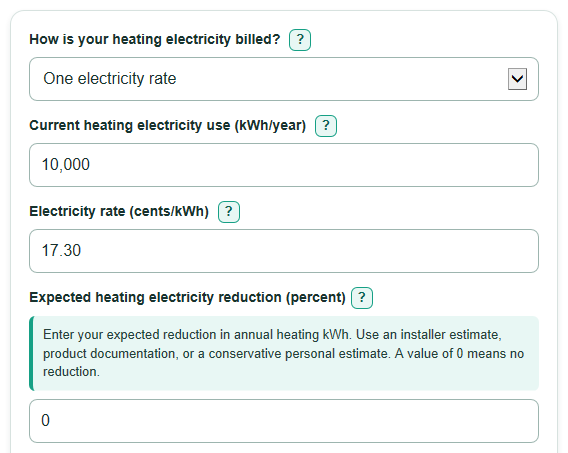
- Choose How is your heating electricity billed? Select one rate unless your bill separates off-peak charging from daytime electricity.
- Enter annual heating use and the matching electricity rate or rates. Use kWh/year, not the heater's kW power rating.
- Enter the expected electricity reduction. With separate rates, enter separate reductions for charging and daytime boost use.
- Enter the high heat retention quote, the ordinary replacement cost you would otherwise pay, and any expected rebates or credits, then select Calculate.
- Sanity-check the results by confirming that the current annual heating cost is close to your bill-based estimate and that a positive savings amount matches a lower upgraded cost.
Definitions
kWh/year: Kilowatt-hours used over one year. This measures electricity use, unlike kW, which is a heater's power at one moment.
Off-peak charging: Electricity used to charge storage heaters during a lower-price time period, often overnight.
Daytime boost use: Electricity used for direct heat outside the charging period, often at a higher rate.
Electricity reduction: The expected percentage drop in electricity use after the upgrade. It is applied to kWh, not directly to the bill.
Net added upfront cost: High heat retention installed cost minus ordinary replacement installed cost and rebates and credits.
Simple payback: The number of years for first-year savings to equal a positive net added upfront cost. It does not include financing or future price changes.
Common mistakes and quick fixes
Mistake: Entering heater capacity in kW as Current heating electricity use.
Fix: Enter annual energy in kWh/year from bills, interval data, or a heating-energy estimate.
Mistake: Using the full bill divided by kWh for Electricity rate when the bill includes fixed charges.
Fix: Use variable supply and delivery charges per kWh, and leave ordinary fixed account charges out.
Mistake: Selecting separate rates but putting all use into Current off-peak charging use.
Fix: Put charging-period kWh in that field and daytime or peak boost kWh in Current daytime boost use.
Mistake: Entering a promised percent saving as Expected daytime boost reduction without checking what it applies to.
Fix: Enter the expected reduction in daytime boost kWh only; use a conservative estimate if the quote does not separate it.
Mistake: Treating High heat retention installed cost as the entire decision cost when a standard replacement is needed anyway.
Fix: Enter the comparable alternative in Ordinary replacement installed cost so the calculator measures the added cost of the upgrade.
Mistake: Adding normal electric customer charges to Avoidable fixed charges.
Fix: Keep it at $0 unless the project actually closes a separate account, meter, or service charge.
Limitations & Key Assumptions / Boundary Conditions
- The calculator estimates usage-dependent heating electricity costs only. It excludes normal fixed electric account charges unless you enter a charge that the project will truly remove.
- Annual savings depend on the reduction percentages you enter. Weather, thermostat settings, room use, insulation, heater controls, and occupant habits can change actual kWh use.
- The projection keeps first-year savings constant for every selected year. It does not model future electricity-rate changes, maintenance, repairs, financing, taxes, or the time value of money.
- A positive payback does not prove that a particular heater will deliver the entered reduction. Use product information, installer estimates, and your own bill history to choose the percentages.
- If current heating shares a household meter, separating heating kWh from other electricity use is an estimate unless you have a dedicated meter or circuit monitor.
- A negative net added upfront cost means the entered rebates and avoided ordinary replacement cost exceed the upgrade quote. The calculator preserves that result rather than changing it to zero.
Methodology
Cost calculation
The calculator multiplies annual heating electricity use by the applicable variable electricity rate. One-rate billing uses one annual kWh total and one cents-per-kWh rate. Separate time periods calculate off-peak charging and daytime boost costs independently, then add them. The 17.30 cents/kWh starting value is a 2025 US residential planning rate; replace it with your bill's variable rate. [1]
current cost = current kWh x rate in cents per kWh / 100
upgraded cost = current kWh x (1 - reduction percent / 100) x rate in cents per kWh / 100
For separate time periods, the calculator applies that cost calculation once to off-peak charging and once to daytime boost use. This shows how much each period contributes to savings.
Payback calculation
First-year heating savings are the current annual heating cost minus the upgraded annual heating cost, plus any avoidable fixed charges entered. The added upfront cost compares the upgrade with the alternative you would otherwise buy.
annual savings = current annual heating cost - upgraded annual heating cost + avoidable fixed charges
net added upfront cost = high heat retention installed cost - ordinary replacement installed cost - rebates and credits
simple payback = net added upfront cost / annual savings
If net added upfront cost is $0 or less, simple payback is shown as 0 years. If it is positive and annual savings are $0 or negative, payback is not reached.
Worked example
With 10,000 kWh/year, a rate of 17.30 cents/kWh, and a 20% expected reduction, current annual heating cost is $1,730 and upgraded annual heating cost is $1,384. That is $346 in first-year savings. If the upgrade costs $6,000, a standard replacement costs $3,000, and rebates are $500, the net added upfront cost is $2,500 and simple payback is about 7.23 years.
net savings over selected years = annual savings x years to compare - net added upfront cost
Calculation choices
The longer-term result holds annual savings constant. It does not claim that electric resistance heaters produce more heat per kWh after an upgrade; the entered reduction represents expected changes in annual electricity use, such as less unwanted heat loss or less daytime boost use.