
Compare the lifetime cost of a storage-tank boiling-water tap with an electric kettle using your kitchen costs and daily use.
Advanced options
Table of contents
How to use our Boiling Water Tap vs Electric Kettle Lifetime Cost Calculator
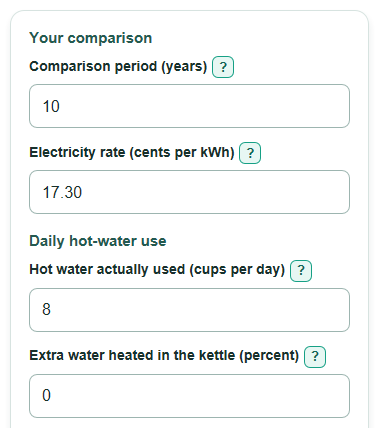
- Enter the Comparison period, your all-in Electricity rate, and the Hot water actually used each day.
- Enter Extra water heated in the kettle to account for water you heat but do not use.
- Add the Tap and tank price, Tap installation cost, and Kettle purchase or replacement price. A zero excludes that cost.
- Open Advanced options to add standby power, filter costs, replacement timing, temperatures, and efficiency values when you have them.
- Calculate, then read the signed tap-minus-kettle cost first. Check that the lifetime totals include realistic purchase and installation amounts before making a decision.
Definitions
Standby power: Electricity a storage-tank tap uses while waiting, even when no water is dispensed.
Useful water: Hot water actually poured into a drink, food, or cookware. It does not include unused kettle water.
Extra water heated in the kettle: The percent of kettle water heated but not used. Heating 5 cups to use 4 cups is 25 percent extra.
Heating efficiency: The share of electricity used for active heating that reaches the water. A lower percent requires more electricity for the same temperature rise.
Temperature rise: The difference between Starting water temperature and the appliance's target or output temperature.
Break-even daily use: The nonnegative number of useful cups per day at which the two modeled lifetime costs are equal.
Common mistakes and quick fixes
Mistake: Entering the tap heating-element wattage as Tap standby power.
Fix: Enter average idle or standby watts from the manual or an energy meter. The full element wattage is not standby power.
Mistake: Including unused kettle water in Hot water actually used.
Fix: Enter only water that is poured and used there, then enter the unused share in Extra water heated in the kettle.
Mistake: Leaving Tap and tank price or Tap installation cost at 0 when a quote is available.
Fix: Enter the equipment price and applicable plumber, electrician, outlet, cabinet, and labor costs separately.
Mistake: Treating a blank Years between kettle purchases as an error.
Fix: Leave it blank to count one kettle for the whole Comparison period; enter a positive interval only if you expect replacements.
Mistake: Setting Tap output temperature or Kettle target temperature at or below Starting water temperature.
Fix: Use a target temperature higher than the starting water temperature so the model has a real heating job to calculate.
Mistake: Reading a negative tap-minus-kettle cost as an error.
Fix: A negative Tap cost minus kettle cost over the comparison period means the tap costs less under the entered assumptions.
Limitations & Key Assumptions / Boundary Conditions
- This model is for a storage-tank boiling-water tap. It does not match a tankless dispenser or a whole-house water heater.
- It uses a 365-day planning year, a water density of 1 kg per liter, and water specific heat of 4.186 kJ per kg degree C. Actual water properties vary slightly with temperature.
- Tap standby power is treated as constant for 24 hours per day. Sleep modes, vacation shutdowns, and changing room conditions can change actual use.
- Active heating is estimated from water volume, temperature rise, and entered efficiency. It is not a manufacturer energy rating or a measured appliance test.
- The tap is assumed not to need replacement during the Comparison period. Each counted kettle is assumed to cost the same entered Kettle purchase or replacement price, with no inflation or repair cost.
- Fixed electric utility customer charges are excluded because they usually do not change between these appliance choices. Use a marginal or all-in bill rate that fits your decision.
- Water use, filter schedules, maintenance, electricity prices, and local boiling temperature can change over time, so treat results as planning estimates.
Methodology
Cost method
The calculator estimates yearly electricity for heating water, then adds recurring costs and upfront purchases over the selected Comparison period. The default Electricity rate of 17.30 cents per kWh is a 2025 US residential planning estimate from EIA data. [1]
water mass per cup = 0.2365882365 L per US cup x 1 kg per L
ΔT in degrees C = (target temperature in degrees F - starting water temperature in degrees F) / 1.8
tap active kWh per year = useful cups per day x water mass per cup x 4.186 x tap ΔT x 365 / (3600 x tap efficiency)
kettle kWh per year = useful cups per day x (1 + extra water percent / 100) x water mass per cup x 4.186 x kettle ΔT x 365 / (3600 x kettle efficiency)
Efficiency is entered as a decimal in the calculation, so 100 percent is 1. The kettle formula applies extra water only to the kettle. Kettle wattage is not used because it mainly changes heating time, while this estimate is based on water amount and temperature rise.
tap standby kWh per year = standby watts x 24 x 365 / 1000
tap operating cost per year = tap annual kWh x electricity rate / 100 + filter cost + other maintenance
kettle operating cost per year = kettle annual kWh x electricity rate / 100
tap lifetime cost = tap and tank price + installation cost + comparison years x tap operating cost per year
kettle lifetime cost = kettle price x kettles counted + comparison years x kettle operating cost per year
tap minus kettle cost = tap lifetime cost - kettle lifetime cost
A positive signed difference means the tap costs more. A negative difference means the tap costs less. If Years between kettle purchases is blank, one kettle is counted. Otherwise, the calculator counts the initial kettle and replacements before the comparison period ends.
Break-even calculation
The calculator separates costs that do not change with daily water use, such as installation, standby electricity, filters, maintenance, and kettle purchases, from the per-cup heating costs. It solves for the useful cups per day where the two lifetime totals match. No numeric break-even is shown if the per-cup cost slopes are equal, electricity is free, or the crossing point would be below zero cups per day.
break-even cups per day = -fixed lifetime cost difference / variable lifetime cost difference per cup per day
Mini-example
If Hot water actually used is 8 cups per day and Extra water heated in the kettle is 25 percent, the kettle heats 10 cups per day. If Tap standby power is 10 watts, standby use alone is 87.6 kWh per year before adding energy used to heat dispensed water.