
Estimate smart radiator valve payback using your heating cost, project quote, expected savings, and basic radiator-system fit.
Payback estimate
Advanced options
Fit and installation costs
Other project costs
This does not include financing, future energy-price changes, or equipment life.
Table of contents
How to use our Smart Thermostatic Radiator Valve Payback Calculator
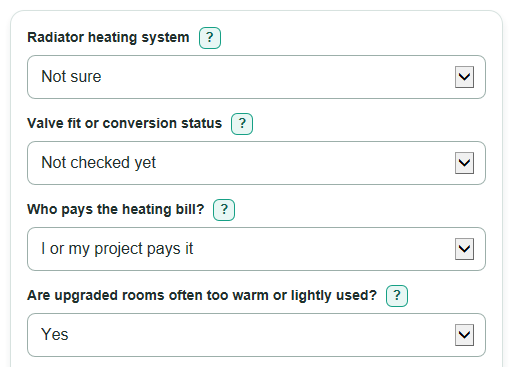
- Choose your Radiator heating system, then select the best known Valve fit or conversion status for the product you plan to buy.
- State Who pays the heating bill? and whether upgraded rooms are often too warm or lightly used.
- Enter only avoidable heating charges in Annual space-heating cost, then enter the radiator count, installed cost, and your expected heating-cost reduction.
- Open Advanced options to add adapter work, extra plumbing labor, a hub, confirmed rebates, and yearly ownership costs when they apply.
- Calculate, then check the Project applicability check before relying on payback. A check-fit or low-applicability result means confirm the system details or lower the savings assumption.
Definitions
Smart thermostatic radiator valve: A control fitted to an individual radiator that can adjust heat for that room. It is different from a wall-mounted smart thermostat.
Hydronic radiator: A hot-water radiator heated by water circulating from a boiler.
One-pipe steam radiator: A steam radiator with one pipe that commonly uses an air vent. Its control method can differ from a standard hot-water valve head.
Base installed cost: The cost per radiator for the valve hardware and basic installation. The starting $140 figure is a historical median installed cost from a 2015 New York one-pipe steam evaluation, not a current national price. [1]
Annual net savings: Estimated heating savings after subtracting yearly costs such as subscriptions, batteries, or service.
Simple payback: The time for annual net savings to equal the net upfront project cost. It does not include financing, energy-price changes, or equipment life.
Common mistakes and quick fixes
Mistake: Entering the full gas or electric bill as Annual space-heating cost.
Fix: Include space-heating fuel and usage-based delivery charges only. Leave out cooling, appliances, and fixed customer charges.
Mistake: Treating Valve fit or conversion status as confirmed before checking the exact valve body and smart valve product.
Fix: Use Not checked yet until a product guide or installer confirms fit, adapters, or valve-body work.
Mistake: Counting every radiator in Radiators receiving smart valves when only some will receive controls.
Fix: Count only radiators included in this purchase or quote.
Mistake: Applying a high Expected heating-cost reduction when rooms are already comfortable and used all day.
Fix: Lower the percentage unless rooms are regularly overheated or can be kept cooler for meaningful periods.
Mistake: Putting an unconfirmed incentive in Confirmed rebates.
Fix: Enter rebates only after checking that the product and building qualify.
Mistake: Forgetting subscription or battery expenses in Recurring valve cost.
Fix: Add yearly required ownership costs so Estimated annual savings after recurring costs is not overstated.
Limitations & Key Assumptions / Boundary Conditions
- The expected heating-cost reduction is your planning assumption, not a product rating or guarantee.
- The estimate applies that percentage to annual space-heating cost only. Cooling, appliances, fixed utility charges, and other non-heating charges are excluded.
- A code 2 applicability check is a basic screening result, not confirmation that a specific smart valve fits every radiator or will work correctly with boiler controls.
- One-pipe steam, uncertain valve fit, adapters, valve-body replacement, and plumbing work may require an installer or product-specific compatibility check.
- If a tenant does not pay the heating bill, building fuel use may change without creating personal utility-bill savings for that tenant.
- Five-year net savings keeps annual savings constant for five years. It does not model fuel-price changes, repairs, battery replacement beyond the entered yearly cost, financing, taxes, or equipment failure.
Methodology
Calculation method
The calculator first screens the setup. It shows low applicability when someone else pays the heating bill or the upgraded rooms are not often too warm or lightly used. It shows check fit when the system is unknown, the system is one-pipe steam, valve fit is not confirmed, or the room opportunity is uncertain. Otherwise, it shows a reasonable calculation setup.
base_upfront_cost = radiators_to_upgrade * base_installed_cost_each
net_upfront_cost = base_upfront_cost + adapters_or_conversions_count * adapter_conversion_cost_each + additional_plumbing_labor + hub_cost - rebates
annual_gross_savings = annual_heating_cost * expected_heating_cost_reduction / 100
annual_net_savings = annual_gross_savings - recurring_valve_cost
simple_payback_years = net_upfront_cost / annual_net_savings
simple_payback_months = simple_payback_years * 12
five_year_net_savings = annual_net_savings * 5 - net_upfront_cost
Worked example
Suppose five radiators cost $120 each to install, extra plumbing labor is $300, a hub costs $100, and a confirmed rebate is $200. Net upfront cost is $800. With a $2,000 annual heating cost, a 12% reduction gives $240 in annual gross savings. After a $20 yearly valve cost, annual net savings is $220. Simple payback is about 3.64 years, or 43.64 months, and 5-year net savings is $300.
Assumptions and limits
Payback is shown only when annual net savings is positive. If yearly ownership costs equal or exceed modeled heating savings, payback is N/A. The historical $140 per-radiator starting value came from a 2015 New York one-pipe steam evaluation and should be replaced with a current product price or quote. [1]