
Estimate yearly AC electricity savings, bill savings, and payback time when comparing your current unit with a higher SEER2 option.
Table of contents
How to use our SEER2 Savings Calculator
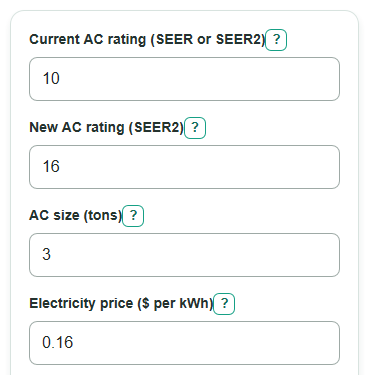
- Enter the Current AC rating (SEER or SEER2) and New AC rating (SEER2) from the unit label, quote, or product paperwork.
- Enter AC size (tons), Electricity price ($ per kWh), and Cooling run time (hours per year). Cooling run time means compressor run hours, not every hour your thermostat is set to cool.
- Open Advanced options if you want payback. Enter Extra upfront cost for higher SEER2 ($), Rebates or credits you expect ($), and Years to add up savings (years).
- Click Calculate and check the main results first: Estimated cooling bill savings per year, Payback time after rebates, and Electricity saved per year.
- Sanity-check the output. If Cooling run time (hours per year) or Electricity price ($ per kWh) is too high or too low, the savings and payback will move by the same kind of amount.
Definitions
SEER2: A seasonal cooling efficiency rating for air conditioners. A higher SEER2 number usually means less electricity for the same cooling output [1].
SEER: An older seasonal efficiency rating. It is close in purpose to SEER2, but the test methods are not identical, so mixed SEER and SEER2 comparisons are estimates.
AC size (tons): The cooling capacity of the air conditioner. One ton is treated as 12,000 Btu per hour in this calculator.
Electricity price ($ per kWh): The price you pay for one kilowatt-hour of electricity. Use the rate from your bill when possible.
Cooling run time (hours per year): The estimated number of hours per year that the AC compressor runs.
Net extra upfront cost after rebates: Extra upfront cost for higher SEER2 ($) minus Rebates or credits you expect ($). It can be negative if rebates are larger than the extra cost entered.
Simple payback: The number of years of estimated bill savings needed to recover the net extra upfront cost.
Common mistakes and quick fixes
Mistake: Using a monthly bill total for Electricity price ($ per kWh).
Fix: Use the $ per kWh rate from your bill; if it says 16 cents per kWh, enter 0.16.
Mistake: Entering thermostat-on hours for Cooling run time (hours per year).
Fix: Enter estimated compressor run hours, since the AC does not run every minute the thermostat is in cooling mode.
Mistake: Putting the full installed price in Extra upfront cost for higher SEER2 ($).
Fix: Enter only the price difference between the higher SEER2 option and the lower-efficiency option.
Mistake: Treating Rebates or credits you expect ($) as guaranteed.
Fix: Enter only rebates or credits you already know you qualify for, or leave it at 0.
Mistake: Reading a negative Estimated cooling bill savings per year as a broken result.
Fix: A negative value means the entered New AC rating (SEER2) costs more to run than the Current AC rating (SEER or SEER2) under your inputs.
Mistake: Comparing Payback time after rebates to a shorter plan than Years to add up savings (years).
Fix: Use a planning period that matches how long you expect to keep the system or home.
Limitations & Key Assumptions / Boundary Conditions
- The calculation estimates cooling electricity only. It does not include repairs, maintenance, financing, installation differences, demand charges, or changes in comfort settings.
- The current and new systems are treated as serving the same cooling load with the same AC size (tons) and Cooling run time (hours per year).
- If Current AC rating (SEER or SEER2) is an older SEER value, the comparison is approximate because SEER and SEER2 test methods are not the same.
- Actual savings can differ if duct leakage, sizing, thermostat habits, humidity control, shading, or weather changes after replacement.
- Payback time after rebates is a simple payback. It does not discount future money, assume electricity price increases, or include tax effects.
- Rebates or credits you expect ($) are user-entered only. The calculator does not check program rules, dates, equipment eligibility, or tax eligibility.
Methodology
Calculation steps
The calculator first converts AC size from tons to cooling capacity in Btu per hour.
capacity_btu_per_hour = system_size_tons * 12000
It then estimates yearly electricity use for each system from capacity, run time, and the entered seasonal rating.
annual_kwh = capacity_btu_per_hour * cooling_hours / (rating * 1000)
Yearly cooling cost is estimated by multiplying yearly kWh by the electricity price.
annual_cost = annual_kwh * electricity_rate
The main savings outputs compare the current AC to the new AC. Signed results are kept, so a negative savings value means the new setup uses more electricity or costs more under the entered numbers.
annual_dollar_savings = old_annual_cost - new_annual_cost
annual_kwh_saved = old_annual_kwh - new_annual_kwh
percent_cost_reduction = annual_dollar_savings / old_annual_cost * 100
The buying-decision outputs subtract known rebates from the extra upgrade cost, then compare that net upfront amount with the yearly bill savings.
net_extra_upfront = extra_upgrade_cost - rebate_credit
simple_payback_years = net_extra_upfront / annual_dollar_savings
planning_net_savings = annual_dollar_savings * planning_years - net_extra_upfront
If annual_dollar_savings is positive and net_extra_upfront is zero or negative, payback is shown as 0 years. If annual_dollar_savings is zero or negative and net_extra_upfront is positive, payback is shown as N/A instead of infinity.
Mini-example
For a 3-ton system, the cooling capacity is 3 * 12,000 = 36,000 Btu per hour. With 1,200 cooling hours per year, a current rating of 10, a new SEER2 rating of 16, and an electricity price of $0.16 per kWh, the current AC uses 4,320 kWh per year and costs $691.20 per year. The new AC uses 2,700 kWh per year and costs $432.00 per year. The estimated cooling bill savings are $259.20 per year, with 1,620 kWh saved per year and a 37.5% cooling bill cut. If the higher SEER2 option costs $3,000 extra and rebates are $1,000, net extra upfront cost is $2,000. Simple payback is about 7.72 years, and net savings over 10 years are $592.