
Estimate one-cycle credit card interest or a fixed-payment payoff plan using your balance, APR, and payment amount.
Table of contents
How to use our Credit Card Interest Calculator
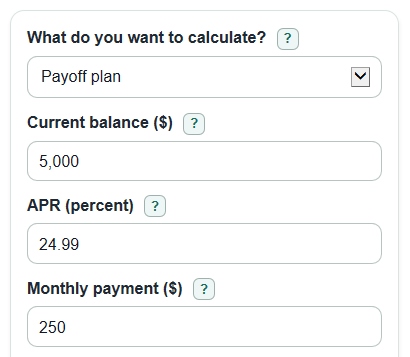
- Choose What do you want to calculate?: Payoff plan for months and total interest, or One-month interest for a single billing-cycle charge.
- Enter the balance fields that match the mode: Current balance ($) for payoff, or Average daily balance ($) for one-cycle interest.
- Enter APR (percent), then add Monthly payment ($) for payoff or Billing cycle length (days) for one-month interest.
- Open Advanced options only if you need to match a statement more closely with Days in interest year, Extra payment now ($), or Average month length for payoff (days).
- Check the results for sense: if First month interest is close to Monthly payment ($), most of the payment is not lowering the balance.
Definitions
APR (percent): The annual percentage rate. It is the yearly interest rate for the card, not the monthly rate.
Average daily balance ($): The average balance across the billing cycle. Credit card interest estimates often use this balance because purchases, payments, and credits can happen on different days.
Billing cycle length (days): The number of days in the statement period used for the one-month interest estimate.
Daily interest rate: APR divided by Days in interest year. The calculator shows it as a percent per day.
Current balance ($): The card balance the payoff plan starts from, before any Extra payment now ($).
First payment that lowers the balance: The part of the first regular payment left after First month interest is covered.
Total paid: The payoff starting balance plus Total interest paid. It does not include Extra payment now ($).
Common mistakes and quick fixes
Mistake: Entering a monthly interest rate in APR (percent).
Fix: Enter the yearly card rate in APR (percent), such as 24.99 for 24.99% APR.
Mistake: Using Current balance ($) as Average daily balance ($) when the balance changed a lot during the cycle.
Fix: Use the Average daily balance ($) from your statement, or estimate the average of your daily balances.
Mistake: Including future purchases in Current balance ($).
Fix: Use the balance you want the payoff plan to pay down, before new spending.
Mistake: Putting the minimum due in Monthly payment ($) when you plan to pay more.
Fix: Enter the regular amount you actually expect to pay each month in Monthly payment ($).
Mistake: Leaving Billing cycle length (days) at 30 when your statement has a different cycle length.
Fix: Use the day count shown on your statement if you are checking a real Estimated interest charge.
Mistake: Adding Extra payment now ($) and also subtracting it from Current balance ($).
Fix: Either lower Current balance ($) yourself or enter the extra amount in Extra payment now ($), but do not do both.
Limitations & Key Assumptions / Boundary Conditions
- This is an estimate. Your issuer's exact method can differ by purchase APR, cash advance APR, fees, timing rules, grace period status, and rounding.
- The one-month interest mode uses Average daily balance ($), APR (percent), Billing cycle length (days), and Days in interest year. It does not rebuild every daily transaction.
- The payoff plan assumes no new purchases, no fees, no rate changes, and the same Monthly payment ($) each month until the final smaller payment.
- The payoff plan adds interest before each regular monthly payment, using Daily interest rate times Average month length for payoff (days). It does not compound inside the month.
- If Monthly payment ($) is too small to cover the first month's interest when APR is above 0, the calculator should not give a payoff month because the balance would not go down.
- Paying the full statement balance by the due date may avoid purchase interest when a grace period applies, so a real bill can be lower than this estimate.
Methodology
Daily rate
The calculator first turns APR into a daily rate. APR is entered as a percent, so it is divided by 100 before the daily-rate step.
daily_rate = (apr_percent / 100) / days_per_year
The displayed Daily interest rate is daily_rate * 100, shown as percent per day.
One-month interest
For One-month interest, the calculator multiplies Average daily balance ($) by the daily rate and the number of days in the billing cycle.
interest_charge = average_daily_balance * daily_rate * billing_cycle_days
Mini-example:
with Average daily balance ($) of 1,000, APR (percent) of 24, Billing cycle length (days) of 30, and 365 Days in interest year, the daily rate is 0.24 / 365 = 0.000657534. The estimated interest charge is 1000 * 0.000657534 * 30 = $19.73.
Payoff plan
The payoff plan starts by subtracting Extra payment now ($) from Current balance ($). If that result is zero or less, the payoff is immediate and interest is $0.
payoff_start_balance = current_balance - one_time_payment_now
Then the calculator converts the daily rate to a simple monthly estimate using Average month length for payoff (days).
monthly_rate = daily_rate * average_days_per_month
Each month, interest is added first. Then the regular Monthly payment ($) is applied. The final payment can be smaller than the planned payment.
interest_m = balance_m * monthly_rate
amount_due_m = balance_m + interest_m
payment_m = min(monthly_payment, amount_due_m)
balance_next = amount_due_m - payment_m
total_interest = total_interest + interest_m
Total paid is the payoff starting balance plus the interest found in the loop.
total_paid = payoff_start_balance + total_interest
Mini-example: with Current balance ($) of 5,000, APR (percent) of 24, Monthly payment ($) of 250, no Extra payment now ($), 365 Days in interest year, and 30.4375 Average month length for payoff (days), the first month interest is $100.07. The first payment lowers the balance by $149.93, and the loop pays off the balance in 26 months with about $1,450.75 in total interest.
Sources
- How does my credit card company calculate the amount of interest I owe? | Consumer Financial Protection Bureau - Consumerfinance
- What is a grace period for a credit card? | Consumer Financial Protection Bureau - Consumerfinance
- Credit card contract definitions | Consumer Financial Protection Bureau - Consumerfinance