
Enter your debts, monthly budget, and payoff order to estimate your debt-free month and interest cost.
Advanced options
Table of contents
How to use our Debt Free Date Calculator
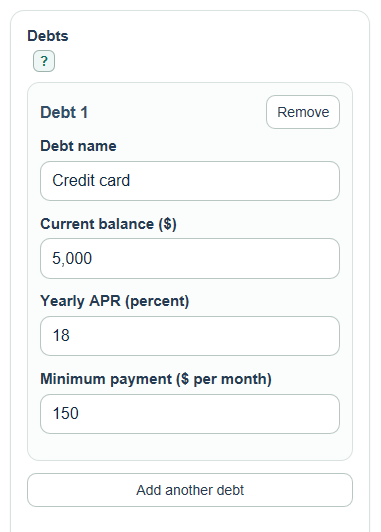
- Add each item under Debts with its current balance, APR, and minimum payment.
- Enter your Monthly debt budget ($), choose Pay extra toward, and check that Plan start date is the month you want to begin.
- Open Advanced options only if you have a One-time extra payment this month ($) or want to change Interest timing.
- Click Calculate, then read Debt-free date, Interest paid from now on, and First debt paid off before the comparison numbers.
- Sanity-check the result: Budget above minimums should match your real budget, and a very long Minimums-only time may mean one minimum payment is barely covering interest.
Definitions
Debts: The list of balances included in this payoff plan, with each balance, APR, and minimum payment.
APR: The yearly interest rate, shown as a percent. The monthly estimate divides APR by 12.
Minimum payment: The least required monthly payment for one debt. The calculator pays these first before sending extra money to the target debt.
Monthly debt budget ($): The total amount you plan to pay each month toward all debts in the list.
Budget above minimums: Monthly debt budget ($) minus the total listed minimum payments. A negative value means your budget is short.
Highest APR first: Also called the avalanche method, this targets the active debt with the highest interest rate first and often lowers interest cost [2].
Smallest balance first: Also called the snowball method, this targets the active debt with the smallest balance first for an earlier payoff milestone [3].
Interest timing: The choice between a simple monthly APR estimate and a daily compounding estimate based on the days in each plan month.
Common mistakes and quick fixes
Mistake: Leaving APR blank in Debts because the rate is 0%.
Fix: Enter 0 in the APR part of Debts if the debt has no yearly interest rate.
Mistake: Entering Monthly debt budget ($) below the total minimum payments and expecting a normal Debt-free date.
Fix: Raise Monthly debt budget ($) or use the Plan note to see the shortfall.
Mistake: Adding a debt to Debts that you will keep paying outside this plan.
Fix: Include only debts that the Monthly debt budget ($) will cover.
Mistake: Choosing Pay extra toward by habit without checking your goal.
Fix: Use Highest APR first to target interest cost, or Smallest balance first if First debt paid off matters more to you.
Mistake: Putting a recurring extra amount into One-time extra payment this month ($).
Fix: Add recurring extra money to Monthly debt budget ($) instead, and use One-time extra payment this month ($) only for a first-month lump sum.
Mistake: Comparing Interest paid from now on to lifetime interest already paid.
Fix: Read Interest paid from now on as future interest starting at Plan start date.
Limitations & Key Assumptions / Boundary Conditions
- The calculator uses the balances, APRs, and minimum payments you enter. It does not pull live account data or update for new charges.
- Credit card issuers may use average daily balance rules, grace periods, fees, promotional rates, or payment allocation rules that differ from this simplified model.
- The minimums-only comparison pays each debt by its own listed minimum payment and does not roll paid-off minimums to other debts.
- If a debt's payment does not cover its interest, or the plan cannot finish within 1200 months, the calculator should show a no-payoff message instead of a normal date.
- The final month payment is capped at the remaining balance after interest, so total paid can be less than a full monthly budget in the last month.
- Daily estimate uses 365 days per year and the number of days in each plan month. Real lenders may use different daily balance details.
- Results are estimates for planning. Late fees, skipped payments, balance transfers, new purchases, or changed minimum payments can move the debt-free date.
Methodology
How the payoff plan is simulated
The calculator runs one month at a time. For each active debt, it adds interest, makes the listed minimum payment when possible, and sends any remaining Monthly debt budget ($) to the target debt chosen by Pay extra toward. If that target is paid off during the month, unused money rolls to the next target in the same month.
monthly_rate = apr_percent / 100 / 12
monthly_interest = balance * monthly_rate
When Interest timing is Daily estimate, the calculator compounds a daily rate over the number of days in the plan month. The CFPB explains that credit card interest is commonly based on daily balance methods, but exact issuer rules can differ [1].
daily_interest = balance * ((1 + apr_percent / 100 / 365) ^ days_in_month - 1)
new_balance = old_balance + interest - payment_to_that_debt
Payoff order
For Highest APR first, active debts are sorted by highest APR, then lowest balance, then input order. For Smallest balance first, active debts are sorted by lowest balance, then highest APR, then input order. Entered order follows the order in Debts. The target order is checked again each month after balances change.
Totals and comparisons
Interest paid from now on is the sum of interest added during the simulation. Total paid from now on is the actual amount paid across all months, including the smaller final payment.
total_interest = sum(interest_added_each_month)
total_paid = starting_total_balance + total_interest
The minimums-only comparison simulates each debt separately using its own listed minimum payment. Paid-off minimum payments are not moved to other debts in that comparison.
minimums_only_months = max(payoff_months_for_each_debt_using_its_min_payment)
minimums_only_interest = sum(interest_for_each_debt_using_its_min_payment)
months_saved_vs_minimums = minimums_only_payoff_months - payoff_months
interest_saved_vs_minimums = minimums_only_interest - total_interest
Mini-example
Suppose Debts has one credit card with a $5,000 balance, 18% APR, and a $150 minimum payment. With Monthly debt budget ($) set to $200 and Interest timing set to Monthly estimate, the monthly rate is 18 / 100 / 12 = 0.015, or 1.5%. The first month's interest is $5,000 * 0.015 = $75. The calculator adds the $75, applies a $200 payment, and the balance becomes $4,875 before the next month. Repeating that process gives the debt-free month, Time to debt free, and future interest estimate.