
Estimate your roof de-icing cable's power use and added electricity cost for a day, 30 active days, or a custom period.
Table of contents
How to use our Roof De-Icing Cable Electricity Cost Calculator
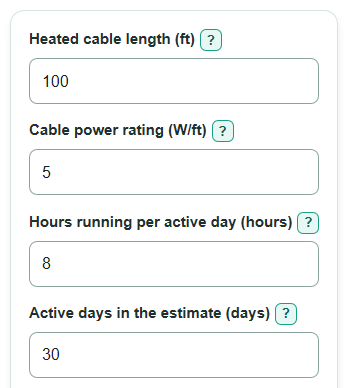
- Enter the full Heated cable length, including roof zigzags, valleys, gutters, and downspouts that receive power.
- Copy the Cable power rating from the exact cable label, package, or manual.
- Enter Hours running per active day and Active days in the estimate based on a controller schedule, smart plug history, or your plan.
- Replace the starter Electricity rate with your bill's per-kWh supply and usage-based delivery charges, then select Calculate.
- Sanity-check the result: more cable, more running hours, or more active days should increase both electricity used and estimated cost.
Definitions
Heated cable length: The total length of cable that can be energized, measured in feet. It can include roof zigzags, valleys, gutters, and downspouts.
Cable power rating: The electrical power the cable is rated to draw per foot, measured in watts per foot (W/ft).
Watt (W): A measure of electrical power at a moment in time. The estimated cable power draw is the load while the cable is on.
Kilowatt-hour (kWh): A measure of electricity used over time. Electric utilities generally bill energy in kWh. [2]
Active day: A day when the cable receives power for the entered number of hours.
Electricity rate: The variable charge per kWh that applies to added usage, usually supply charges plus usage-based delivery charges.
Common mistakes and quick fixes
Mistake: Entering only the roof-edge width as Heated cable length.
Fix: Add every energized section, including zigzags, valleys, gutters, and downspouts.
Mistake: Guessing the Cable power rating from another cable product.
Fix: Use the W/ft rating on the label or manual for your exact cable.
Mistake: Treating every snowy or cold hour as Hours running per active day.
Fix: Count only the hours when the cable actually receives power.
Mistake: Counting all winter days as Active days in the estimate when the cable is off on many days.
Fix: Enter only days when the cable is expected to be energized.
Mistake: Typing 18.11 in Electricity rate for 18.11 cents per kWh.
Fix: This field uses dollars per kWh, so enter 0.1811.
Mistake: Adding a fixed monthly customer charge to Electricity rate.
Fix: Use supply and usage-based delivery charges that rise when you use more kWh; leave out fixed charges.
Limitations & Key Assumptions / Boundary Conditions
- The calculation assumes the entered cable power rating applies across the full Heated cable length while energized.
- It assumes the same Hours running per active day for every Active day in the estimate.
- Self-regulating cable can draw less than its listed maximum under some conditions, so label-based energy use is an estimate.
- The Electricity rate should be your marginal per-kWh charge. Time-of-use rates, tiers, demand charges, and bill credits can make actual cost differ.
- Fixed customer charges, cable purchase, controllers, clips, circuit work, and installation labor are not included.
- Estimated cable power draw is not circuit-sizing advice and does not prove that a breaker, wiring, or existing circuit is suitable.
Methodology
Calculation method
The calculator first finds the cable load from its energized length and label rating. It then converts watts to kilowatts, multiplies by energized hours, and applies the entered electricity rate.
cable_load = heated_length * watts_per_foot
daily_energy = (cable_load / 1000) * hours_per_day
period_energy = daily_energy * active_days
period_cost = period_energy * electricity_rate
daily_cost = daily_energy * electricity_rate
thirty_day_cost = daily_cost * 30
Worked example
For 100 ft of cable rated at 5 W/ft, the estimated load is 500 W. If it runs 8 hours on an active day, it uses 4 kWh per active day. At $0.1811 per kWh, one active day costs about $0.72, and 30 active days cost about $21.73.
Rate and assumptions
The 1,000 watts per kilowatt conversion changes cable load into kilowatts for the kWh calculation. The starter electricity rate of $0.1811 per kWh is a US residential planning average for 2026 year-to-date through May; replace it with the variable per-kWh charges on your own bill. [1] Fixed monthly charges are excluded because cable operation usually does not change them. The 30-day figure means 30 active days at the entered daily runtime, not necessarily 30 calendar days.