
Estimate annual savings and simple payback for a home wind quote using your expected production, electric rate, costs, and incentives.
Advanced options
Compare with household use
How turbine energy is valued
Cost adjustments
Table of contents
How to use our Home Wind Turbine Payback Calculator
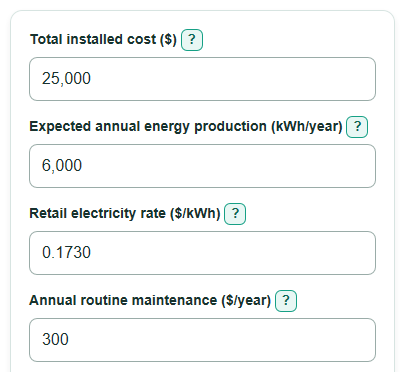
- Enter the full Total installed cost from the quote, including the tower, foundation, permits, wiring, and labor.
- Enter Expected annual energy production from a site-specific installer estimate, not the turbine's rated kW.
- Replace the default Retail electricity rate with avoidable per-kWh charges from your utility bill, then enter Annual routine maintenance and Expected system life.
- Open Advanced options if you know household use, the share used at home, export credit, confirmed incentives, or a yearly repair reserve.
- Check whether Payback within selected system life says yes, and compare annual production with your annual household use before relying on the savings estimate.
Definitions
Expected annual energy production: Estimated turbine electricity over one year, measured in kilowatt-hours per year (kWh/year). It depends on the wind at the turbine's hub height and the site.
Retail electricity rate: The per-kWh charge avoided when the home uses turbine electricity instead of buying it from the utility.
Export credit rate: The per-kWh payment or bill credit for turbine electricity sent to the grid. It can be lower than the retail electricity rate.
Turbine energy used by the home: The percent of annual turbine output used at the home when generated. The remaining output is treated as exported.
Simple payback: The time for annual net savings to recover the upfront cost after confirmed incentives. It does not account for loan interest or the time value of money.
Annual turbine generation gap: Turbine production minus annual household electricity use. A negative gap means the turbine produces fewer kWh than the home uses over a year.
Common mistakes and quick fixes
Mistake: Entering turbine rated power in kW as Expected annual energy production.
Fix: Enter annual energy in kWh/year from a site-specific estimate for the planned hub height and property.
Mistake: Using the whole electric bill divided by kWh for Retail electricity rate, including fixed customer charges.
Fix: Use only avoidable per-kWh supply and delivery charges unless your utility confirms a fixed charge will disappear.
Mistake: Treating all turbine production as home use when some electricity will be sent to the grid.
Fix: Set Turbine energy used by the home and enter the utility's Export credit rate for the rest.
Mistake: Leaving out inspections, insurance, or likely service from Annual routine maintenance.
Fix: Include recurring yearly costs and use Annual repair reserve for a separate allowance for uncertain repairs.
Mistake: Counting possible rebates as Confirmed upfront incentives before eligibility or timing is known.
Fix: Enter only dollar amounts you expect to receive under confirmed program rules.
Mistake: Reading a 100% Annual turbine production as a share of home use as complete independence from the grid.
Fix: Treat it as an annual kWh comparison; generation and home demand may occur at different times.
Limitations & Key Assumptions / Boundary Conditions
- This is a simple, undiscounted estimate. It excludes financing interest, taxes, inflation, electricity-price changes, and the time value of money.
- Results are only as reliable as the entered annual production estimate. Wind varies by location, hub height, terrain, trees, buildings, and turbine performance.
- The calculation values self-used and exported electricity at the rates entered. Time-of-use pricing, demand charges, minimum bills, tiered rates, and changing utility rules can change actual bill savings.
- Fixed monthly utility customer charges usually remain and should not be included in the retail per-kWh rate unless the tariff says they are avoided.
- Annual household-use comparison is a yearly kWh comparison. It does not show whether wind generation occurs when the home needs electricity.
- Major replacements, downtime, insurance changes, and unentered repair costs can make actual payback longer or reduce lifetime net benefit.
Methodology
Calculation method
The calculator starts with the full installed quote and subtracts only confirmed upfront incentives. It then values turbine electricity used by the home at the retail rate and exported electricity at the export credit rate. The default retail rate of $0.1730 per kWh is a 2025 US planning average; replace it with local avoidable per-kWh charges. [1]
net_upfront_cost = installed_cost - upfront_incentive
self_used_kwh = annual_production * self_use_percent / 100
exported_kwh = annual_production - self_used_kwh
annual_energy_value = self_used_kwh * retail_rate + exported_kwh * export_rate
annual_net_savings = annual_energy_value - annual_maintenance - repair_reserve
payback_years = net_upfront_cost / annual_net_savings
Payback is calculated only when annual net savings are greater than zero. If savings are zero or negative, the calculator reports no payback under the entered assumptions. A payback longer than Expected system life is shown as not occurring within that selected life.
annual_home_share_percent = annual_production / annual_home_use * 100
annual_generation_gap = annual_production - annual_home_use
lifetime_net_benefit = annual_net_savings * project_life - net_upfront_cost
Worked example
With $25,000 installed cost, 6,000 kWh/year production, a $0.1730/kWh retail rate, 60% used by the home, a $0.05/kWh export credit, and $300/year maintenance, annual electricity value is $742.80 and annual net savings are $442.80. Simple payback is about 56.46 years before any incentive. If annual household use is 10,000 kWh, turbine production equals 60% of annual use and the generation gap is -4,000 kWh/year.
Scope of the estimate
This method uses annual totals, not hour-by-hour generation and usage. A site-specific annual production estimate is more useful than rated turbine power alone because wind resources vary with location and measurement height. [2] The lifetime net benefit is annual net savings times system life minus net upfront cost, so it remains a simple planning screen rather than a full financial forecast.