
Estimate your septic aerator's electricity use and energy-only cost for your bill period and a full year.
Advanced options
Effluent pump
Control or alarm panel
Energy-only cost for the aerator alone. Fixed customer charges and optional equipment are excluded.
Includes the aerator plus any pump and panel values entered above.
Assumes the entered daily run times and electricity rate stay the same for 365 days.
This is the aerator plus any optional septic loads.
Uses 365 days and does not depend on the bill-period length.
Other household electricity use is not included.
Fixed customer charges are not added.
Table of contents
How to use our Septic Aerator Electricity Cost Calculator
- Find the aerator's watts on its label, manual, service record, or a compatible energy meter, then enter it in Aerator power draw.
- Enter Aerator run time in hours per day. Use 24 only if the aerator runs continuously.
- Copy the exact number of service days from your bill into Electric bill period, then enter the usage-based Electricity usage rate in cents per kWh.
- If you want a full septic equipment estimate, open Advanced options and add the Effluent pump power draw and run time or the Control or alarm panel power draw and run time.
- Check that Aerator electricity use for this bill period is reasonable for the entered watts, daily hours, and days before using the cost estimate.
Definitions
Watt (W): A measure of power, or how quickly equipment uses electricity.
Kilowatt-hour (kWh): A measure of electrical energy billed by the utility. One kWh equals 1,000 watt-hours.
Run time: The average number of hours a device operates each day. It can differ from 24 hours if a controller cycles the device.
Energy-only cost: The electricity-use charge estimated from kWh times the entered cents-per-kWh rate. It excludes fixed customer charges.
Effluent pump: A pump that moves treated wastewater. Its power draw and run time may differ from the aerator.
Control or alarm panel: Electrical equipment that controls or monitors the septic system and may use electricity separately from the aerator.
Common mistakes and quick fixes
Mistake: Entering 100 into Aerator power draw because the aerator uses 100 kWh, not because its label says 100 watts.
Fix: Enter the equipment's power in watts in Aerator power draw. The calculator turns watts and run time into kWh.
Mistake: Entering 24 for Aerator run time when the controller cycles the aerator.
Fix: Check the controller, manual, installer, or observed schedule and enter the average hours per day.
Mistake: Using 30 for Electric bill period when the bill covers 28, 31, or another number of days.
Fix: Use the service-day count printed on that electric bill.
Mistake: Adding a fixed monthly customer charge to Electricity usage rate.
Fix: Enter only applicable usage-based cents-per-kWh charges. Fixed account charges usually do not rise because the aerator operates.
Mistake: Giving Effluent pump power draw the same daily schedule as the aerator without checking it.
Fix: Enter the pump's own average run time, or leave both pump fields at 0 to exclude it.
Mistake: Treating Combined septic electricity cost for this bill period as the aerator-only cost after adding optional equipment.
Fix: Use Aerator electricity cost for this bill period for the aerator alone and the combined cost only for all included loads.
Limitations & Key Assumptions / Boundary Conditions
- This is an energy-only estimate. It excludes fixed customer charges because those charges usually do not change when the aerator runs.
- The result is only as accurate as Aerator power draw and Aerator run time. A nameplate watt rating can differ from measured average power, and controller schedules can change.
- The annual estimates use 365 days and assume the entered daily run times and Electricity usage rate stay unchanged all year.
- Tiered prices, time-of-use prices, taxes, fuel adjustments, and separate delivery charges can make the actual bill impact differ from one entered cents-per-kWh rate.
- Optional pump and panel estimates require their own power and runtime. Entering 0 excludes that load; do not reuse the aerator schedule unless it truly matches.
- This calculator estimates electricity use and cost only. It does not assess septic system performance, maintenance needs, or electrical safety.
Methodology
Calculation method
The calculator first finds daily electricity use for each included device. It divides watt-hours by 1,000 to convert them to kilowatt-hours.
aerator daily kWh = aerator watts x aerator hours per day / 1000
pump daily kWh = pump watts x pump hours per day / 1000
panel daily kWh = panel watts x panel hours per day / 1000
The aerator bill-period kWh uses only the aerator. Combined kWh adds the aerator and any optional pump or panel before multiplying by the entered bill days.
aerator bill-period kWh = aerator daily kWh x bill days
combined bill-period kWh = (aerator + pump + panel daily kWh) x bill days
Cost is calculated from unrounded kWh and the entered rate in cents per kWh. Dividing by 100 changes cents to dollars. Displayed money is rounded to the nearest cent.
bill-period cost = bill-period kWh x electricity rate in cents per kWh / 100
annual cost = daily kWh x 365 x electricity rate in cents per kWh / 100
Worked example
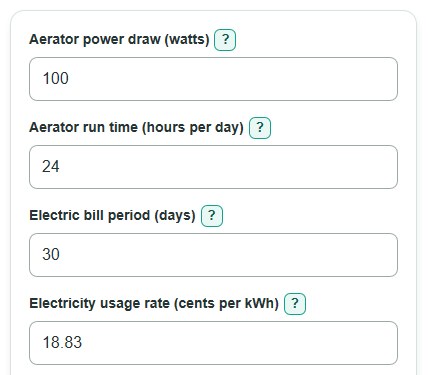
With a 100-watt aerator running 24 hours per day for 30 bill days, daily use is 2.4 kWh and bill-period use is 72 kWh. At 18.83 cents per kWh, the estimated aerator electricity cost for that bill period is $13.56. The default rate is a US residential planning estimate from EIA [1]; replace it with the applicable usage-based rate from your own bill.
Calculation boundaries
A pump or panel contributes only when its own watts and daily run time are entered above zero. The calculation does not allocate fixed monthly service charges. It also uses one effective electricity rate, so a bill with changing prices by time, usage tier, or season may differ from this estimate.