
Estimate how much a dehumidifier adds to your electric bill, with optional cycling for humidistat or timer use.
Advanced options
Table of contents
How to use our Dehumidifier Electricity Cost Calculator
- Enter Dehumidifier power (watts) from the label, manual, or product page.
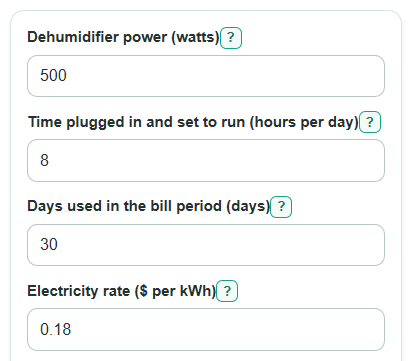
- Enter Time plugged in and set to run (hours per day), Days used in the bill period (days), and your Electricity rate ($ per kWh) from your bill.
- Open Advanced options if the unit cycles on and off, uses standby power, or runs only part of the year.
- Select Calculate, then read Cost for this bill period first and use Electricity used in this bill period to compare with your total bill kWh.
- Sanity-check the result: if the dehumidifier is set for 24 hours per day at 100 percent running time, Average power across a full day should be close to the watts you entered.
Definitions
Watt: A measure of how fast the dehumidifier uses electric power at a moment in time.
kWh: Kilowatt-hour. This is the amount of electricity used when 1,000 watts runs for 1 hour.
Electricity rate ($ per kWh): The price you pay for each kWh. Your full bill rate may include supply, delivery, and other per-kWh charges.
Actual full-power running time (percent): The share of the scheduled time when the dehumidifier is really running at its rated power.
Standby power: Small electric draw when the dehumidifier is not scheduled to run, such as a display or control board.
Average power across a full day: The day's total electricity use spread evenly over 24 hours.
Common mistakes and quick fixes
Mistake: Using amps in Dehumidifier power (watts) .
Fix: Enter watts, or estimate watts as volts times amps if the label only lists amps.
Mistake: Entering only compressor-on time in Time plugged in and set to run (hours per day) while also lowering Actual full-power running time (percent) .
Fix: Put the scheduled plugged-in time in hours, then use the percent field for cycling.
Mistake: Leaving Electricity rate ($ per kWh) as a guess when your bill has a different rate.
Fix: Use the total price per kWh from your electric bill for the best estimate.
Mistake: Putting a yearly day count in Days used in the bill period (days) and also using Months used per year (months) .
Fix: Enter days in one typical active bill period or month, then enter the number of active months.
Mistake: Treating Estimated savings from cycling as a utility rebate or guaranteed savings.
Fix: Use it as a comparison with 100 percent full-power use for the same scheduled hours.
Limitations & Key Assumptions / Boundary Conditions
- The estimate uses rated watts. Real wattage can change with fan speed, room temperature, humidity, frost control, and model design.
- The cycling setting is an average. A humidistat may run more on wet days and less after the room dries out.
- Yearly results treat Days used in the bill period (days) as the days in a typical active month, then multiply by Months used per year (months).
- The calculator does not model bucket shutoff, drain problems, dirty filters, defrost cycles, or changes in basement moisture over time.
- The default Electricity rate ($ per kWh) is only a starting value. Your utility rate is the better input.
- Standby use is counted only outside the scheduled run time, so Time plugged in and set to run (hours per day) cannot add standby hours beyond 24 hours.
Methodology
Calculation steps
The calculator first converts watts to kilowatts by dividing by 1,000. It then multiplies by scheduled hours, the full-power running percent, and the number of days. If standby watts are entered, standby use is added for the part of the day outside the scheduled run time.
daily_kwh = (watts / 1000) * hours_per_day * (running_percent / 100) + (standby_watts / 1000) * (24 - hours_per_day)
period_kwh = daily_kwh * days_per_period
period_cost = period_kwh * electricity_rate
daily_cost = daily_kwh * electricity_rate
yearly_kwh = daily_kwh * days_per_period * months_per_year
yearly_cost = yearly_kwh * electricity_rate
average_watts = (daily_kwh / 24) * 1000
cycling_savings_period = (((watts / 1000) * hours_per_day * (1 - running_percent / 100)) * days_per_period) * electricity_rate
Worked example
For a 500 watt dehumidifier set to run 8 hours per day for 30 days at $0.18 per kWh, with 100 percent full-power running time and 0 standby watts, daily use is 4.00 kWh. The bill-period use is 120.00 kWh, so the estimated bill-period cost is $21.60. If the same pattern is used for 12 active months, the yearly estimate is 1,440.00 kWh and $259.20.
Calculation choices
Estimated savings from cycling appears only when Actual full-power running time (percent) is below 100. It compares the selected cycling percent with full-power use for the same scheduled hours. It does not treat standby watts as a savings item.
Sources
- ENERGY STAR - Qualified Dehumidifiers Sell Sheet (PDF; EF/efficiency basics; L per kWh framing) - Energystar
- ENERGY STAR - Program Requirements for Dehumidifiers v2.1 (PDF; definitions + eligibility criteria; L/kWh) - Energystar
- Use of electricity - U.S. Energy Information Administration (EIA) - EIA
- Electric Power Monthly - U.S. Energy Information Administration (EIA) - EIA