
Estimate reverse mortgage cash, credit growth, monthly draws, and future loan balance from your home value, liens, PLF, and assumptions.
Table of contents
How to use our Reverse Mortgage Calculator
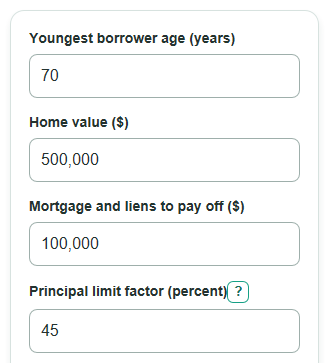
- Enter the Youngest borrower age, Home value, Mortgage and liens to pay off, Principal limit factor, and Years to compare.
- Open Advanced options if you want to change the Home value cap to use, Estimated upfront loan costs, or yearly growth rates.
- Click Calculate to see Estimated cash or credit after payoff first, then compare Line of credit after waiting, Estimated monthly draw if spread out, and Loan balance after taking cash now.
- Check whether the Home value cap used for the estimate is lower than your Home value, because that means the cap limited the gross principal limit.
- Sanity-check the output: if Estimated cash or credit after payoff is negative, the entered payoff and costs exceed the estimated principal limit, so the comparison outputs should be treated as not available cash.
Definitions
HECM: Home Equity Conversion Mortgage, a common reverse mortgage insured under FHA rules for homeowners age 62 and older [2].
Youngest borrower age: The age used for the reverse mortgage estimate when more than one borrower is involved.
Home value cap to use: The maximum home value amount this estimate allows before applying the principal limit factor. HUD publishes FHA mortgage limit information, so this calculator keeps the cap editable [1].
Principal limit factor: The percent of the capped home value that may be available before subtracting required payoffs and upfront costs.
Gross principal limit: The capped home value multiplied by the principal limit factor.
Estimated cash or credit after payoff: The estimated amount left after subtracting Mortgage and liens to pay off and Estimated upfront loan costs from the gross principal limit.
Line of credit growth: The assumed yearly growth of unused credit in the wait-and-draw-later estimate.
Estimated home equity: Projected home value minus the projected reverse mortgage loan balance. It can be negative in this planning estimate.
Common mistakes and quick fixes
Mistake: Entering Home value after subtracting the current mortgage.
Fix: Enter the full estimated market value in Home value, then put the payoff amount in Mortgage and liens to pay off.
Mistake: Guessing Principal limit factor as if it were the interest rate.
Fix: Use Principal limit factor as the allowed percent of the capped home value, preferably from a current lender quote or HUD table.
Mistake: Leaving Mortgage and liens to pay off too low because a HELOC, tax lien, or second mortgage was forgotten.
Fix: Add all required payoff amounts to Mortgage and liens to pay off before calculating.
Mistake: Treating Estimated upfront loan costs as cash you will pay separately when you meant to finance them.
Fix: Include financed closing costs in Estimated upfront loan costs, or enter 0 only if you want to exclude them from the estimate.
Mistake: Using an old Home value cap to use.
Fix: Update Home value cap to use for the HECM limit year you are trying to model.
Mistake: Comparing Line of credit after waiting and Loan balance after taking cash now with different time assumptions.
Fix: Use the same Years to compare for all payout choices so the side-by-side results share one time period.
Limitations & Key Assumptions / Boundary Conditions
- This is a planning estimate, not a lender quote, approval, or legal payoff statement.
- The calculator does not look up current HUD principal limit factor tables. The Principal limit factor must come from a current quote, table, or other source you trust.
- The Home value cap to use is editable because FHA and HUD limits can change. If the cap is wrong, the gross principal limit can be wrong.
- Standard HECM rules generally apply to homeowners age 62 and older. If Youngest borrower age is below 62, the math can still run, but the eligibility note should be taken seriously.
- The projection uses constant yearly rates. Real reverse mortgage rates, mortgage insurance charges, servicing fees, home values, taxes, insurance, repairs, and borrower draws can change over time.
- Negative Estimated cash or credit after payoff means the entered Mortgage and liens to pay off plus Estimated upfront loan costs are higher than the estimated gross principal limit.
- Negative Estimated home equity is kept as a signed planning result. It does not by itself tell you what the borrower or heirs would owe under actual non-recourse HECM rules.
Methodology
Calculation steps
The estimate starts by capping the entered Home value at the Home value cap to use.
Home value cap used for the estimate = min(Home value, Home value cap to use)
The Estimated gross principal limit is the capped home value times the Principal limit factor.
Estimated gross principal limit = Home value cap used for the estimate * (Principal limit factor / 100)
Estimated cash or credit after payoff subtracts required payoffs and upfront costs. The value is not floored at zero.
Estimated cash or credit after payoff = Estimated gross principal limit - Mortgage and liens to pay off - Estimated upfront loan costs
Future amounts use yearly compound growth for the selected Years to compare.
Future amount = starting amount * (1 + yearly rate percent / 100) ^ Years to compare
The monthly draw estimate converts the Yearly line of credit growth rate into a monthly rate so monthly draws match the selected yearly assumption.
Monthly rate = (1 + yearly rate percent / 100) ^ (1 / 12) - 1
If the monthly credit growth rate is zero, the Estimated monthly draw if spread out is available credit divided by months. Otherwise, it uses this payout formula.
Estimated monthly draw if spread out = available credit * monthly credit rate / (1 - (1 + monthly credit rate) ^ (-months))
Loan balance after monthly draws grows the required starting balance first, then adds the growing balance effect of the equal monthly draws.
Loan balance after monthly draws = starting required balance * (1 + monthly loan rate) ^ months + monthly draw * (((1 + monthly loan rate) ^ months - 1) / monthly loan rate)
If the monthly loan rate is zero, the draw part is monthly draw times months.
Estimated home equity = projected home value - projected loan balance
Mini-example
For a $500,000 Home value, $100,000 Mortgage and liens to pay off, 45% Principal limit factor, and $15,000 Estimated upfront loan costs, the capped home value is $500,000 and the Estimated gross principal limit is $225,000. The Estimated cash or credit after payoff is $225,000 - $100,000 - $15,000 = $110,000. With 10 Years to compare and a 6% yearly credit growth rate, the Line of credit after waiting is about $196,993. With a 6% yearly loan balance growth rate, taking all available cash now makes the projected loan balance about $402,941 after 10 years.