
Estimate the monthly payment, balloon balance, and payoff timing for a seller-financed deal with optional extra principal payments.
Advanced options
| Item | Original plan | With extras |
|---|
Table of contents
How to use our Seller Financing Calculator
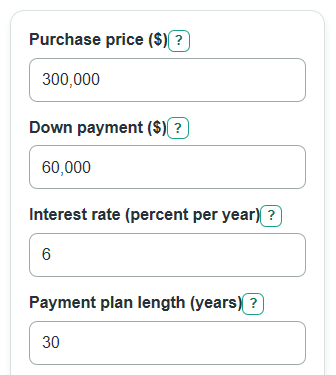
- Enter the Purchase price, Down payment, Interest rate, Payment plan length, and Balloon due after values from the proposed note.
- Use Advanced options if you want to test Extra principal each month, a One-time extra principal payment, or the One-time extra paid in month.
- Click Calculate to see the Balloon balance with extra payments, the Regular monthly payment before extra principal, and the payoff timing.
- Compare Balloon balance without extra payments with Balloon balance with extra payments to see how much the extra principal changes the balloon payoff.
- Sanity-check the output: the Down payment should be lower than the Purchase price, the Balloon due after years should match the deal term, and a larger extra principal amount should not increase the balloon balance.
Definitions
Seller financing: A deal where the seller lets the buyer pay part of the price over time instead of getting the whole sale price at closing.
Purchase price: The agreed sale price before subtracting the down payment.
Down payment: Money paid up front. It lowers the amount financed by the seller.
Interest rate: The yearly note rate charged on the unpaid principal balance.
Payment plan length: The number of years used to spread the regular principal-and-interest payments.
Balloon due after: The time until the remaining balance is due in one large payment. A balloon payment is a large last payment that can be due because the loan payments do not fully pay off the loan by that date [3].
Extra principal each month: An added monthly amount that goes toward principal after the regular payment.
Balloon balance with extra payments: The remaining principal at the balloon month after scheduled payments and any extra principal payments are applied.
Estimated payoff month with extra payments: The first payment month when the principal balance reaches $0 if the note continues long enough.
Common mistakes and quick fixes
Mistake: Entering the loan amount in Purchase price instead of the full sale price.
Fix: Put the full agreed sale price in Purchase price and the up-front cash in Down payment.
Mistake: Typing 0.06 in Interest rate for a 6 percent note.
Fix: Enter 6 in Interest rate because the field uses percent per year.
Mistake: Making Balloon due after longer than the deal actually allows.
Fix: Use the year when the remaining balance must be paid, refinanced, or renegotiated.
Mistake: Treating Regular monthly payment before extra principal as the whole housing payment.
Fix: Remember it is principal and interest only; add taxes, insurance, dues, and servicing costs outside this calculator.
Mistake: Entering Extra principal each month when the note does not allow extra principal payments.
Fix: Check the draft note first, then use Extra principal each month only if prepayment is allowed.
Mistake: Setting One-time extra paid in month after the note would already be paid off.
Fix: Use a month within the active payment plan, or leave One-time extra principal at 0.
Limitations & Key Assumptions / Boundary Conditions
- This is loan math only. It is not tax, legal, title, escrow, or contract advice.
- The calculator assumes a fixed interest rate, monthly payments, and the same scheduled principal-and-interest payment each month until payoff or the balloon date.
- Results do not include property taxes, insurance, HOA dues, servicing fees, late fees, recording costs, attorney fees, or seller tax effects.
- The balloon balance is measured after the scheduled payment and any extra principal for that balloon month are applied.
- Extra principal is treated as allowed and applied directly to principal. A real note may limit prepayments or charge a prepayment penalty.
- Displayed dollar amounts are rounded to cents, but the monthly simulation keeps full precision before display.
- If the note pays off before the balloon date, the balloon balance is $0. If the balloon date arrives first, the calculator does not assume refinancing is approved.
Methodology
Calculation steps
The calculator starts by finding the amount the seller is financing.
financed_amount = purchase_price - down_payment
It converts the yearly rate and years into monthly loan periods.
monthly_rate = annual_rate_percent / 100 / 12
total_months = payment_plan_length_years * 12
balloon_months = balloon_due_after_years * 12
For a nonzero interest rate, the scheduled principal-and-interest payment uses the standard amortizing loan payment formula. Monthly mortgage-style payments are commonly calculated from the loan amount, interest rate, and loan term [4].
payment = financed_amount * monthly_rate / (1 - (1 + monthly_rate)^(-total_months))
For a 0 percent interest rate, the payment is the financed amount divided evenly across the payment plan.
payment = financed_amount / total_months
Each month, interest is added first. Then the scheduled payment is applied. Extra principal is applied after the scheduled payment, and it cannot push the balance below $0.
interest_this_month = balance_start * monthly_rate
scheduled_paid = min(payment, balance_start + interest_this_month)
principal_from_scheduled = scheduled_paid - interest_this_month
balance_after_scheduled = balance_start - principal_from_scheduled
extra_applied = min(extra_principal_requested, balance_after_scheduled)
balance_end = balance_after_scheduled - extra_applied
The original plan is simulated the same way with Extra principal each month set to $0 and One-time extra principal set to $0. The balloon balance cut is the difference between the original balloon balance and the extra-payment balloon balance.
balloon_balance_cut = balloon_balance_without_extra - balloon_balance_with_extra
Mini-example
Suppose the Purchase price is $120,000, the Down payment is $20,000, the Interest rate is 0 percent, the Payment plan length is 10 years, and the Balloon due after value is 5 years. The financed amount is $100,000. The regular monthly payment is $833.33. After 60 months, the balloon balance without extra payments is $50,000.
If Extra principal each month is $100 and there is no one-time extra payment, the monthly cash out is $933.33. After 60 months, the balloon balance with extra payments is $44,000, so the balloon balance cut is $6,000. The estimated payoff month is 108 if the note continues past the balloon date.
Rounding and timing
Money shown on the page is rounded to the nearest cent. The balance is still calculated month by month with unrounded values. The payoff month is the first month where the ending principal balance reaches $0. Interest paid through the balloon month with extra payments stops at the earlier of the balloon month or the payoff month.
Sources
- What is a balloon payment? When is one allowed? | Consumer Financial Protection Bureau - Consumerfinance
- What is a payoff amount and is it the same as my current balance? | Consumer Financial Protection Bureau - Consumerfinance
- On a mortgage, what's the difference between my principal and interest payment and my total monthly payment? | Consumer Financial Protection Bureau - Consumerfinance
- How do mortgage lenders calculate monthly payments? | Consumer Financial Protection Bureau - Consumerfinance