
Estimate how long your propane generator can run from a cylinder or tank, with optional reserve, schedule, and cost planning.
Table of contents
How to use our Propane Generator Runtime Calculator
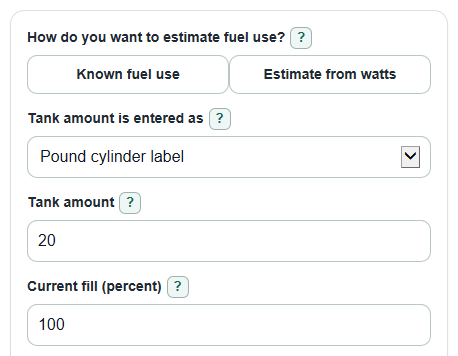
- Choose how to estimate fuel use: use Known fuel use if your manual lists Propane used per hour (gallons per hour), or choose Estimate from watts if you only know Power you will run (watts).
- Set Tank amount is entered as before typing Tank amount, because a 20 lb cylinder is not the same as a 20 gallon tank.
- Enter Current fill (percent), then use Advanced options for Keep in reserve (percent), Planned run time each day (hours), and optional Propane price ($ per gallon).
- Click Calculate and read Estimated runtime first, then compare Days at your daily run plan with Continuous runtime.
- Sanity-check the answer by comparing Fuel used per hour with your generator manual; if the calculator used watts, treat the result as a planning estimate.
Definitions
Tank amount: The cylinder label in pounds, such as 20 lb or 40 lb, or the tank label in gallons, such as 120, 250, or 500 gallons.
Current fill (percent): How full the tank or cylinder is now. For a home tank, this usually means the gauge reading.
Propane used per hour (gallons per hour): The liquid propane burn rate used to estimate runtime. A generator manual fuel table is usually the best source for this number.
Power you will run (watts): The running electrical load you expect the generator to supply, not the brief starting or surge watts.
Generator efficiency (percent): The share of propane heat energy that becomes electric energy. A higher percent means less fuel used per hour for the same watts.
Keep in reserve (percent): The share of propane the calculator leaves unused before estimating runtime.
Usable propane after reserve: The liquid propane counted in the runtime calculation after fill percent and reserve are applied.
Overfilling prevention device (OPD): A backup shutoff device in the filling valve of many propane cylinders; PHMSA describes OPDs for 4 to 40 lb propane cylinders [1].
Common mistakes and quick fixes
Mistake: Typing 20 in Tank amount while Tank amount is entered as is set to gallon tank, even though you have a 20 lb grill cylinder.
Fix: Choose Pound cylinder label for BBQ-style cylinders so the calculator converts pounds to gallons correctly.
Mistake: Using starting watts in Power you will run (watts) .
Fix: Enter running watts, which is the power you expect the generator to carry after motors have started.
Mistake: Leaving Generator efficiency (percent) at a guess and treating the watts-based result like a manual rating.
Fix: If you can find your manual's fuel table, switch to Known fuel use and enter Propane used per hour (gallons per hour) .
Mistake: Setting Current fill (percent) to 100 for a large home tank just because it was recently filled.
Fix: Enter the actual gauge reading; many propane tanks are filled below 100 percent to leave expansion space.
Mistake: Reading only Continuous runtime when you plan to run the generator for part of each day.
Fix: Set Planned run time each day (hours) and use Days at your daily run plan for outage planning.
Mistake: Entering a reserve in Keep in reserve (percent) and then comparing the result to a full-tank runtime chart.
Fix: Compare charts to Usable propane after reserve , not the tank's full listed size.
Limitations & Key Assumptions / Boundary Conditions
- The watts mode is an estimate. Real fuel use can differ because generators have different engines, governors, alternators, and fuel curves.
- The calculator does not model vaporization limits. Cold weather, small cylinders, regulator size, hose length, and high demand can reduce usable output even when liquid propane remains.
- Tank amount for a pound cylinder is treated as propane weight. The calculator does not add an extra 80 percent factor to pound-labeled cylinders.
- Tank amount for a gallon tank is treated as tank gallons multiplied by Current fill (percent). If you enter a gauge reading above 80 percent, the calculator still uses your number.
- Cost results use only Propane price ($ per gallon). They do not include delivery fees, tank rental, oil changes, generator maintenance, or taxes.
- The calculator assumes fuel use stays steady. Runtime can change when appliances cycle on and off or when the generator runs far below or near its rated load.
- Starting surge is not included. Use Power you will run (watts) for the steady load, and check your generator manual separately for starting heavy motors.
Methodology
How the calculation works
The calculator first converts the entered propane amount to liquid gallons. It uses the tank unit you selected, so pound-labeled cylinders and gallon-labeled tanks are handled differently.
liquid_gallons = tank_amount_lb * fill_percent / 100 / 4.24
liquid_gallons = tank_amount_gal * fill_percent / 100
Next, it subtracts the reserve you chose.
available_gallons = liquid_gallons * (1 - reserve_percent / 100)
If you choose known fuel use, the burn rate is the value you entered.
burn_gph = fuel_use_gph
If you choose the watts estimate, the calculator turns electric load into heat energy demand, then divides by generator efficiency and propane heat content.
burn_gph = (running_watts * 3.412) / ((efficiency_percent / 100) * 91452)
Runtime is the usable propane divided by the burn rate. The daily schedule result divides runtime by your planned generator hours per day.
runtime_hours = available_gallons / burn_gph
continuous_days = runtime_hours / 24
scheduled_days = runtime_hours / hours_per_day
Weight and cost outputs are supporting checks.
available_pounds = available_gallons * 4.24
burn_lbh = burn_gph * 4.24
cost_per_hour = burn_gph * propane_price
available_fuel_cost = available_gallons * propane_price
Mini-example
For a full 20 lb cylinder with 0 percent reserve and a generator using 0.6 gallons per hour, usable propane is about 20 / 4.24 = 4.72 gallons. Runtime is 4.72 / 0.6 = 7.86 hours. If the planned run time is 24 hours per day, that is 0.33 days of continuous running.
Validation checks
The calculator blocks tank amounts at 0 or below, fill values outside 0 to 100 percent, reserve values below 0 or at least 100 percent, daily run times above 24 hours, and fuel burn rates at 0 or below. In watts mode, efficiency must be more than 0 and no more than 100 percent. If propane price is blank, cost cards are hidden; if it is entered, it must be 0 or more.