
Calculate a polymer batch recipe, feed rate, material cost, and batch coverage time from your dry sludge dose and working volume.
Advanced options
Table of contents
How to use our Polymer Make-Down Batch Calculator
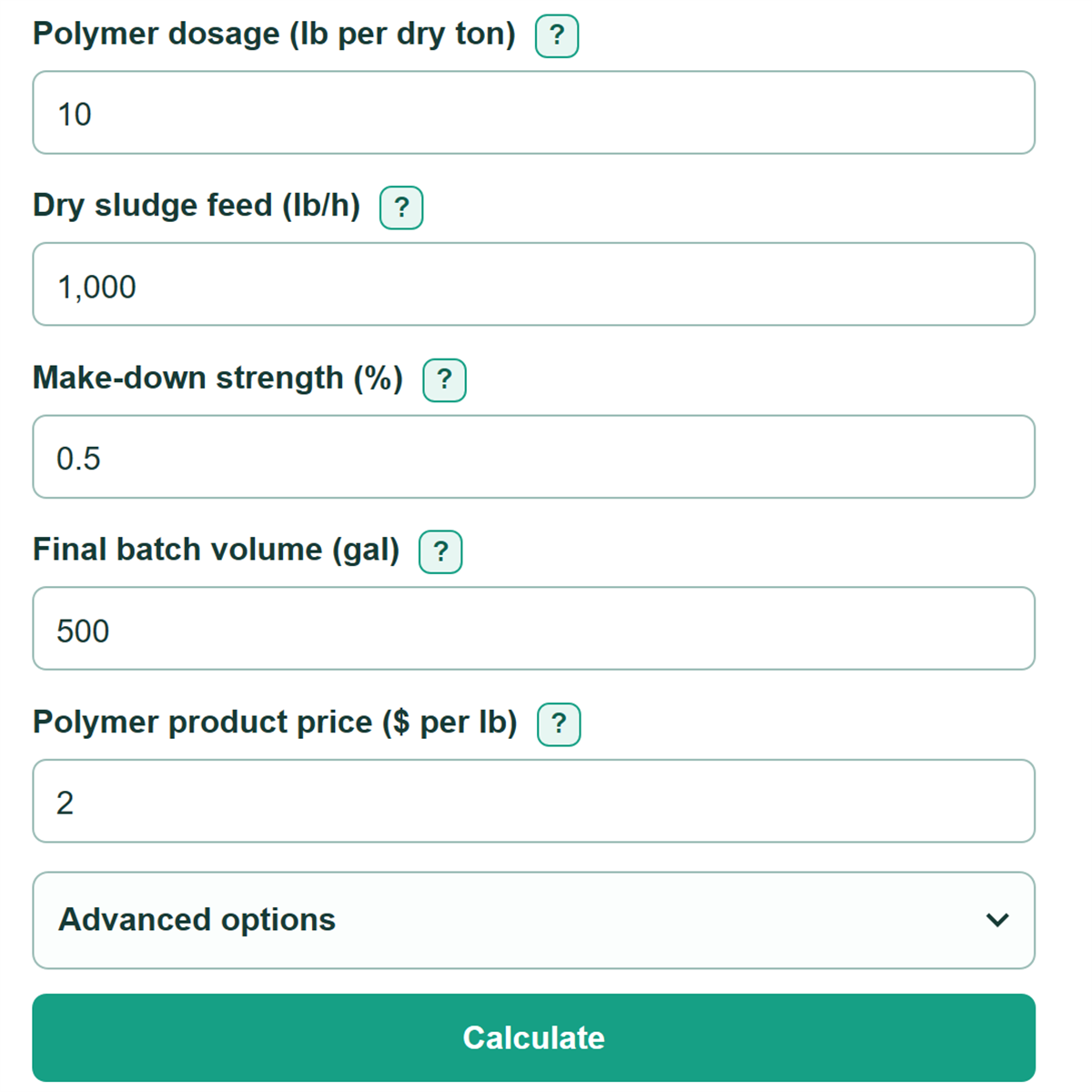
- Enter the approved Polymer dosage (lb per dry ton) and the current Dry sludge feed (lb/h).
- Enter Make-down strength (%) as a percent by weight. For example, enter 0.5 for 0.5%, not 0.005.
- Enter the planned Final batch volume (gal) and the current Polymer product price ($ per lb).
- Open Advanced options if needed to replace Product active content (%) or Made-down solution density (lb/gal) with supplier or site values, then select Calculate.
- Check that Required made-down solution feed (mL/min) is close to a measured pump drawdown result before using the calculated setting.
Definitions
Dry ton: A US short ton of dry solids, equal to 2,000 lb.
Polymer dosage: Pounds of active polymer needed for each dry ton of sludge.
Make-down strength: Active polymer concentration in the prepared solution by weight. A strength of 0.5% is a decimal fraction of 0.005.
Product active content: The share of purchased product that is active polymer by weight. Dry polymer is often entered as 100% when it is fully active by weight.
Made-down solution density: Weight of the prepared polymer solution per gallon. It converts solution mass to solution volume.
Batch coverage time: How long the selected final batch volume lasts at the calculated solution feed demand.
Drawdown calibration: A measured pump-output check based on how much liquid leaves a tank over a known time.
Common mistakes and quick fixes
Mistake: Entering 0.005 in Make-down strength (%) to mean 0.5%.
Fix: Enter 0.5 because the field uses percent, then confirm the displayed decimal fraction is 0.005.
Mistake: Using wet sludge flow for Dry sludge feed (lb/h).
Fix: Use the dry-solids mass rate from the plant calculation or process record.
Mistake: Entering tank capacity instead of the actual Final batch volume (gal).
Fix: Use the planned working fill volume after make-down.
Mistake: Leaving Product active content (%) at 100 for a liquid product that is partly active.
Fix: Enter the active-content percentage from the product data sheet or label.
Mistake: Treating Required made-down solution feed (gal/h) as proven pump delivery.
Fix: Measure pump output with a drawdown check and adjust the operating setting as needed.
Mistake: Reading Polymer material cost for this batch ($) as the complete treatment cost.
Fix: Add water, labor, energy, freight, disposal, and equipment costs separately if they matter for your decision.
Limitations & Key Assumptions / Boundary Conditions
- This is a mass-balance planning calculation for a dry-sludge dosing workflow. It does not replace jar testing, supplier instructions, or approved plant procedures.
- The calculated feed rate is a pump-demand target, not a measured pump output. Confirm delivery with a drawdown calibration.
- Batch water is estimated from remaining mass using 8.34 lb/gal for water-like density. Actual water volume can differ with product properties and temperature.
- The model assumes the entered make-down strength, product active content, and solution density apply throughout the batch.
- Polymer material cost includes purchased polymer only. It excludes water, labor, electricity, freight, disposal, and equipment costs.
- If Dry sludge feed (lb/h) is zero, no operating polymer feed is requested. The selected batch recipe and its material cost can still be calculated independently.
Methodology
Calculation method
The calculator first converts dry sludge throughput into active polymer demand. It then uses the prepared solution concentration and density to find the required solution volume feed.
active polymer feed (lb/h) = polymer dosage (lb/dry ton) * dry sludge feed (lb/h) / 2000
active fraction = make-down strength (%) / 100
product fraction = product active content (%) / 100
solution feed (gal/h) = active polymer feed / (solution density (lb/gal) * active fraction)
The batch recipe starts with final batch volume multiplied by made-down solution density. Active polymer is the selected fraction of that batch mass. Purchased product mass accounts for the product active-content fraction.
batch solution mass (lb) = final batch volume (gal) * solution density (lb/gal)
batch active polymer (lb) = batch solution mass * active fraction
batch product mass (lb) = batch active polymer / product fraction
batch water (gal) = (batch solution mass - batch product mass) / 8.34
Batch cost uses purchased product mass, while coverage divides final batch volume by required solution feed. The pump-check value converts US gallons per hour to milliliters per minute.
batch cost ($) = batch product mass (lb) * product price ($/lb)
batch coverage (hours) = final batch volume (gal) / solution feed (gal/h)
solution feed (mL/min) = solution feed (gal/h) * 3785.411784 / 60
daily product cost ($/day) = active polymer feed (lb/h) * 24 * product price ($/lb) / product fraction
Worked example
With 10 lb per dry ton, 1,000 lb/h of dry sludge, 0.5% make-down strength, a 500 gal batch, 100% active product, 8.34 lb/gal solution density, and $2.00/lb product, active polymer demand is 5 lb/h. The solution feed is about 119.90 gal/h, so the batch lasts about 4.17 hours. The batch contains 20.85 lb of product, costs $41.70, and needs an estimated 497.5 gal of water.
Calculation choices
Percent inputs are divided by 100 before use, so 0.5% becomes 0.005. The calculator blocks a make-down strength above product active content because that would produce a negative estimated water amount. A zero dry sludge feed produces zero operating feed and zero daily product cost; batch recipe values remain based on the selected batch volume.