
Calculate baffling-adjusted chlorine contact time and compare achieved chlorine CT with your facility's required CT target.
Table of contents
How to use our Chlorine CT Disinfection Calculator
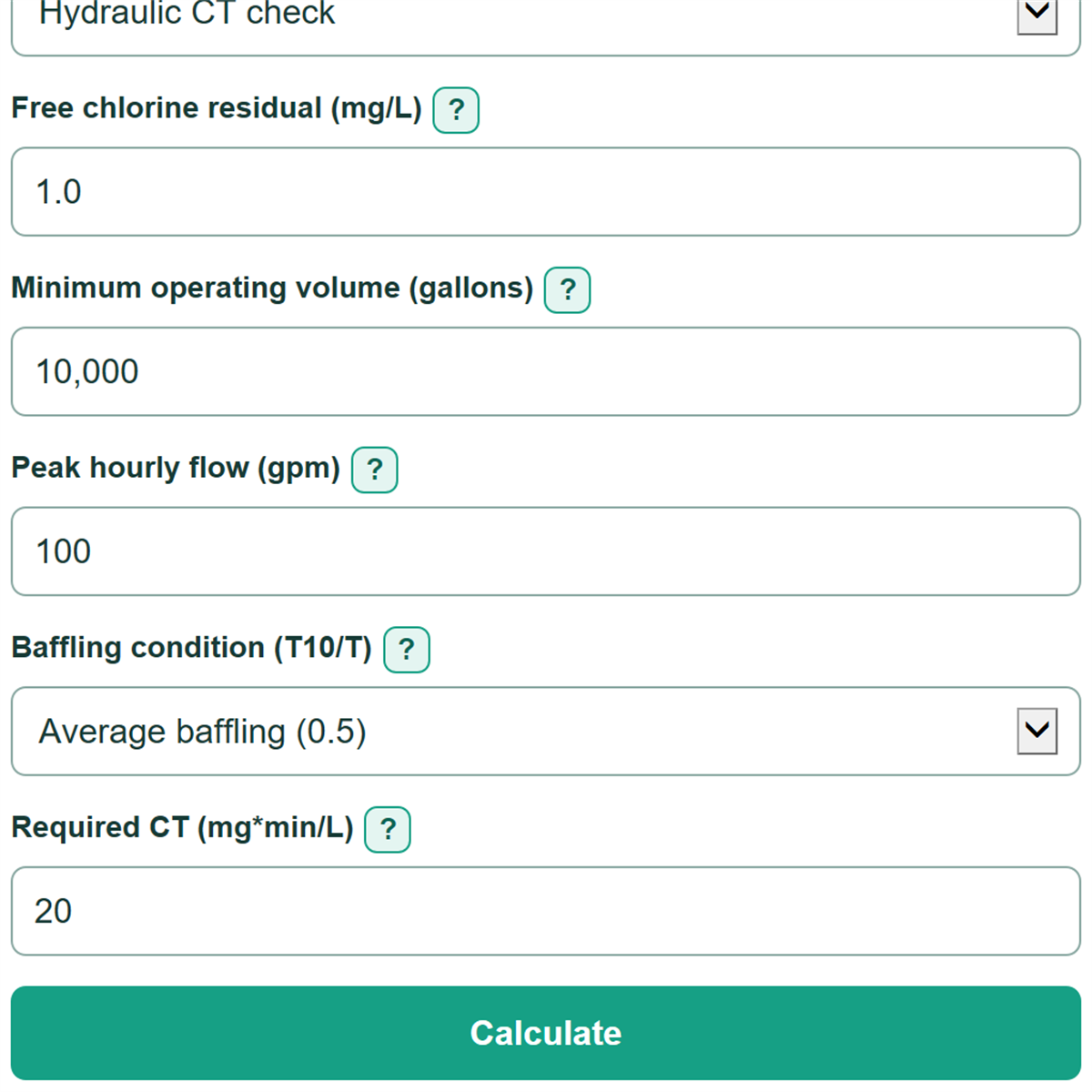
- Enter the measured Free chlorine residual (mg/L) from the approved point of credit.
- Enter the lowest available Minimum operating volume (gallons) and the applicable Peak hourly flow (gpm).
- Choose the Baffling condition (T10/T) supported by your approved hydraulic assessment, then enter the facility's Required CT (mg*min/L).
- Click Calculate and read Required CT check, Achieved chlorine CT, and CT margin.
- Sanity-check the result: effective contact time should be lower than theoretical detention time unless T10/T is 1.0, and a positive CT margin should match a result that meets the entered target.
Definitions
Free chlorine residual (mg/L): The measured concentration of free chlorine at the approved point used for CT credit.
Theoretical detention time: Minimum operating volume divided by peak hourly flow. It is the hydraulic time before a baffling adjustment.
T10: The effective contact time used in this calculation. It is found by multiplying theoretical detention time by T10/T.
T10/T: The baffling factor, or the fraction of theoretical detention time credited as effective contact time. A value closer to 1 means water moves more like plug flow; a lower value means more mixing or short-circuiting.
CT (mg*min/L): Free chlorine residual multiplied by effective contact time. CT calculations use a disinfectant residual and contact time together. [1]
CT margin: Achieved chlorine CT minus Required CT (mg*min/L). A negative margin is a shortfall.
Common mistakes and quick fixes
Mistake: Entering chlorine pump dose as Free chlorine residual (mg/L).
Fix: Use the measured residual at the approved point of credit.
Mistake: Using nominal tank capacity for Minimum operating volume (gallons).
Fix: Enter only the lowest volume available for contact during the condition being checked.
Mistake: Using average daily flow for Peak hourly flow (gpm).
Fix: Use the peak hourly flow from the approved operating or design basis.
Mistake: Choosing a favorable Baffling condition (T10/T) without hydraulic support.
Fix: Choose the value supported by the approved tracer study or basin assessment.
Mistake: Treating Required CT (mg*min/L) as a universal chlorine target.
Fix: Copy the applicable facility or regulatory CT target for the specific treatment condition.
Mistake: Reading a negative CT margin as zero.
Fix: A negative CT margin is a shortfall below Required CT (mg*min/L); follow the facility procedure.
Limitations & Key Assumptions / Boundary Conditions
- This is a screening calculation using the values entered. It does not establish regulatory compliance or replace a facility compliance procedure.
- Use a free chlorine residual from the approved point of credit. A pump dose, a different sampling point, or an unrepresentative reading can change the result.
- Minimum operating volume and peak hourly flow must describe the same operating condition. Nominal capacity and average flow can overstate contact time.
- The selected Baffling condition (T10/T) must be supported by an approved tracer study or hydraulic assessment for compliance use.
- Required CT depends on the applicable disinfectant, organism, temperature, pH, and treatment-credit requirement. This calculator does not determine that target.
- The calculation assumes gallons and gpm are measured consistently, so volume divided by flow produces minutes.
Methodology
Calculation steps
The calculator first finds hydraulic detention time from the conservative operating volume and peak flow. It then applies the selected T10/T baffling factor, multiplies that effective time by the measured free chlorine residual, and compares the result with the entered target.
Theoretical detention time (min) = Minimum operating volume (gallons) / Peak hourly flow (gpm)
Effective contact time, T10 (min) = Theoretical detention time (min) * T10/T
Achieved chlorine CT (mg*min/L) = Free chlorine residual (mg/L) * Effective contact time (min)
CT margin (mg*min/L) = Achieved chlorine CT - Required CT
CT compared with required CT = Achieved chlorine CT / Required CT
How to read the check
The Required CT check says the entered target is met when achieved chlorine CT is equal to or greater than Required CT (mg*min/L). The CT margin remains signed: a positive number is above the target, while a negative number is below it.
Worked example
With 10,000 gallons of minimum operating volume and 100 gpm peak hourly flow, theoretical detention time is 100 minutes. At T10/T = 0.5, effective contact time is 50 minutes. With 1.0 mg/L free chlorine residual, achieved chlorine CT is 50 mg*min/L. If Required CT (mg*min/L) is 20, the CT margin is +30 mg*min/L and the comparison ratio is 2.5.