
Calculate the liquid chemical feed rate, estimated pump setting, monthly product use, and chemical cost from your process flow and dose.
Table of contents
How to use our Industrial Chemical Feed Rate, Pump Setting and Cost Calculator
- Enter System flow and choose the System flow unit shown on the flow meter, SCADA record, or operating log.
- Enter the Target dose, then choose what the dose describes: Active ingredient or Delivered product.
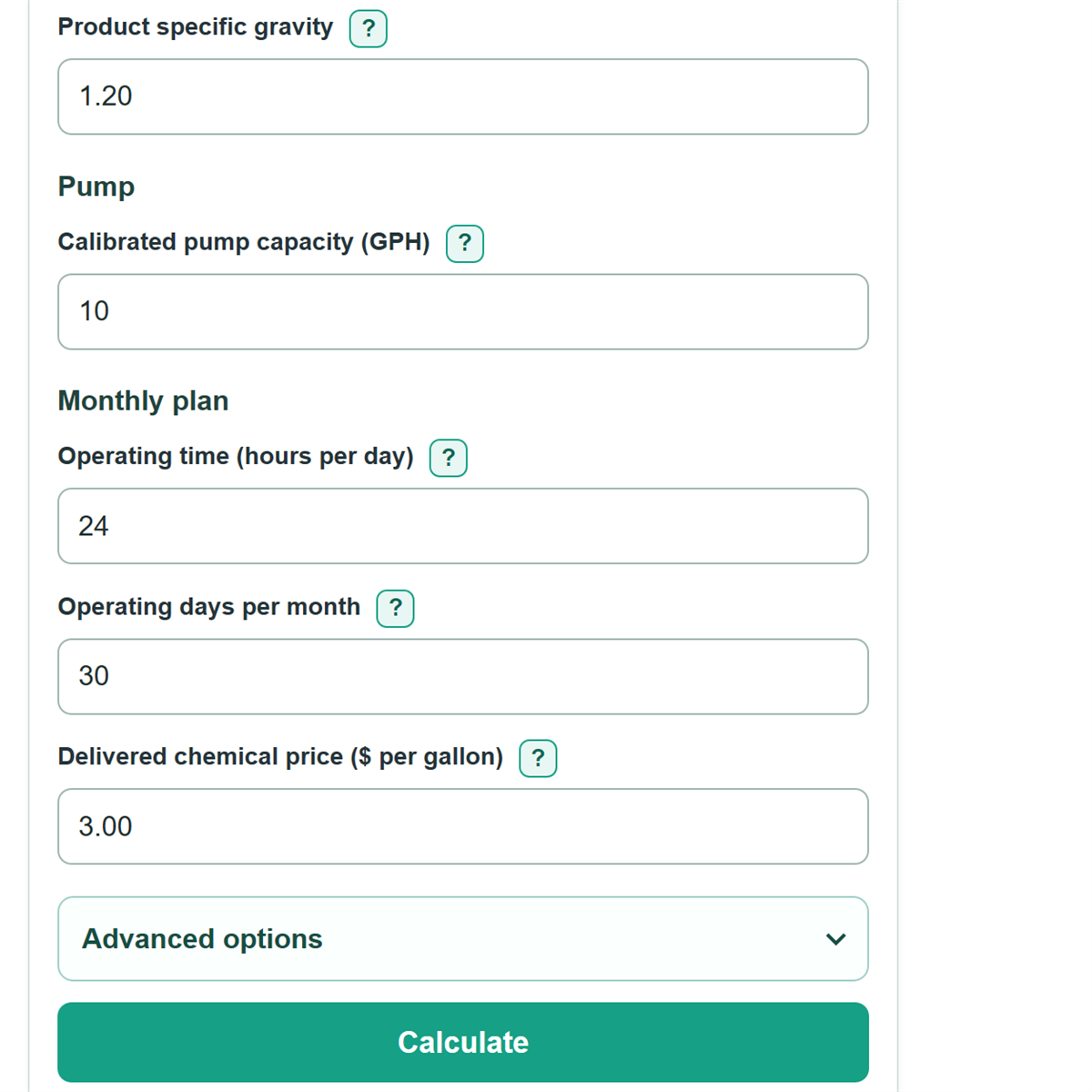
- Enter product data from the label or technical data sheet, including Product strength when the dose is active ingredient and Product specific gravity.
- Enter Calibrated pump capacity, the operating schedule, and Delivered chemical price from a current quote or invoice.
- Click Calculate, then compare Required product feed rate with a timed drawdown or approved field calibration before using the estimated pump setting.
Definitions
System flow: The amount of treated water moving through the injection or process point, entered as GPM, GPH, or GPD.
Target dose: The chemical amount intended for each liter of process water. For dilute water solutions, mg/L and ppm are treated as numerically equal in this calculator.
Active ingredient: The chemical part that does the treatment work. An active-ingredient dose must be adjusted for the delivered product's percent active. [1]
Delivered product: The full liquid product as purchased, including water or other non-active ingredients.
Product strength: The percent of the delivered product that is active ingredient.
Product specific gravity: Product density divided by water density. It converts product mass into product volume.
GPH: Gallons per hour. It is the required liquid-product feed rate and the unit used for calibrated pump capacity.
mL/min: Milliliters per minute. This is the same feed rate in a convenient unit for a timed pump calibration.
Feed margin: An optional percentage added to the target dose before feed rate, product use, and cost are calculated.
Common mistakes and quick fixes
Mistake: Entering a GPH or GPD reading while System flow unit is set to GPM.
Fix: Choose the exact unit printed beside the System flow reading before calculating.
Mistake: Selecting Active ingredient when the Target dose already means delivered liquid product.
Fix: Choose Delivered product under What does the target dose describe? ; Product strength is then not used.
Mistake: Using a product label percentage as Product specific gravity.
Fix: Enter the density ratio from the technical data sheet for Product specific gravity, and enter percent active separately as Product strength.
Mistake: Using catalog output instead of actual field output for Calibrated pump capacity.
Fix: Use a drawdown or other verified capacity at the intended pressure and usable pump setting.
Mistake: Assuming the plant runs all month without checking Operating time and Operating days per month.
Fix: Enter the schedule for the month being planned; these inputs change Monthly product use and cost.
Mistake: Putting a monthly delivery fee into Delivered chemical price.
Fix: Keep the usage price in Delivered chemical price and enter a known repeating fee as Fixed monthly chemical charge ($).
Limitations & Key Assumptions / Boundary Conditions
- This calculator uses a flow-proportional mass balance. It does not determine the correct treatment dose, residual, reaction demand, or chemical compatibility.
- mg/L and ppm are treated as equal only for a dilute water solution. Use site-specific engineering methods for concentrated, unusual, or non-water process streams.
- For an active-ingredient dose, product strength is the active mass divided by total product mass, expressed as a percentage (w/w). Product strength and specific gravity must match the actual delivered product. Product properties can vary by formulation and batch.
- The estimated pump setting is percent of entered calibrated capacity. It is not a direct stroke or speed command and must be checked at actual discharge pressure and operating conditions.
- Monthly product use assumes the entered flow and feed rate apply throughout the entered operating hours and days. Variable flow needs a representative flow or separate calculations for each operating period.
- Monthly chemical cost includes calculated gallons times the entered delivered price, plus an optional fixed monthly charge. It excludes taxes, deposits, disposal, minimum-order fees, and other charges unless you include them in an entered price or charge.
Methodology
Calculation method
The calculator first changes System flow into gallons per minute. It then applies any Feed margin. If the dose describes active ingredient, it divides the effective dose by the active fraction of Product strength to find the delivered-product dose. This follows the usual chemical-feed mass-balance approach. [1]
flow_gpm = system_flow, system_flow / 60, or system_flow / 1440
The first form is used for GPM, the second for GPH, and the third for GPD.
effective_dose_mg_l = target_dose_mg_l * (1 + feed_margin_percent / 100)
product_dose_mg_l = effective_dose_mg_l / (product_strength_percent / 100)
This strength adjustment is used only when What does the target dose describe? is Active ingredient. For Delivered product, product_dose_mg_l equals effective_dose_mg_l.
feed_rate_gph = flow_gpm * 60 * product_dose_mg_l / 1000000 / specific_gravity
The calculation uses 1 kilogram per liter as the reference water-density approximation. Because both stream flow and product feed use US gallons, the gallon-to-liter conversion cancels in the GPH mass-balance expression.
feed_rate_ml_min = feed_rate_gph * 3.785411784 * 1000 / 60
The mL/min conversion uses 3.785411784 liters per US gallon.
pump_setting_percent = feed_rate_gph / calibrated_pump_capacity_gph * 100
monthly_product_use = feed_rate_gph * operating_hours_per_day * operating_days_per_month
monthly_chemical_cost = monthly_product_use * delivered_price_per_gallon
monthly_budget_with_fixed_charge = monthly_chemical_cost + fixed_monthly_charge
Worked example
For 500 GPM, a 10 mg/L active-ingredient dose, 12.5 percent active product, and specific gravity of 1.20, the delivered-product dose is 80 mg/L. The required feed rate is 2 GPH, or about 126.18 mL/min. With a 10 GPH calibrated pump, the estimated setting is 20 percent. Running 24 hours per day for 30 days uses 1,440 gallons; at $3 per gallon, the usage-based monthly chemical cost is $4,320.
Calculation scope
A pump percentage above 100 percent means the entered pump capacity cannot meet the required feed rate. A negative Pump capacity remaining value is a capacity shortfall. Zero operating hours or zero operating days produces zero monthly product use and zero usage-based cost, while the required instantaneous feed rate remains available. Blank advanced fields count as zero; nonnumeric or negative values are rejected where they are not allowed.