
Convert miles per hour to feet per second, or reverse the conversion, and see how far that speed covers in 1 second.
Table of contents
How to use our MPH to Feet Per Second Converter
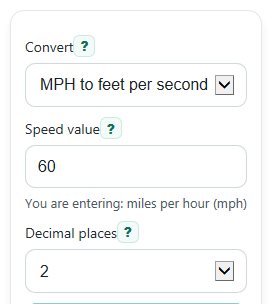
- Choose a direction in Convert: either MPH to feet per second or Feet per second to MPH.
- Type one number into Speed value. You can enter 0, decimals, or a negative value if you are working on a physics problem.
- Pick how many digits to show in Decimal places, then click Calculate.
- Read Converted speed for the main answer, then use Distance covered in 1 second to picture what that speed means in real life.
- Do a quick check: 60 mph should be 88 ft/s, and converting 88 ft/s back should give 60 mph, apart from any display rounding you chose.
Definitions
MPH: Miles per hour, a speed unit that tells how many miles are traveled in 1 hour.
Feet per second (ft/s): A speed unit that tells how many feet are traveled in 1 second.
Converted speed: The same speed written in the other unit.
Distance covered in 1 second: How many feet the motion covers during one second at the entered speed.
Conversion factor: The number multiplied by the starting speed to change units. For mph to ft/s, the exact factor is 22/15. For ft/s to mph, the exact factor is 15/22.
Statute mile: The standard US mile, equal to 5,280 feet [1].
Common mistakes and quick fixes
Mistake: Leaving Speed value blank and expecting a result.
Fix: Enter a number in Speed value ; the calculator rejects blank entries.
Mistake: Choosing the wrong direction in Convert and then thinking Converted speed is wrong.
Fix: Check whether you are starting with mph or ft/s, then set Convert to the matching direction.
Mistake: Thinking Decimal places changes the actual math.
Fix: Use Decimal places only to change how the answer looks; Converted speed is still calculated from the exact factor first.
Mistake: Reading Distance covered in 1 second as a time value.
Fix: Treat Distance covered in 1 second as feet traveled in one second, not as seconds.
Mistake: Assuming negative Speed value is invalid.
Fix: Negative values are allowed, and a negative Converted speed means motion in the opposite direction.
Mistake: Expecting Conversion factor used to match the rounded display exactly every time.
Fix: Remember that Conversion factor used shows the factor for the chosen direction, while Converted speed may be rounded for display.
Limitations & Key Assumptions / Boundary Conditions
- This converter handles only mph and feet per second. It does not convert to meters per second, kilometers per hour, or other speed units.
- Decimal places changes only the displayed rounding. Internal math uses the exact factors 22/15 and 15/22.
- Distance covered in 1 second is a simple interpretation of constant speed. Real motion can change from second to second.
- Negative values are allowed for math and physics use. In everyday driving, speed is usually treated as nonnegative, so the sign mainly shows direction.
- Results are unit conversions, not measurements. If the original speed was estimated or rounded, the converted value carries that same uncertainty.
Methodology
How the conversion works
The calculator uses exact unit relationships:
1 mile = 5,280 feet [1], and 1 hour = 3,600 seconds [2]. From that, miles per hour can be rewritten as feet per second.
ft/s = mph x 5280 / 3600
ft/s = mph x 22 / 15
mph = ft/s x 3600 / 5280
mph = ft/s x 15 / 22
What each result means
Converted speed is the main answer in the other unit. Distance covered in 1 second gives a plain-language meaning in feet. When you start with mph, that 1-second distance is numerically the same as the ft/s result. When you start with ft/s, it repeats the entered ft/s value as feet traveled in one second.
Conversion factor used shows the multiplier for the chosen direction: 22/15 for mph to ft/s, or 15/22 for ft/s to mph.
Mini example
If the input is 60 mph, multiply by 22/15.
60 x 22 / 15 = 88
So Converted speed is 88 ft/s, and Distance covered in 1 second is also 88 feet.
If the input is 88 ft/s, multiply by 15/22.
88 x 15 / 22 = 60
So the speed is 60 mph.
Display rounding
The calculator rounds only the displayed result to the selected Decimal places. It does not round the factor first, which helps avoid small conversion drift.
Assumptions used
This tool assumes a constant speed during the 1-second interpretation and uses the standard statute mile and exact time conversion values. Real-world readings may differ slightly if the original measurement was rounded.