
Convert speed between meters per second and kilometers per hour with a quick answer, exact factor, and clear unit-change steps.
Table of contents
How to use our m/s to km/h Converter
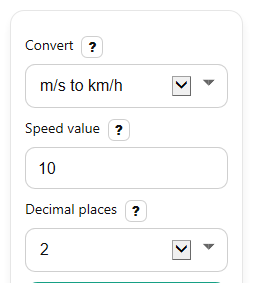
- Choose a direction in Convert: either m/s to km/h or km/h to m/s.
- Enter the number you want to change in Speed value. You can enter 0 or a negative number if your class uses signs for direction.
- Pick how many digits to show in Decimal places, then click Calculate.
- Read Converted speed first, then check Conversion factor used and Formula used if you want to verify the math by hand.
- Use How the conversion works as a quick sanity check: 10 m/s should become 36 km/h, and 72 km/h should become 20 m/s.
Definitions
m/s: Meters per second, a speed unit that tells how many meters are traveled in 1 second.
km/h: Kilometers per hour, a speed unit that tells how many kilometers are traveled in 1 hour.
Convert: The direction of the unit change, either from m/s to km/h or from km/h to m/s.
Speed value: The starting number you want to change into the other unit.
Decimal places: How many digits appear after the decimal point in the displayed answer.
Conversion factor used: The exact multiplier or divisor for the unit change, such as 3.6 or 1/3.6.
Formula used: The rule the calculator applies for the direction you picked.
Common mistakes and quick fixes
Mistake: Leaving Speed value blank and expecting the tool to guess.
Fix: Enter a number in Speed value before you click Calculate .
Mistake: Picking the wrong option in Convert , such as entering km/h while m/s to km/h is selected.
Fix: Make sure Convert matches the unit you are starting with, not the unit you want at the end.
Mistake: Thinking Converted speed changes the actual motion.
Fix: Read Converted speed as the same speed written in a different unit.
Mistake: Rounding too early and then getting a different homework answer.
Fix: Increase Decimal places first, then round only your final Converted speed if needed.
Mistake: Forgetting that a negative Speed value can stay negative after conversion.
Fix: If your class uses negative for opposite direction, keep the sign; the Converted speed should keep the same sign.
Mistake: Memorizing 3.6 without knowing when to multiply or divide.
Fix: Check Formula used and How the conversion works to see whether this direction uses times 3.6 or divide by 3.6.
Limitations & Key Assumptions / Boundary Conditions
- This converter changes units only. It does not estimate distance, time, acceleration, or real-world conditions.
- The displayed answer is rounded based on Decimal places, even though the internal factor is exact for the stated conversion.
- Very large or very precise inputs may show rounded display values, so use more decimal places when you need a closer displayed result.
- Negative inputs are allowed because they can represent direction in math or physics, but some real-world speed contexts use only nonnegative values.
- The result depends on choosing the correct starting unit in Convert. If the direction is wrong, the number will also be wrong.
Methodology
Core rule
This converter uses the standard relationship between meters, kilometers, seconds, and hours. One kilometer is 1000 meters, and one hour is 3600 seconds [1].
km/h = m/s x 3.6
m/s = km/h / 3.6
Why the factor is 3.6
To change 1 m/s into km/h, first change meters to kilometers, then change seconds to hours.
1 m/s = 1 x (1 km / 1000 m) x (3600 s / 1 h)
1 m/s = 3600 / 1000 km/h = 3.6 km/h
That is why converting from m/s to km/h means multiplying by 3.6. Going the other way means dividing by 3.6.
Worked mini-example
If Convert is set to m/s to km/h and Speed value is 10, the calculator multiplies 10 by 3.6.
10 x 3.6 = 36
So Converted speed is 36 km/h.
If Convert is set to km/h to m/s and Speed value is 72, the calculator divides 72 by 3.6.
72 / 3.6 = 20
So Converted speed is 20 m/s.
Rounding and sign
The calculator computes the conversion, then formats the displayed answer using your chosen Decimal places. A negative input stays negative because only the unit changes, not the direction.
Assumptions used
This method assumes the input is already a speed in the unit named by Convert. It does not correct a wrong starting unit, and it does not add any physics beyond a direct unit conversion.