
Convert kilometers per hour to knots or reverse it fast, with optional m/s output and clear unit checks.
Table of contents
How to use our KPH to Knots Converter
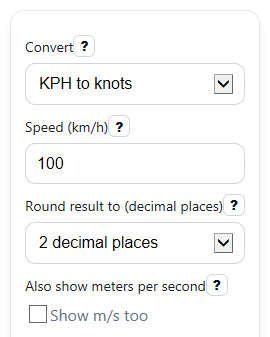
- Choose a direction in Convert: either KPH to knots or Knots to KPH.
- Enter one number in Speed using the source unit shown in the label, such as km/h or knots.
- Pick how many digits to show in Round result to, and turn on Also show meters per second if you want a quick cross-check.
- Click Calculate to see Converted speed, the Formula used, the Exact conversion factor, and the optional Meters per second value.
- Sanity-check the answer: if you convert from km/h to knots, the number should get smaller, and if you convert from knots to KPH, the number should get larger.
Definitions
KPH (km/h): Kilometers per hour, a speed unit based on kilometers traveled in one hour.
Knot (kn): A speed unit equal to one nautical mile per hour.
Nautical mile: A distance of 1852 meters used in marine and air navigation.
Meters per second (m/s): A speed unit often used in science and engineering.
Exact conversion factor: The fixed unit relationship behind the calculation, such as 1 knot = 1.852 km/h.
Round result to: The number of decimal places shown in the displayed answer.
Common mistakes and quick fixes
Mistake: Entering mph in Speed when Convert is set to KPH to knots .
Fix: Make sure Speed is in km/h for that mode, or switch Convert to the direction you actually need.
Mistake: Leaving Speed blank and expecting it to act like 0.
Fix: Type a real number in Speed , such as 0, 20, or 100.
Mistake: Thinking Converted speed should stay the same size after switching direction.
Fix: Remember that 1 knot equals 1.852 km/h, so the number changes when the unit changes.
Mistake: Choosing Round result to at 0 decimal places, then thinking the math is less accurate.
Fix: The calculator still uses the exact factor internally; that setting only changes how many digits are shown.
Mistake: Confusing About knots with miles per hour.
Fix: Use the note to remember that a knot is a nautical mile per hour, not mph.
Mistake: Expecting Meters per second to appear without turning it on.
Fix: Check Also show meters per second if you want that extra comparison output.
Limitations & Key Assumptions / Boundary Conditions
- This converter handles unit conversion only. It does not account for wind, current, ground speed, airspeed type, or any navigation effects.
- The result depends on the selected direction in Convert. Enter the value in the source unit shown for Speed.
- Displayed values are rounded according to Round result to, so the shown answer may differ slightly from the full internal value.
- Negative values are allowed because signed speeds can be useful in some math or directional contexts, but they may not match every real-world use case.
- Meters per second is an optional cross-check output only. It does not change the main conversion.
Methodology
How the conversion works
The calculator uses the exact relationship that 1 knot equals 1.852 kilometers per hour because 1 nautical mile is 1852 meters and 1 hour is 3,600 seconds [1].
kn = kph / 1.852
kph = kn * 1.852
m/s = kph / 3.6
m/s = kn * (1852 / 3600)
What each output means
Converted speed is the main answer in the destination unit. Formula used shows which equation matched your chosen direction. Exact conversion factor shows the fixed unit relationship, and Meters per second appears only when you ask for it.
Mini example
If Convert is set to KPH to knots and Speed is 100, the calculator divides 100 by 1.852.
100 / 1.852 = 53.9956803456 kn
If Round result to is 2 decimal places, the displayed Converted speed is 54.00 knots. If the optional m/s output is on, 100 km/h also becomes 27.7777777778 m/s before display rounding.
Assumptions used
The math assumes standard unit definitions and applies no extra corrections. Rounding changes only the displayed digits, not the internal conversion value used to compute the result.