
Estimate how a bigger monthly principal-and-interest mortgage payment can shorten payoff time and reduce interest from today forward.
Advanced options
Table of contents
How to use our Mortgage Payment Increase Calculator
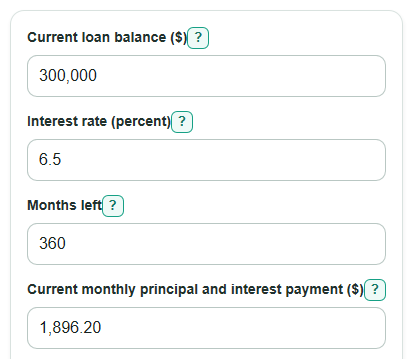
- Enter Current loan balance ($), Interest rate (percent), Months left, and Current monthly principal and interest payment ($) from your latest mortgage statement.
- Enter Increase each month ($) as the extra principal you plan to add to each monthly payment.
- Use Advanced options only if the extra payment starts later or if Raise the extra amount each year (percent) should grow the extra amount after it starts.
- Select Calculate and read Time until paid off with the increase first, then compare Interest saved and Time saved with the no-increase plan.
- Sanity-check the output: if Time until paid off with no increase is far from Months left, recheck Current loan balance ($), Interest rate (percent), and Current monthly principal and interest payment ($).
Definitions
Current loan balance ($): The unpaid principal still owed on the mortgage, not the original loan amount or home value.
Interest rate (percent): The yearly fixed mortgage rate used to calculate monthly interest.
Current monthly principal and interest payment ($): The required payment that covers loan interest and reduces principal. It does not include escrow, taxes, insurance, or HOA dues.
Increase each month ($): The extra principal amount added to each monthly payment after any start delay.
Raise the extra amount each year (percent): The percent increase applied to the extra principal amount every 12 months after the extra payment starts.
Amortization: The month-by-month process where each payment pays interest first and the rest lowers the loan balance.
Final payment in the higher-payment plan: The last payment needed to bring the balance to zero, which may be smaller than the planned higher payment.
Common mistakes and quick fixes
Mistake: Entering the original home price in Current loan balance ($).
Fix: Use the unpaid principal balance from your mortgage account or statement.
Mistake: Putting escrow, taxes, insurance, or HOA dues into Current monthly principal and interest payment ($).
Fix: Enter only the required principal-and-interest payment, because escrow costs do not pay down the loan balance.
Mistake: Using years in Months left.
Fix: Convert years to months, such as 30 years = 360 months or 15 years = 180 months.
Mistake: Treating Increase each month ($) as the total new payment.
Fix: Enter only the extra amount. The calculator adds it to Current monthly principal and interest payment ($).
Mistake: Entering 5 in Raise the extra amount each year (percent) when you meant $5 more each year.
Fix: Use a percent rate there. For no yearly step-up, enter 0.
Mistake: Ignoring Calculation note when the extra payment starts after the loan would already be paid off.
Fix: Check Start increase after (months) and compare it with Time until paid off with no increase.
Limitations & Key Assumptions / Boundary Conditions
- The calculator models a fixed-rate mortgage from the current balance forward. It does not model adjustable-rate changes, refinancing, recasting, or biweekly payment schedules.
- Inputs are for principal and interest only. Taxes, homeowners insurance, PMI, escrow shortages, HOA dues, and servicer fees are not included.
- Extra payments are treated as principal payments made with the monthly payment. Your lender may have rules about how to apply extra principal.
- The yearly step-up changes only the extra payment, not the required Current monthly principal and interest payment ($).
- The calculation uses whole monthly payments and caps the final payment so it does not overpay the loan.
- If the current payment does not cover monthly interest, the loan does not amortize and the calculator blocks the result with an error.
- Some loans may have prepayment penalties or payoff processing rules. Check your mortgage documents or servicer before relying on savings for a final payoff decision.
Methodology
How the payoff is calculated
The calculator runs a month-by-month amortization for two plans: the current payment only, and the current payment plus the increase plan. Extra mortgage payments can reduce payoff time and total interest on a fixed-rate loan because more principal is paid sooner [1].
monthly_rate = annual_rate_percent / 100 / 12
For each baseline month, interest is calculated from the balance at the start of the month. The rest of the payment lowers principal.
interest = balance * monthly_rate
principal_paid = current_payment - interest
ending_balance = balance - principal_paid
How the increase plan is applied
If Start increase after (months) is 0, the extra principal starts with the next payment. If it is greater than 0, the extra amount is 0 until that many months have passed.
if month <= start_extra_after_months, extra = 0
else years_after_start = floor((month - start_extra_after_months - 1) / 12)
extra = monthly_increase * (1 + yearly_raise_percent / 100) ^ years_after_start
The planned higher payment is the current principal-and-interest payment plus that month's extra principal. If the planned payment would overpay the loan, the final payment is reduced to the remaining principal plus that month's interest.
planned_payment = current_payment + extra
if principal_paid >= balance then final_payment = interest + balance
Interest and time saved
Total interest is found from the actual payments made during each plan.
total_interest = sum(all actual payments) - starting_balance
interest_saved = baseline_interest - interest_with_increase
time_saved_months = baseline_payoff_months - new_payoff_months
Mini-example
For a $300,000 balance at 6.5 percent interest with 360 months left, a $1,896.20 current principal-and-interest payment, and a $200 monthly increase starting now, the baseline payoff is 360 months. The higher-payment plan pays off in about 277 months, saving about 83 months and about $103,449 of interest. The final payment is smaller than a normal higher payment because the calculation stops when the balance reaches zero.
Sources
- Loan amortization and extra payments - Wells Fargo - Wellsfargo
- Is there a limit on how much my mortgage lender can make me pay into an escrow account for interest and taxes? | Consumer Financial Protection Bureau - Consumerfinance
- How does a mortgage loan officer or broker get paid? | Consumer Financial Protection Bureau - Consumerfinance
- Processing Mortgage Loan Payments and Payoffs | Fannie Mae - Fanniemae