
Convert milliliters to grams using the right density for water, common ingredients, or your own custom value.
Table of contents
How to use our mL to Grams Converter
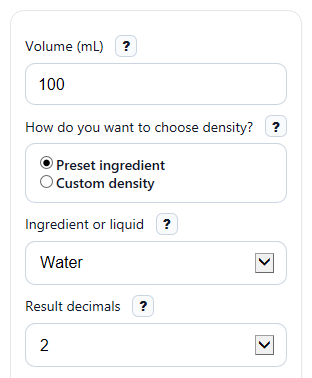
- Enter your amount in Volume (mL).
- Choose How do you want to choose density?, then either pick an Ingredient or liquid or enter a Density (g/mL).
- Select Result decimals if you want a shorter or more precise display.
- Click Calculate to see Mass, Density used, and How it was calculated.
- Sanity-check the answer by reading Density used: if it is 1 g/mL, grams should match milliliters; if it is higher or lower than 1, the grams should also be higher or lower.
Definitions
Volume (mL): How much space the substance takes up, measured in milliliters.
Density (g/mL): How many grams fit into 1 milliliter of a substance. This is the key value needed for the conversion.
Mass: The amount of matter in the substance, shown here in grams.
Density used: The exact density value the calculator applied, either from a preset ingredient or from your custom entry.
Preset ingredient: A built-in density for a common food or liquid. It is usually an estimate, not a perfect match for every brand or condition.
Custom density: Your own grams-per-milliliter value, used when you already know the substance's density.
Common mistakes and quick fixes
Mistake: Assuming Volume (mL) always equals Mass in grams.
Fix: Check Density used . mL and grams match only when density is 1 g/mL, which is close to water.
Mistake: Leaving Density (g/mL) blank or entering 0 in custom mode.
Fix: Enter a density greater than 0 g/mL before you calculate.
Mistake: Using the wrong Ingredient or liquid preset for a dry ingredient or syrup.
Fix: Pick the closest preset, then read the Note because packed, moist, or brand-specific products can change the estimate.
Mistake: Typing a negative number in Volume (mL) .
Fix: Enter 0 mL or more. If the amount is zero, the calculator will return 0 g.
Mistake: Not checking How it was calculated when the answer looks odd.
Fix: Use that line to confirm the calculator multiplied your milliliters by the density you meant to use.
Limitations & Key Assumptions / Boundary Conditions
- This converter needs density to work. Without the correct density, the gram value can be wrong even if the milliliters are correct.
- Preset values are approximate. Real density can change with temperature, brand, moisture, and ingredient variation.
- Dry ingredients such as flour and sugars are especially variable because scoop style and packing can change how much mass fits into the same volume.
- For water-like substances, 1 mL is close to 1 g, but not always exactly equal under every condition.
- The calculator assumes your entered Density (g/mL) is correct when you use custom mode.
- This tool converts only from milliliters to grams. It does not account for air bubbles, settling, or measurement errors in the original volume.
Methodology
Formula used
The converter multiplies volume by density.
grams = milliliters x density
If density is 1 g/mL, the number of grams equals the number of milliliters. That is why 100 mL of water is about 100 g.
What the calculator does
In preset mode, it uses the density tied to the selected Ingredient or liquid.
In custom mode, it uses the number entered in Density (g/mL).
It then shows the answer as Mass, repeats the Density used, and prints the substituted formula in How it was calculated.
Mini example
Suppose you enter 250 mL and a density of 0.92 g/mL.
grams = 250 x 0.92
grams = 230
So the mass is 230 g.
Why density matters
Milliliters measure volume, while grams measure mass [2]. They are different kinds of measurement, so you need density to connect them. Common liquids have different densities, and liquid density can also change with temperature [1].
Assumptions used
The calculator assumes the selected preset density is a reasonable estimate for your ingredient. For dry ingredients and thick liquids, real results may differ because packing, moisture, and brand can change density.