
Convert grams to tablespoons or tablespoons to grams using the ingredient, tablespoon standard, and a custom factor when needed.
Advanced options
Table of contents
How to use our Grams to Tablespoons Converter
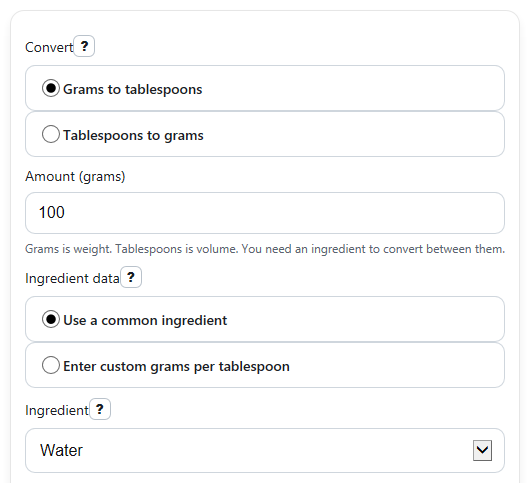
- Choose the direction under Convert, then enter your Amount in the unit that matches that direction.
- Under Ingredient data, pick Use a common ingredient and select an Ingredient, or choose Enter custom grams per tablespoon if your recipe or package gives its own factor.
- Select the Tablespoon standard that matches your recipe, such as US, metric, or Australian.
- Open Advanced options if you want to change Round result to, then click Calculate.
- Check that Grams per tablespoon used matches your ingredient and that Kitchen-friendly amount still makes sense for your measuring spoon before using the result.
Definitions
Amount: The number you want to convert. Its unit depends on the direction you picked in Convert.
Ingredient data: Choose whether to use a preset ingredient factor or your own Custom grams per tablespoon (g per tbsp).
Tablespoon standard: The spoon volume size used for the math, such as US 14.7868 mL, metric 15 mL, or Australian 20 mL.
Grams per tablespoon used: The weight of 1 tablespoon of the chosen ingredient for the selected tablespoon size. This is the key conversion factor.
Volume equivalent: The matching volume in milliliters based on the tablespoon result and the chosen tablespoon standard.
Kitchen-friendly amount: A practical version of the answer, often shown as tablespoons plus leftover teaspoons when that helps.
Common mistakes and quick fixes
Mistake: Entering grams in Amount after choosing Tablespoons to grams .
Fix: When Convert is set to Tablespoons to grams , type tablespoons in Amount , not grams.
Mistake: Leaving Ingredient on the wrong preset, such as water when your recipe uses flour.
Fix: Recheck Ingredient and confirm the matching Grams per tablespoon used before trusting Converted amount .
Mistake: Using Use a common ingredient when you actually have a package-specific value.
Fix: Switch Ingredient data to Enter custom grams per tablespoon and fill in Custom grams per tablespoon (g per tbsp) .
Mistake: Ignoring Tablespoon standard and assuming every tablespoon is the same size.
Fix: Pick the standard that matches your recipe, because it changes both Converted amount and Volume equivalent .
Mistake: Rounding too early and treating Kitchen-friendly amount as more exact than Converted amount .
Fix: Use Converted amount for accuracy first, and use Kitchen-friendly amount only as a practical measuring shortcut.
Mistake: Entering 0 or a negative number in Amount for a recipe conversion.
Fix: Enter a number greater than 0 in Amount so the calculator can return a meaningful cooking quantity.
Limitations & Key Assumptions / Boundary Conditions
- Results are approximate because tablespoons measure volume while grams measure weight, so the conversion depends on ingredient density.
- Preset ingredient factors are based on typical kitchen or food-reference values and may not match every brand, grind, moisture level, or packing method.
- Ingredients like flour, cocoa powder, brown sugar, and salt can vary a lot depending on whether they are sifted, packed, coarse, or fine.
- The calculator scales preset factors by the selected Tablespoon standard, which is useful for recipe matching but still assumes the ingredient fills the spoon in a similar way.
- If you know a label or recipe specific weight for 1 tablespoon, Custom grams per tablespoon (g per tbsp) is usually more accurate than a preset.
- This tool is for cooking conversions, not for legal metrology, lab measurement, or nutrition labeling compliance.
Methodology
How the calculator works
The calculator first finds a grams-per-tablespoon factor for your ingredient. If you use a preset ingredient, it starts from a 15 mL base value and scales it to the tablespoon size you selected. If you use custom mode, it uses your entered factor directly.
g_per_tbsp_selected = g_per_tbsp_15ml * (tbsp_mL_selected / 15)
Then it converts in the direction you chose.
tbsp = grams / g_per_tbsp
grams = tbsp * g_per_tbsp
For the supporting milliliter output, it multiplies the tablespoon amount by the selected tablespoon size. Standard kitchen equivalencies treat 1 tablespoon as 3 teaspoons, and common US and metric kitchen standards are about 14.7868 mL and 15 mL respectively [1][2].
mL = tbsp * tbsp_mL_selected
tsp_remainder = (tbsp - floor(tbsp)) * 3
Mini example
Suppose you convert 25 grams of granulated sugar using the metric tablespoon standard and a preset factor of 12.5 g per tablespoon. The tablespoon result is 25 / 12.5 = 2, so the main answer is 2 tablespoons. The volume equivalent is 2 * 15 = 30 mL.
tbsp = 25 / 12.5 = 2
mL = 2 * 15 = 30
Notes on preset factors
Preset ingredient factors are practical kitchen averages, not exact physical constants. Food-reference measurement tables can differ by ingredient preparation, packing, and source, which is why the same ingredient may not weigh exactly the same in every tablespoon [3].
Assumptions behind the results
The tool assumes your ingredient matches the selected preset closely enough for cooking use, that your tablespoon size matches the selected standard, and that the ingredient factor stays proportional when scaled from 15 mL to another tablespoon volume. Real spoon filling, packing, and brand differences can change the true weight.