
Convert a distance between light-years, kilometers, miles, AU, meters, and parsecs, then see which unit is easiest to read for that scale.
How to use our Light Year Conversion Calculator
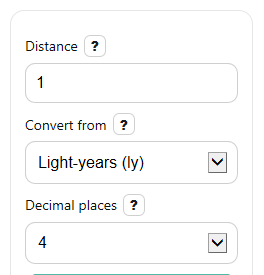
- Enter a number in Distance. Use 0 or a positive value.
- Choose the starting unit in Convert from, such as light-years, kilometers, miles, AU, parsecs, or meters.
- Pick Decimal places to control how much rounding you want in the results.
- Click Calculate to see the same distance in Light-years, Kilometers, Miles, Astronomical units, and Parsecs.
- Sanity-check the answer with Best unit for this scale: AU usually makes more sense for solar-system distances, while light-years or parsecs usually make more sense for distances between stars.
Definitions
Light-year (ly): A unit of distance, not time. It is how far light travels in one Julian year.
Kilometer (km): A metric unit of length equal to 1,000 meters.
Mile (mi): A US-friendly distance unit. One international mile equals 1,609.344 meters [1].
Astronomical unit (AU): A space distance unit based on the average Earth-Sun distance. It is handy for solar-system scales.
Parsec (pc): A larger astronomy distance unit. One parsec is a little more than 3.26 light-years.
Meters (m): The base length unit used inside the conversion method before results are changed into other units.
Decimal places: How many digits are shown after the decimal point when a result is not a whole number.
Common mistakes and quick fixes
Mistake: Leaving Distance blank or typing text instead of a number.
Fix: Enter a numeric value in Distance , such as 1, 0.5, or 2500.
Mistake: Picking the wrong starting unit in Convert from .
Fix: Make sure Convert from matches the unit you already have before you read the outputs.
Mistake: Expecting Astronomical units to be the easiest way to read star-to-star distances.
Fix: Check Best unit for this scale . For very large distances, Light-years or Parsecs are usually easier to read.
Mistake: Thinking a rounded value in Light-years or Parsecs means the exact answer is zero.
Fix: Increase Decimal places from 2 to 4 or 6 to reveal small nonzero results.
Mistake: Comparing Kilometers and Miles without noticing how huge space distances become.
Fix: Use Kilometers or Miles for familiar scale, but use Best unit for this scale to pick a unit that is easier to understand.
Mistake: Entering a negative Distance as if it were a real travel distance.
Fix: Use a value of 0 or more in Distance for physical distance measurements.
Limitations & Key Assumptions / Boundary Conditions
- This calculator assumes Distance is 0 or greater. Negative values are not treated as physical travel distances here.
- Results are unit conversions only. They do not account for gravity, curved space, travel time, or how an object actually moves.
- Very large inputs can create numbers that are hard to format safely in a browser. If that happens, use a smaller value.
- Rounded results depend on the chosen Decimal places setting. Small converted values can look like 0 when heavily rounded.
- Best unit for this scale is a plain-language reading tip, not a strict science rule. Different textbooks or contexts may prefer different units.
- This tool focuses on the most useful companion units for this topic: light-years, kilometers, miles, AU, parsecs, and meters as an input unit.
Methodology
How the conversion works
The calculator first converts your starting value into meters, then converts that meter value into each output unit. This keeps every result tied to one common baseline.
value_in_meters = input_value x factor_to_meter(from_unit)
light_years = value_in_meters / 9.4607304725808e15
kilometers = value_in_meters / 1000
miles = value_in_meters / 1609.344
astronomical_units = value_in_meters / 149597870700
parsecs = value_in_meters / 3.085677581491367e16
Constants used
The calculator uses these standard values:
speed of light = 299,792,458 m/s, Julian year = 31,557,600 s, 1 light-year = 9.4607304725808 x 10^15 m, 1 kilometer = 1,000 m, 1 mile = 1,609.344 m [1], 1 astronomical unit = 149,597,870,700 m, and 1 parsec = 3.085677581491367 x 10^16 m.
Mini example
If Distance is 1 and Convert from is light-years, the calculator starts with 1 light-year.
value_in_meters = 1 x 9.4607304725808e15
kilometers = 9.4607304725808e15 / 1000 = 9.4607304725808e12
parsecs = 9.4607304725808e15 / 3.085677581491367e16 = 0.3066013938
So 1 light-year is about 9.46 trillion kilometers and about 0.3066 parsecs. That is why light-years and parsecs are usually easier to read than kilometers for interstellar distances.
How the best-unit note is chosen
The note is an interpretation helper. Smaller space distances are usually easier to read in AU, while much larger interstellar distances are usually easier to read in light-years or parsecs. Kilometers and miles stay useful when you want a familiar everyday distance unit, even though the numbers can become huge.
Assumptions behind the results
This method assumes standard fixed conversion factors and does not model any physical travel process. Display rounding follows the chosen Decimal places setting, so the shown value may be shorter than the full internal value.