
Enter three known Beer-Lambert values to calculate absorbance, concentration, molar absorptivity, or path length using absorbance or transmittance readings.
Light reading
Known sample values
Table of contents
How to use our Beer-Lambert Law Calculator
- Choose the quantity you need to find under "Calculate which quantity?".
- If absorbance is a known value, choose the reading form, then enter the number exactly as reported: absorbance, transmittance fraction, or percent transmittance.
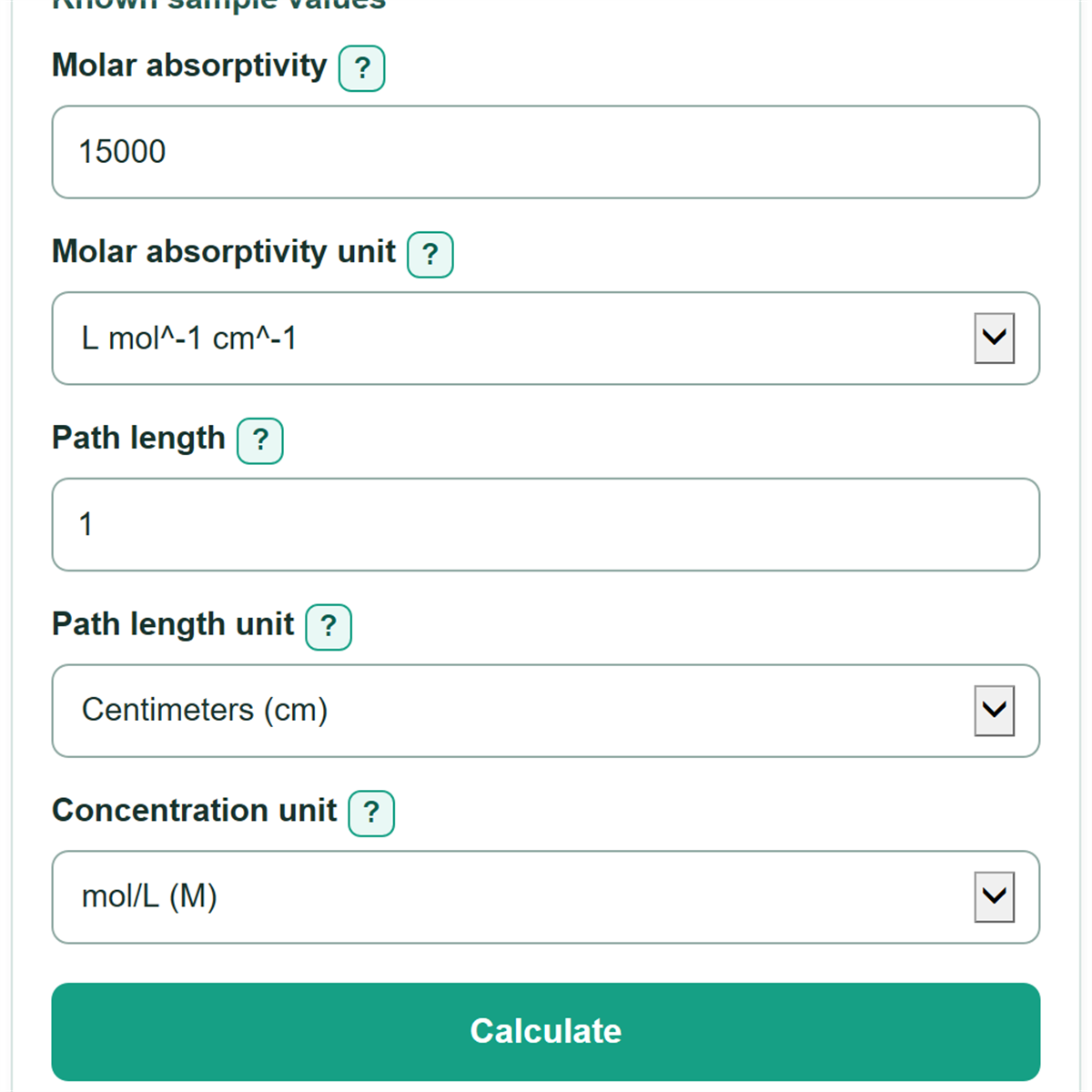
- Enter the remaining known values and select the unit printed beside each one in your lab record, reference source, or cuvette specification.
- Click Calculate to see the requested quantity, the absorbance used in the equation, percent light transmitted, and the rearranged relationship.
- Sanity-check the reading form and units. A transmittance fraction of 0.25 equals 25%T, but an absorbance of 0.25 is a different measurement.
Definitions
Absorbance (A): A unitless measure of how much light a sample absorbs. Higher absorbance means less light passes through.
Transmittance (T): The fraction of incoming light that passes through a sample. In this calculator, it must be greater than 0 and no more than 1.
Percent transmittance (%T): Transmittance written as a percent. For example, T = 0.25 is 25%T.
Molar absorptivity (ε): A coefficient describing how strongly a dissolved substance absorbs light at a particular wavelength and set of conditions.
Path length (l): The distance light travels through the sample, usually the width of liquid inside a cuvette or sample cell.
Concentration (c): The amount of absorbing substance per volume of solution, often reported as mol/L, mmol/L, or umol/L.
Beer-Lambert law: The relationship A = εlc, which links absorbance with molar absorptivity, path length, and concentration. [1]
Common mistakes and quick fixes
Mistake: Entering 25 as a transmittance fraction.
Fix: Choose "Percent transmittance" for 25%T, or choose "Transmittance fraction" and enter 0.25.
Mistake: Using a molar absorptivity value from a different wavelength or solvent.
Fix: Use a coefficient for the same substance, wavelength, solvent, and relevant lab conditions.
Mistake: Treating a 10 mm cuvette as 10 cm.
Fix: Select millimeters for a value reported in mm. A 10 mm path length equals 1 cm.
Mistake: Entering a value in mM while mol/L is selected.
Fix: Select mmol/L for a value in mM, or convert 0.050 mM to 0.000050 mol/L before entering it.
Mistake: Entering zero transmittance.
Fix: Use a positive transmittance reading. Zero transmittance would require infinite absorbance, so it cannot produce a finite answer.
Limitations & Key Assumptions / Boundary Conditions
- The calculation assumes absorbance changes linearly with concentration at the selected wavelength.
- Molar absorptivity must match the substance, wavelength, solvent, and relevant experimental conditions used for the sample.
- Cloudiness, particles, bubbles, fingerprints, and dirty cuvettes can scatter or block light and change the measured reading.
- Chemical changes, fluorescence, stray light, and highly concentrated samples can make measurements differ from the simple Beer-Lambert relationship.
- Known path length must be greater than zero. Known molar absorptivity and concentration may be zero, but division by a zero factor can produce no solution or infinitely many solutions instead of one numeric answer.
- The result uses the values entered. It does not replace a calibration curve or laboratory quality checks when those are required.
Methodology
Equation and unit conversion
The calculator applies the Beer-Lambert relationship to values in compatible units. [1]
A = εlc
It converts path length to cm, concentration to mol/L, and molar absorptivity to L mol^-1 cm^-1 before solving. A value in mm is multiplied by 0.1. A value in mmol/L is multiplied by 0.001, and a value in umol/L is multiplied by 0.000001. A coefficient in L mmol^-1 cm^-1 is multiplied by 1,000.
Reading conversion
For a transmittance entry, the calculator first finds absorbance. For a percent-transmittance entry, it divides the percent by 100 to obtain T.
A = -log10(T)
%T = 100 x 10^(-A)
Rearranging the equation
The selected missing quantity determines which version of the relationship is used.
c = A / (εl)
ε = A / (lc)
l = A / (εc)
Worked example
With A = 0.600, ε = 15,000 L mol^-1 cm^-1, and l = 1.00 cm, concentration is 0.600 / (15,000 x 1.00) = 0.000040 mol/L. The matching light transmitted is about 25.12%T.
Zero-factor results
When solving by division, the calculator checks the original denominator. A zero denominator with positive absorbance has no solution. A zero denominator with zero absorbance has infinitely many solutions in the calculator's nonnegative domain. A zero concentration can still produce an absorbance of exactly zero when molar absorptivity and path length are positive.