
Convert sieve mesh labels and opening sizes in microns, millimeters, or inches using the selected reference table.
Advanced options
How to use our Mesh to Micron Converter Calculator
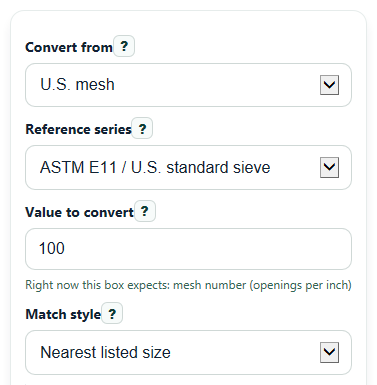
- Choose Convert from based on the size label you already have, then pick the matching Reference series from your chart, supplier, or spec sheet.
- Enter one positive number in Value to convert. The unit comes from your Convert from choice, so 100 could mean mesh, 100 um, 0.100 mm, or 0.100 in depending on the mode.
- Set Match style to Nearest listed size for the closest standard opening, or choose a one-sided match if you need the next tighter or looser listed opening.
- Click Calculate, then read Matched mesh size and the three Opening size outputs. Check How close the match is to see whether you got an exact listed size or an approximate table match.
- Use Next smaller listed opening and Next larger listed opening as a sanity check before buying a sieve or filter, especially if Important note says your value was rounded or outside the table range.
Definitions
Mesh: A count label for a sieve screen, usually meaning how many openings fit across one linear inch of screen.
Micron (um): A very small metric length unit. 1 um = 0.001 mm.
Opening size: The nominal width of the sieve opening tied to the matched standard size.
Reference series: The sieve table you want to use, such as ASTM, ISO, or Tyler. This matters because tables are not all identical.
Match style: The rule used when your entered value falls between listed sieve openings: nearest, next smaller opening, or next larger opening.
Exact listed size: Your input matches a standard table row directly.
Approximate match: Your input falls between listed rows, so the tool returns the closest allowed table entry instead of inventing a new mesh value.
Common mistakes and quick fixes
Mistake: Typing a micron value while Convert from is still set to U.S. mesh.
Fix: Change Convert from to Microns before entering the number in Value to convert .
Mistake: Treating Matched mesh size as an exact formula result for any micron value.
Fix: Read How close the match is . If it says approximate, compare Next smaller listed opening and Next larger listed opening too.
Mistake: Using the wrong Reference series for your chart or supplier.
Fix: Match Reference series to the standard named on your document. Different series can give different listed openings or mesh labels.
Mistake: Entering 0, a negative number, or text in Value to convert .
Fix: Enter one positive numeric value only in Value to convert , with no words or symbols.
Mistake: Choosing the wrong side of the table when a value falls between listed sizes.
Fix: Use Match style : choose Next smaller opening for a tighter screen, Next larger opening for an easier pass-through, or Nearest listed size for the closest table match.
Mistake: Looking only at Opening size in mm and ignoring the micron output.
Fix: Compare all three Opening size outputs so your drawing, filter spec, and sieve chart stay in the same size language.
Limitations & Key Assumptions / Boundary Conditions
- This converter uses table lookup by the selected Reference series, not one universal mesh-to-micron formula.
- Different standards and supplier charts can assign slightly different nominal openings or equivalent labels, so results can change when you switch series.
- For Convert from = U.S. mesh, only mesh labels that exist in the chosen table can match exactly. The tool should not guess non-listed mesh numbers.
- If your value is below the smallest listed opening or above the largest listed opening in the selected series, the result is capped to the nearest table edge and marked as outside table range.
- Some series may not provide a usable mesh label for every listed opening. In those cases, opening sizes remain the most reliable output.
- Nominal sieve opening is not the same as guaranteed particle size passing behavior in every real material, because particle shape, wire size, loading, and test method can change actual separation.
Methodology
How the calculator works
The tool first converts your entry into microns, then compares that micron value with the listed nominal openings in the selected Reference series. It returns either the exact listed row or the row chosen by your Match style. This is a lookup process, not a direct mesh formula.
mm = um / 1000
in = um / 25400
um = mm * 1000
um = in * 25400
matched_row = row with minimum |input_um - row_um|
Match logic
If Match style is set to nearest, the calculator finds the listed opening with the smallest absolute difference from your converted micron value. If you choose next smaller opening, it picks the nearest listed opening below your value. If you choose next larger opening, it picks the nearest listed opening above your value. When your value lands outside the table, the nearest edge row is shown and the result is flagged as outside range.
Mini example
Suppose Convert from is Millimeters, Reference series is ASTM E11 / U.S. standard sieve, and Value to convert is 0.1.
um = 0.1 * 1000 = 100
Now compare 100 um to nearby listed ASTM openings: 106 um and 90 um. With Match style
set to Nearest listed size
, 106 um is closer, so the matched row is ASTM No. 140. The outputs show 106 um, 0.106 mm, and approximately 0.00417323 in.
The ASTM table uses nominal openings listed by Gilson for ASTM E11 test sieves, including No. 100 = 150 um, No. 140 = 106 um, and No. 200 = 75 um. The separate Tyler equivalent chart retains its own approximate values.
Why mesh is not a simple formula
Mesh is a screen count label, while microns describe opening width. Real sieve standards define listed nominal openings by table, and those tables can differ across ASTM, ISO, and Tyler references. That is why the calculator reports nearby listed sizes and an exact or approximate match status instead of pretending every micron value has one exact mesh answer.
Assumptions used
The calculator assumes the selected series table is the authority for matching. Unit conversions between um, mm, and inches are exact, but the mesh correspondence depends on the chosen standard table and its listed nominal apertures.