
Calculate Kp from gas equilibrium pressures or convert Kc to Kp while checking coefficients, delta n, and pressure-unit setup.
Advanced options
How to use our Kp Calculator
- Choose "What do you want to calculate?" and then use the matching inputs only: either enter "Gas products at equilibrium" and "Gas reactants at equilibrium" for pressure mode, or enter "Kc" and "Temperature (K)" for conversion mode.
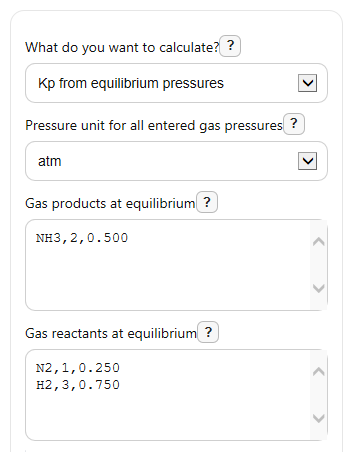
- For each reaction line, type one gas as name, coefficient, pressure. Example: NH3,2,0.500. Use only gases in the two gas boxes, and keep all entered pressures in the one "Pressure unit for all entered gas pressures" you selected.
- If you are using Kc conversion mode, choose "How do you want to set change in gas moles?" Then either let the calculator count gas coefficients automatically from your gas lines or enter "Change in gas moles, delta n" yourself.
- Open "Advanced options" only if needed to change "Significant figures for results," "Number style," or "Standard pressure for dimensionless form," then click Calculate.
- Sanity-check the result by reading "Expression used," "Change in gas moles used," and "Pressure unit note." If the exponents, gas count, or unit basis do not match your balanced reaction, fix the inputs and calculate again.
Definitions
Kp: The equilibrium constant written with gaseous partial pressures. A larger value usually means products are favored more strongly at equilibrium for the reaction as written.
Kc: The equilibrium constant written with concentrations. In gas problems, it can be converted to Kp using temperature and delta n.
Partial pressure: The pressure due to one gas in a mixture. In this calculator, each pressure entered in the gas lists is an equilibrium partial pressure.
Stoichiometric coefficient: The number in front of a species in the balanced equation. It becomes the exponent in the Kp expression.
Change in gas moles, delta n: Total gas-product coefficients minus total gas-reactant coefficients. Only gases are counted.
Expression used: The exact Kp setup built from your gas entries, with products in the numerator and reactants in the denominator.
Standard pressure for dimensionless form: The reference pressure choice, such as 1 bar or 1 atm, used for the dimensionless convention often discussed in chemistry texts.
Common mistakes and quick fixes
Mistake: Putting solids or liquids into "Gas products at equilibrium" or "Gas reactants at equilibrium."
Fix: Enter only gaseous species in those boxes. Leave out solids and pure liquids when finding "Kp."
Mistake: Typing a line in "Gas products at equilibrium" without all 3 parts.
Fix: Use exactly name, coefficient, pressure on each line, such as NH3,2,0.500.
Mistake: Mixing atm, bar, kPa, or torr while "Pressure unit for all entered gas pressures" is set to one unit.
Fix: Convert your pressures first so every pressure matches the selected unit, then check the "Pressure unit note."
Mistake: Entering a zero or negative pressure in "Gas reactants at equilibrium" or "Gas products at equilibrium."
Fix: Use equilibrium partial pressures greater than 0 for every gas line.
Mistake: Using an unbalanced reaction, so the powers in "Expression used" are wrong.
Fix: Make sure each coefficient in your gas lines matches the balanced equation before trusting "Kp."
Mistake: In "Kc" mode, entering Celsius into "Temperature (K)."
Fix: Convert to kelvin first. For example, 25 C should be entered as 298.15 in "Temperature (K)."
Limitations & Key Assumptions / Boundary Conditions
- This calculator assumes the reaction is already balanced correctly. If coefficients are wrong, Kp and delta n will be wrong.
- Only gaseous species belong in the Kp expression. Solids and pure liquids are excluded by chemistry convention.
- All entered gas pressures in one calculation must use the same unit basis. The calculator does not repair mixed-unit entries for you.
- The Kp = Kc(RT)^delta n conversion is based on the ideal-gas relationship. Real-gas behavior at high pressure can give different values.
- In pressure mode, each gas line must include a positive coefficient and a positive equilibrium partial pressure. Zero or negative pressures are not physically valid here.
- If you choose manual delta n, the result depends entirely on the number you entered, even if the reaction lines suggest a different value.
- The displayed form of Kp can depend on the standard-pressure convention chosen for the dimensionless interpretation note.
Methodology
Core equations
The calculator uses one of two standard chemistry relationships. In pressure mode, it builds Kp directly from the equilibrium partial pressures of gaseous species only. In conversion mode, it uses Kc, temperature, and delta n.
Kp = product(P_i^nu_i) / product(P_j^nu_j)
Kp = Kc x (R x T)^(delta n)
delta n = sum(nu_products_gas) - sum(nu_reactants_gas)
How the calculator builds the reaction math
For each line in the gas product and gas reactant boxes, the calculator reads the species name, its stoichiometric coefficient, and its equilibrium partial pressure. Products are multiplied in the numerator, reactants are multiplied in the denominator, and each pressure is raised to its coefficient. Only gases are counted in Kp and in delta n [1][4].
If you choose automatic delta n in Kc mode, the calculator adds the gas coefficients on the product side and subtracts the gas coefficients on the reactant side. If you choose manual delta n, it uses your entered value instead of counting coefficients.
Gas constant and pressure basis
For Kc-to-Kp conversion, the calculator uses a gas constant that matches the chosen pressure basis. It uses R = 0.082057 L atm mol^-1 K^-1 for atm and R = 0.08314 L bar mol^-1 K^-1 for bar-based work. For kPa or torr, it converts through the matching atm basis so the factor stays consistent with the selected pressure system. The underlying molar gas constant value is standard [3].
1 atm = 101.325 kPa = 760 torr = 1.01325 bar
Worked mini-example
Suppose the reaction is N2 + 3H2 equilibrium 2NH3 and the equilibrium partial pressures are NH3 = 0.500 atm, N2 = 0.250 atm, and H2 = 0.750 atm. The calculator forms the expression below from the coefficients 2, 1, and 3.
Kp = (0.500^2) / (0.250^1 x 0.750^3)
Step 1: Numerator = 0.500^2 = 0.25.
Step 2: Denominator = 0.250 x 0.750^3 = 0.10546875.
Step 3: Kp = 0.25 / 0.10546875 = 2.37037, which rounds to 2.37 with 3 significant figures.
For a Kc conversion example, if Kc = 0.500, T = 298.15 K, and delta n = -2, then Kp is found from the RT factor first.
(R x T)^(delta n) = (0.082057 x 298.15)^(-2) = 0.0167139
Kp = 0.500 x 0.0167139 = 0.00835694
Assumptions behind the result
This method follows the usual ideal-gas equilibrium treatment of Kp and the common relation between Kp and Kc [1]. Results can differ from classroom answer keys if your teacher uses a different standard-pressure convention, a different rounding rule, or a different form for reporting dimensionless equilibrium constants.