
Enter element symbols and mass percentages or grams to find the simplest whole-number chemical formula from your composition data.
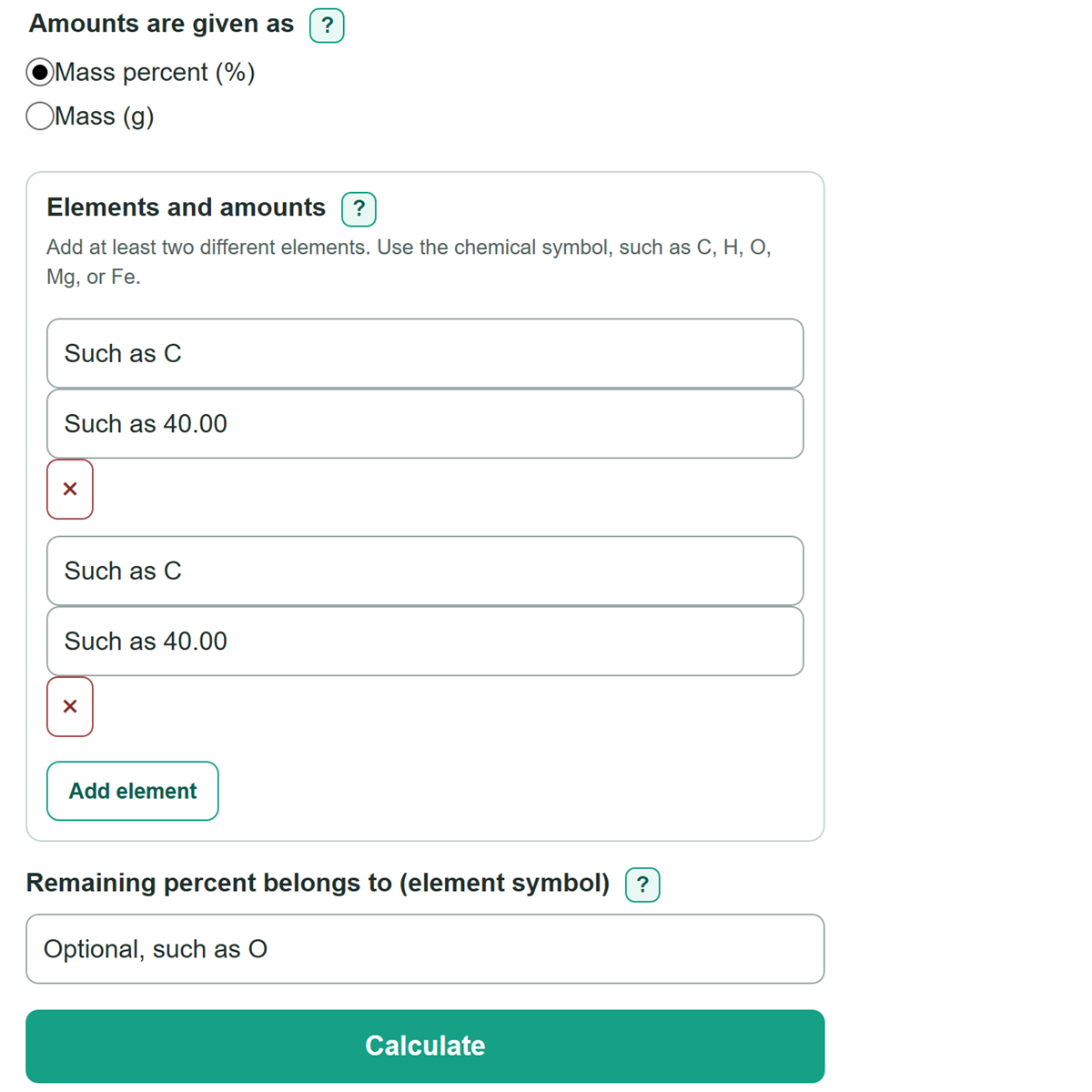
Add at least two different elements. Use the chemical symbol, such as C, H, O, Mg, or Fe.
| Element | Amount | Grams used | Atomic mass | Moles | Ratio | After multiplier | Subscript |
|---|
Table of contents
How to use our Empirical Formula Calculator
- Choose whether the values in your problem are mass percent (%) or mass (g).
- Add each element symbol and amount exactly as shown in the worksheet, problem, or lab data.
- For a percent problem that names one element as the unlisted balance, enter that symbol in Remaining percent belongs to; otherwise leave it blank.
- Click Calculate to get the empirical formula, empirical molar mass, and element calculation table.
- Check that every final subscript matches the table and that any shared ratio multiplier was applied to every normalized ratio.
Definitions
Empirical formula: The simplest whole-number ratio of atoms in a compound, such as CH2O.
Mass percent: The mass of an element in 100 parts by mass of a sample. For this calculation, 40% can be treated as 40 g in a 100 g sample.
Atomic mass: The mass value, in g/mol, used to convert an element's grams into moles.
Mole: A chemistry counting unit. Grams divided by atomic mass gives moles.
Normalized mole ratio: An element's moles divided by the smallest mole amount, making the smallest ratio equal to 1.
Shared ratio multiplier: A whole number applied to every normalized ratio when the ratios are close to fractions such as 1.5 or 1.33.
Common mistakes and quick fixes
Mistake: Entering mole percent while Mass percent (%) is selected.
Fix: Check Amounts are given as and then recalculate. Enter percentages by mass. Convert mole percent to mass percent before using this calculator.
Mistake: Rounding a normalized ratio such as 1.5 directly to 2.
Fix: Check Amounts are given as and then recalculate. Use the shared ratio multiplier shown by the calculator. Multiply every normalized ratio by the same number before choosing subscripts.
Mistake: Entering the same element in more than one row.
Fix: Check Amounts are given as and then recalculate. Combine its amounts into one row. Each element symbol can appear only once.
Mistake: Naming a remaining element when the listed percentages total 100% or more.
Fix: Check Amounts are given as and then recalculate. Remove the remaining element or correct the listed mass percentages so their total is below 100%.
Mistake: Treating empirical formula molar mass as the compound's molecular molar mass.
Fix: Check Amounts are given as and then recalculate. Use this value only for one empirical-formula unit. Finding a molecular formula needs separate molecular molar-mass information.
Limitations & Key Assumptions / Boundary Conditions
- This calculator finds an empirical formula, not a molecular formula. A molecular formula can be a whole-number multiple of the empirical formula.
- In mass-percent mode, each percentage is treated as the same number of grams in a 100 g sample. In mass mode, the entered grams are used directly.
- The calculator tests shared multipliers from 1 through 12 and accepts a ratio within 0.05 of a whole number. It stops instead of forcing a formula when the entered data do not fit that rule.
- Small differences between atomic-mass tables can slightly change displayed moles and empirical molar mass.
- Without a named remaining element, mass percentages may total slightly above or below 100% because reported values can be rounded. With a remaining element, the listed total must be below 100%.
Methodology
Calculation method
For mass-percent entries, the calculator uses a 100 g sample, so 40.00% is used as 40.00 g. For each element, it divides grams by atomic mass to find moles, divides all mole amounts by the smallest amount, and converts the resulting ratio into whole-number subscripts. [1]
remaining percent = 100 - sum of listed mass percentages
moles = grams / atomic mass
normalized ratio = element moles / smallest mole amount
The calculator tests whole-number multipliers from 1 through 12 and uses the first one that puts every normalized ratio within 0.05 of a whole number. Those whole numbers become subscripts. A subscript of 1 is left out of the displayed formula.
empirical molar mass = sum of (subscript * atomic mass)
Worked example
For 40.00% C, 6.71% H, and 53.29% O, use 40.00 g C, 6.71 g H, and 53.29 g O. Their mole amounts are about 3.330, 6.657, and 3.331. Dividing by the smallest gives about 1.000, 1.999, and 1.000, so the formula is CH2O. Its empirical molar mass is 30.026 g/mol.
If a named remaining element is used, its calculated percentage is added to the same mole-ratio calculation. The table shows the entered amount, grams used, atomic mass, moles, normalized ratio, multiplied ratio, and final subscript for each element.